01
Shang, c.1200 BCE
Words 36 lines
Tiānmìng.
The mandate of heaven.
Nobody knows who hands it out.
Nobody knows the day it gets taken back.
My grandmother was seven when the fever took her.
Her mother walked her to the apothecary in Anyang,
where the ground gives up bones after every hard rain.
The man behind the counter weighed out dragon bone.
Turtle shell. Ox shoulder. Three thousand years in the dirt.
He said grind it, boil it, drink it,
and the dragon will carry the fever out of her.
She told me there were marks on it.
Little scratches, like a bird had walked across the surface.
She asked the man what they meant.
He said nothing. Cracks. That's how you know it's old.
So she drank it.
And she got better.
And she never thought about it again.
What did it say
What did it say
Somebody asked a question here
Somebody wrote it down
Here is what I know that she didn't.
Those were not cracks. That was writing.
That was a king asking heaven if the harvest would hold.
Asking if the queen would live.
Asking if the war was worth the sons.
Heaven answered in the fire. The bone split.
And a scribe carved the answer beside the question
so it would outlive every mouth in the room.
Thirty centuries of somebody trying to know the future.
And we ground it down to powder.
And we swallowed it.
And we got better.
And we forgot every single word.
She was asking what the harvest would bring.
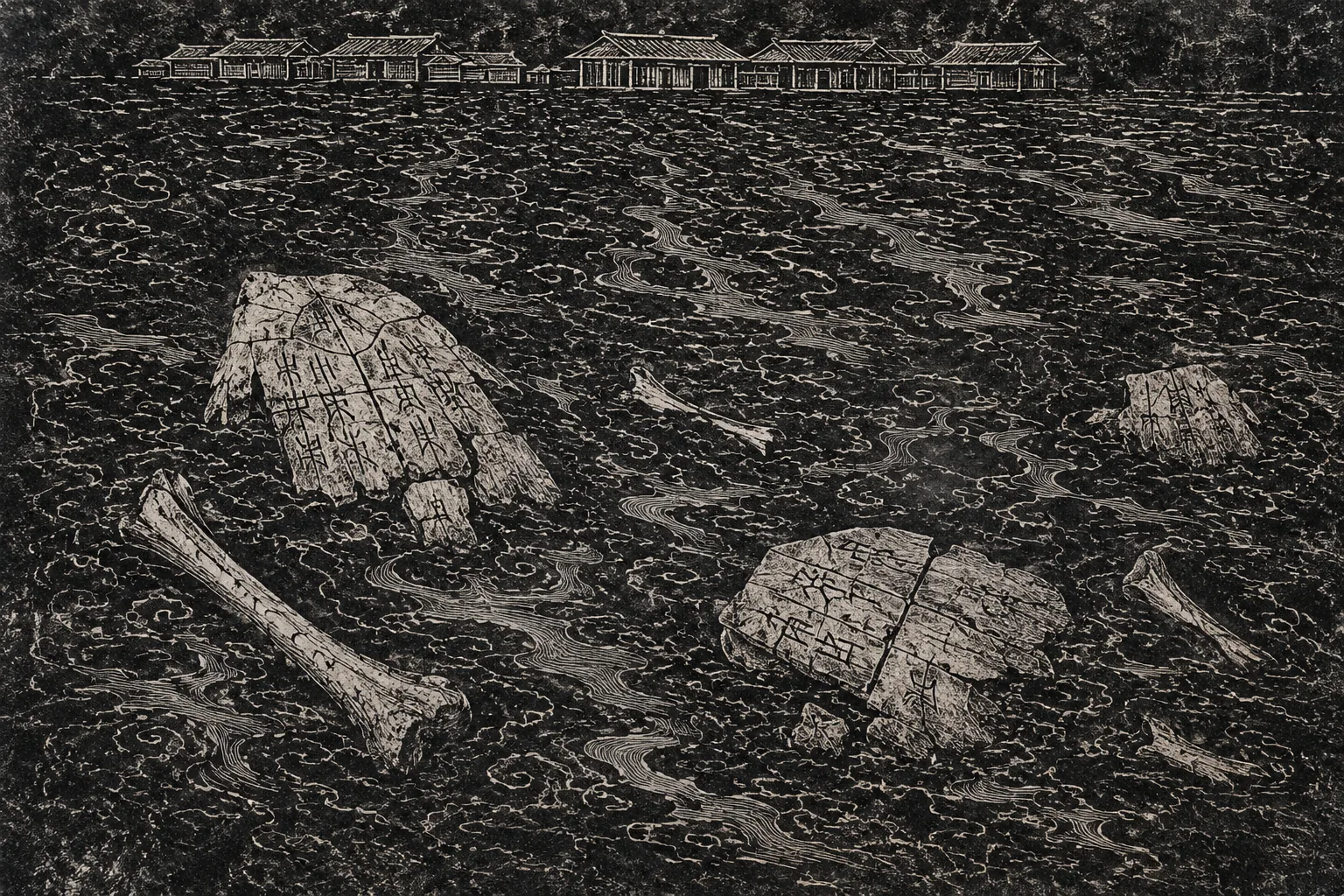
Generated illustration · the fields over Yinxu, the last Shang capital, c.1200 BCE · after a Chinese ink rubbing (拓本) of an incised surface · inscription illustrative
01
where the ground gives up bones after every hard rain
Anyang, Henan province
The fields at Anyang lie over Yinxu, the last capital of the Shang dynasty, abandoned around 1046 BCE. Heavy rain brought inscribed bone to the surface for centuries, and farmers sold it to apothecaries by weight. Systematic excavation of the site began in 1928.
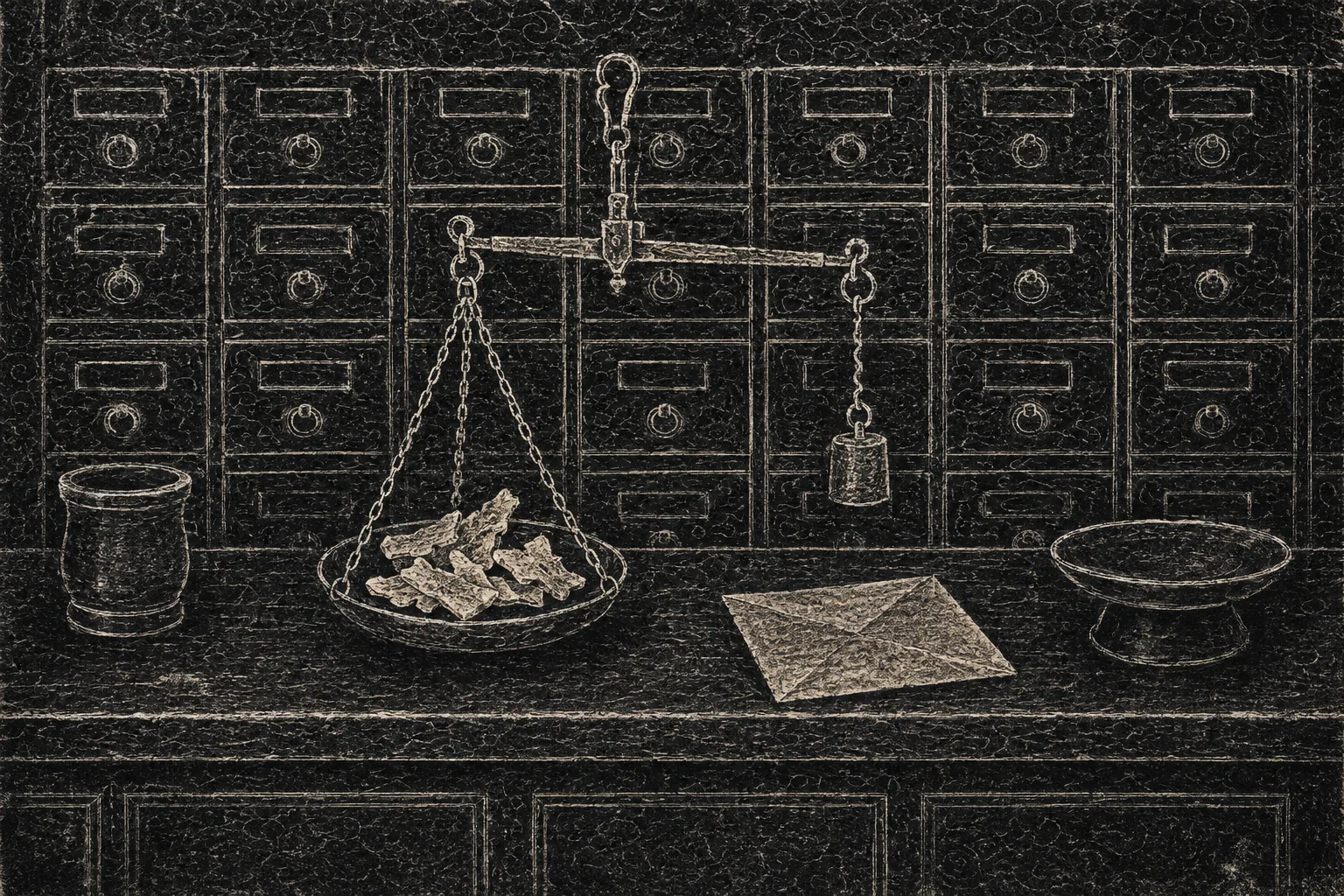
Generated illustration · inscribed bone sold as medicine by weight, into the 1890s · after a Chinese ink rubbing (拓本) of an incised surface
02
The man behind the counter weighed out dragon bone.
Dragon bone (龍骨)
Ground fossil bone was a standard item in Chinese pharmacy, prescribed for fever, fright and bleeding. It was sold by weight. Inscribed marks were treated as a defect, and sellers often scraped them off before sale.
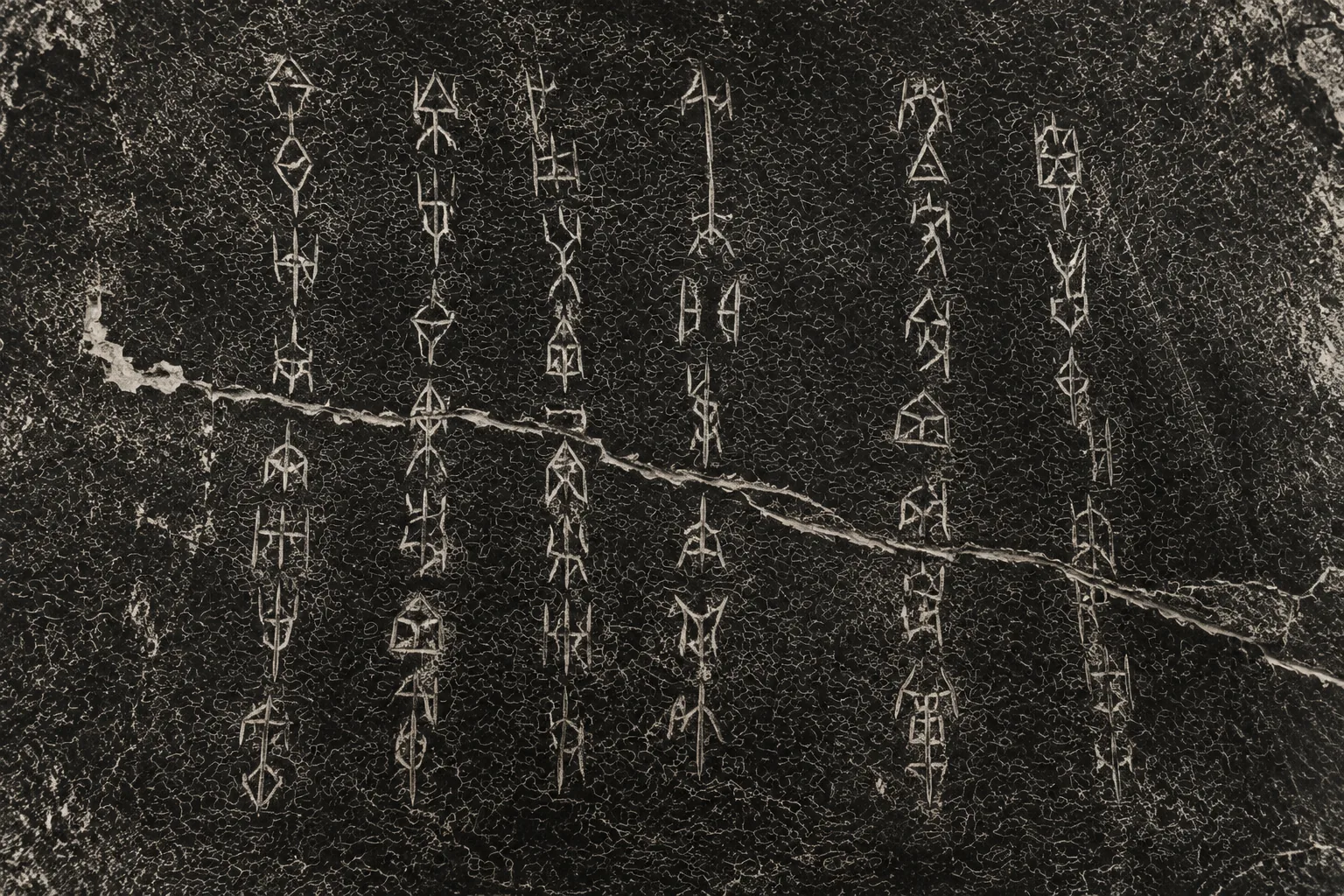
Generated illustration · jiaguwen, the earliest known Chinese writing · after a Chinese ink rubbing (拓本) of an incised surface · inscription illustrative
03
Little scratches, like a bird had walked across the surface.
Oracle bone script (甲骨文)
Shang scribes cut records into bone and shell in vertical columns. The script, jiaguwen, is the direct ancestor of the Chinese characters in use today. About 150,000 inscribed pieces are known, carrying some 4,000 distinct characters. Roughly a third have been deciphered.
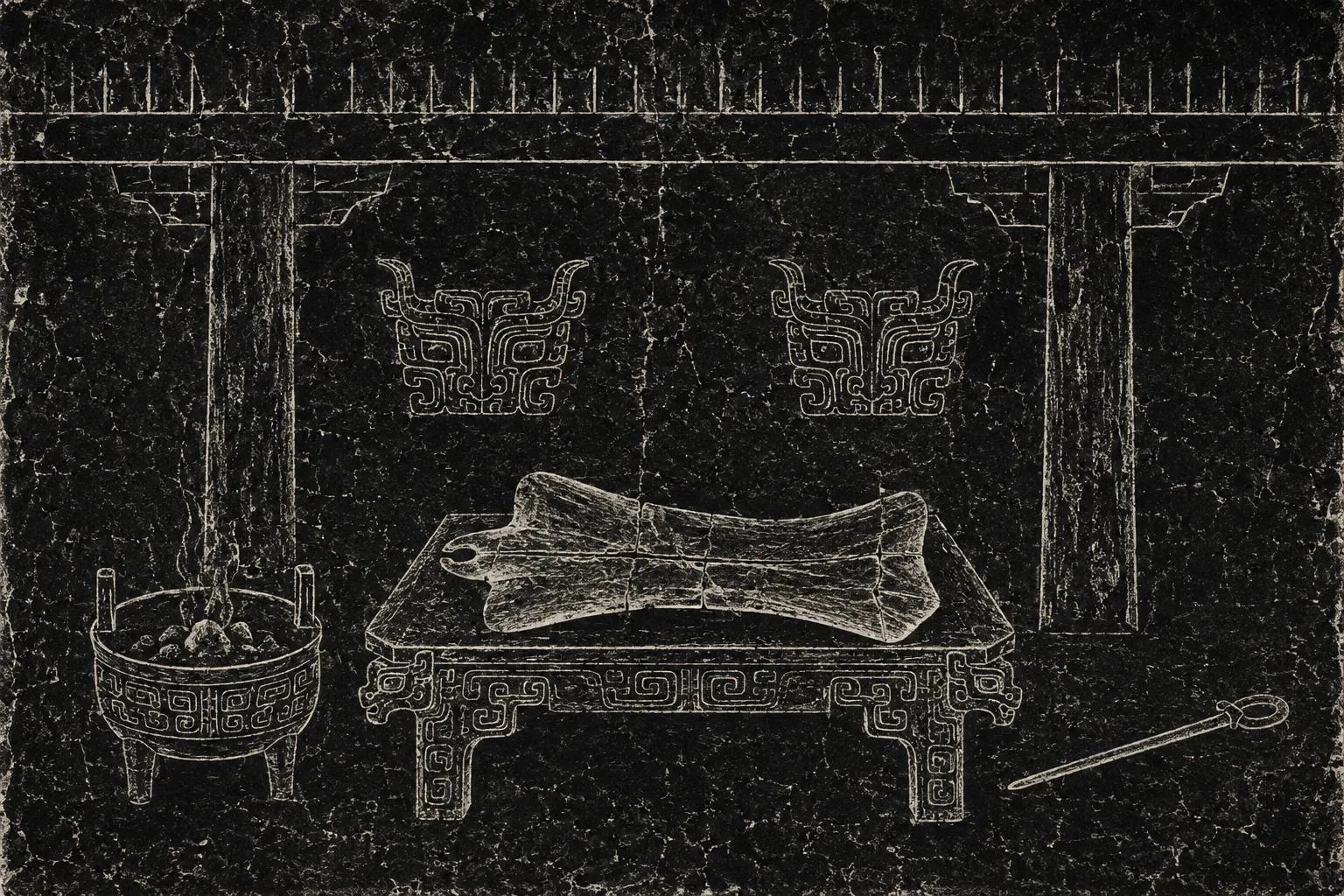
Generated illustration · a royal divination, put to heaven before the answer was known · after a Chinese ink rubbing (拓本) of an incised surface
04
That was a king asking heaven if the harvest would hold.
The questions put to heaven
Shang kings asked direct questions: whether the harvest would hold, whether the queen would survive childbirth, whether a campaign was worth its casualties. The question was carved into the bone before the answer was known. Divination was a function of state, and the king was its chief diviner.
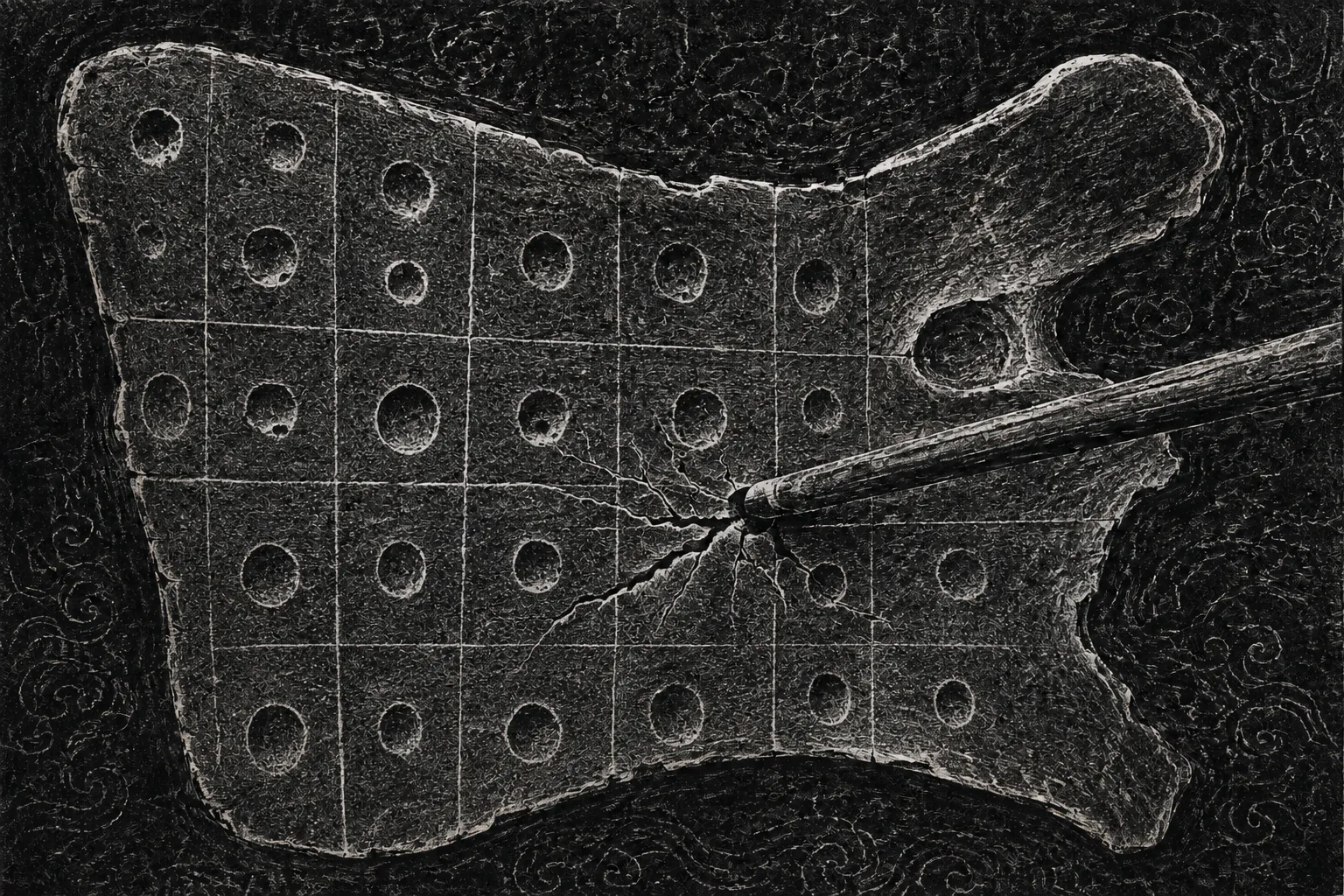
Generated illustration · pyromancy: the bone thinned, heated, and read from the fracture · after a Chinese ink rubbing (拓本) of an incised surface
05
Heaven answered in the fire. The bone split.
Heating and reading the bone
The reverse of the bone was thinned in rows of hollows, then touched with a heated point until it fractured. Diviners read the shape and direction of the crack as the answer. The character 卜, which still means divination, is a drawing of such a crack.
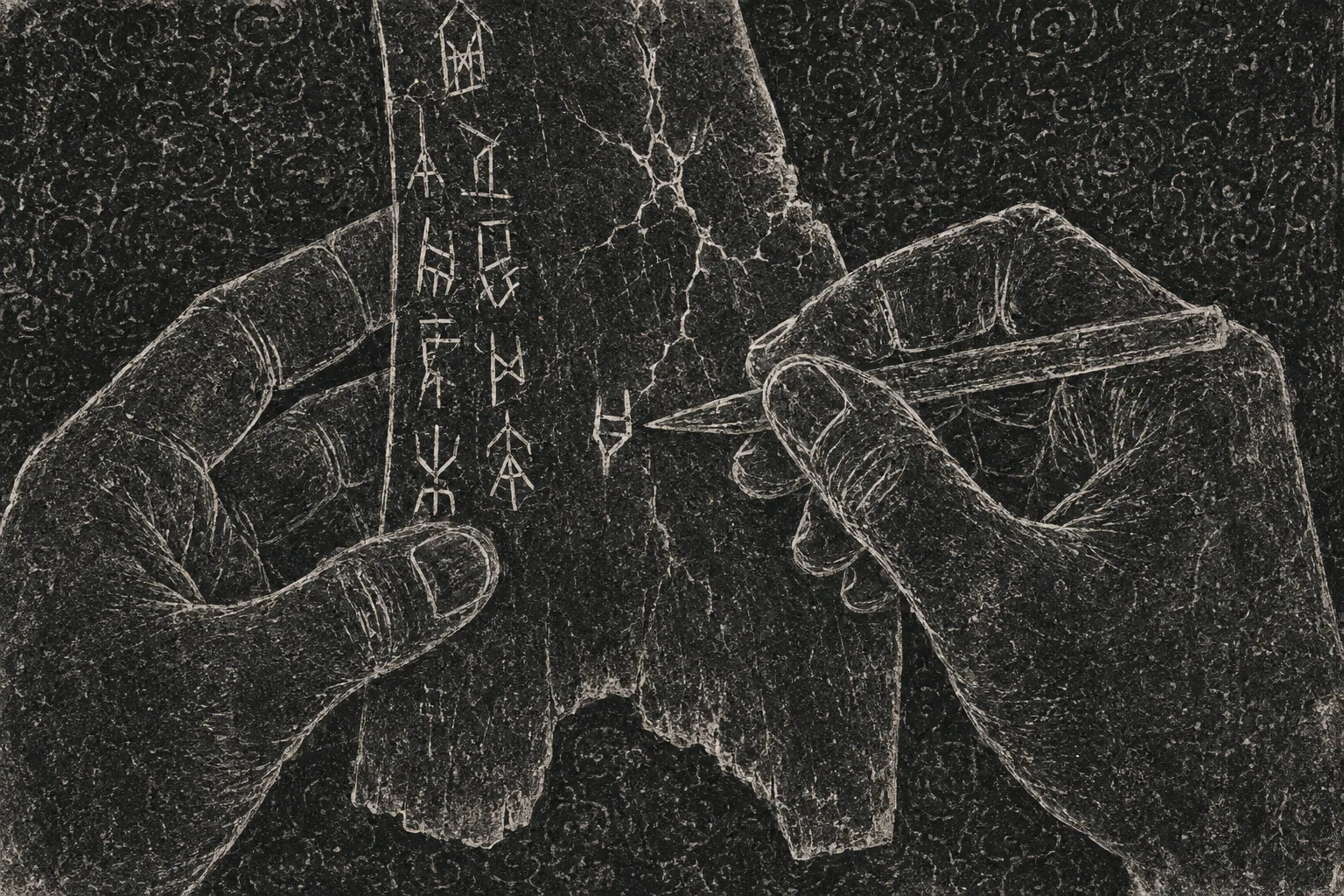
Generated illustration · the outcome filed beside the question, as archive rather than charm · after a Chinese ink rubbing (拓本) of an incised surface · inscription illustrative
06
a scribe carved the answer beside the question
The archive
The outcome was carved beside the question, sometimes with a later note on whether it proved true. The bones were kept, stacked and buried in storage pits rather than discarded, which is why so many survive. They served as records of state rather than as charms.
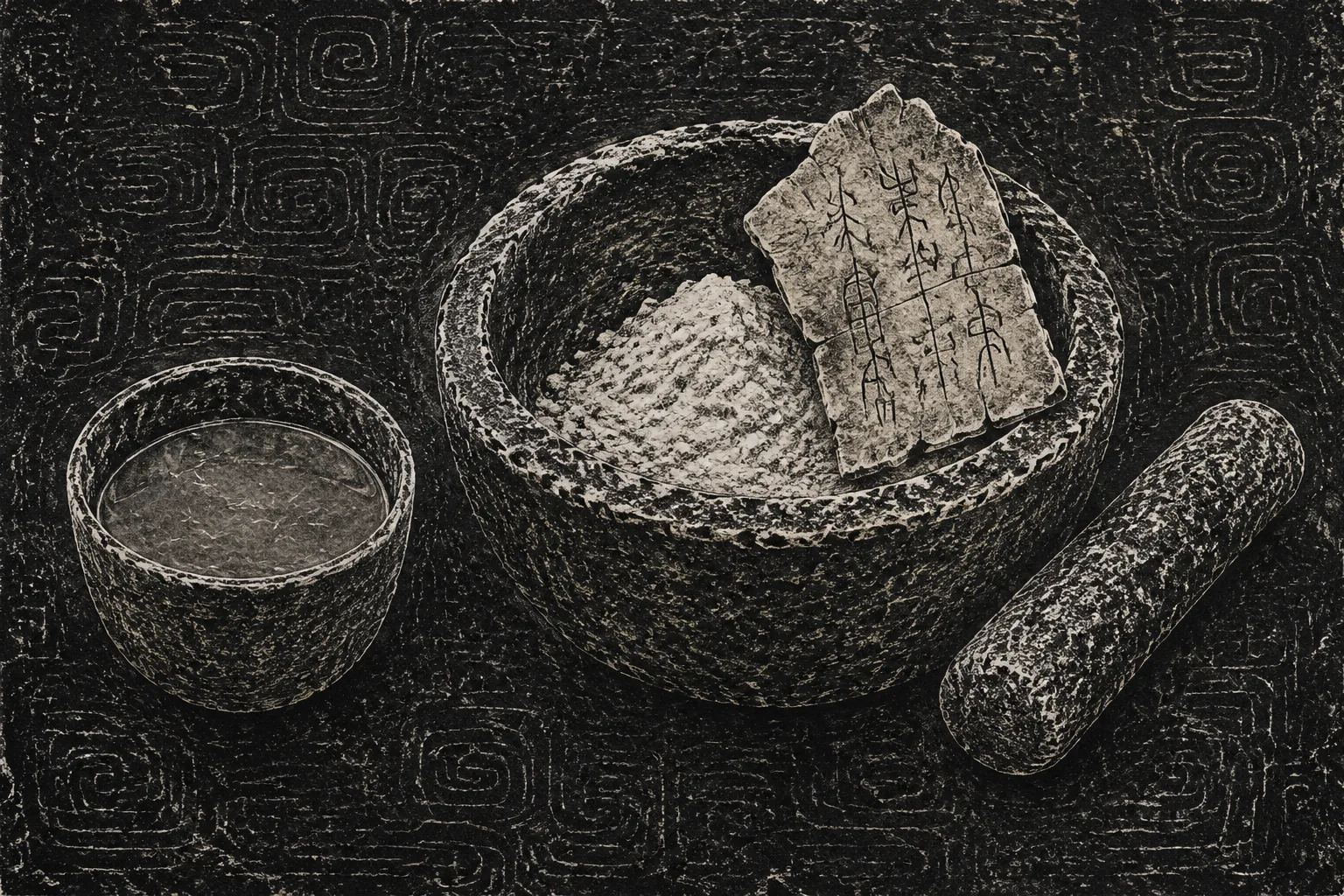
Generated illustration · the same bone ground and drunk as a fever cure · after a Chinese ink rubbing (拓本) of an incised surface · inscription illustrative
07
And we ground it down to powder. And we swallowed it.
Bone consumed as medicine
How much inscribed bone was ground up for medicine before 1899 cannot be established. It was traded in tons. Each fragment carried a question and its recorded answer, and was destroyed in the course of being used.
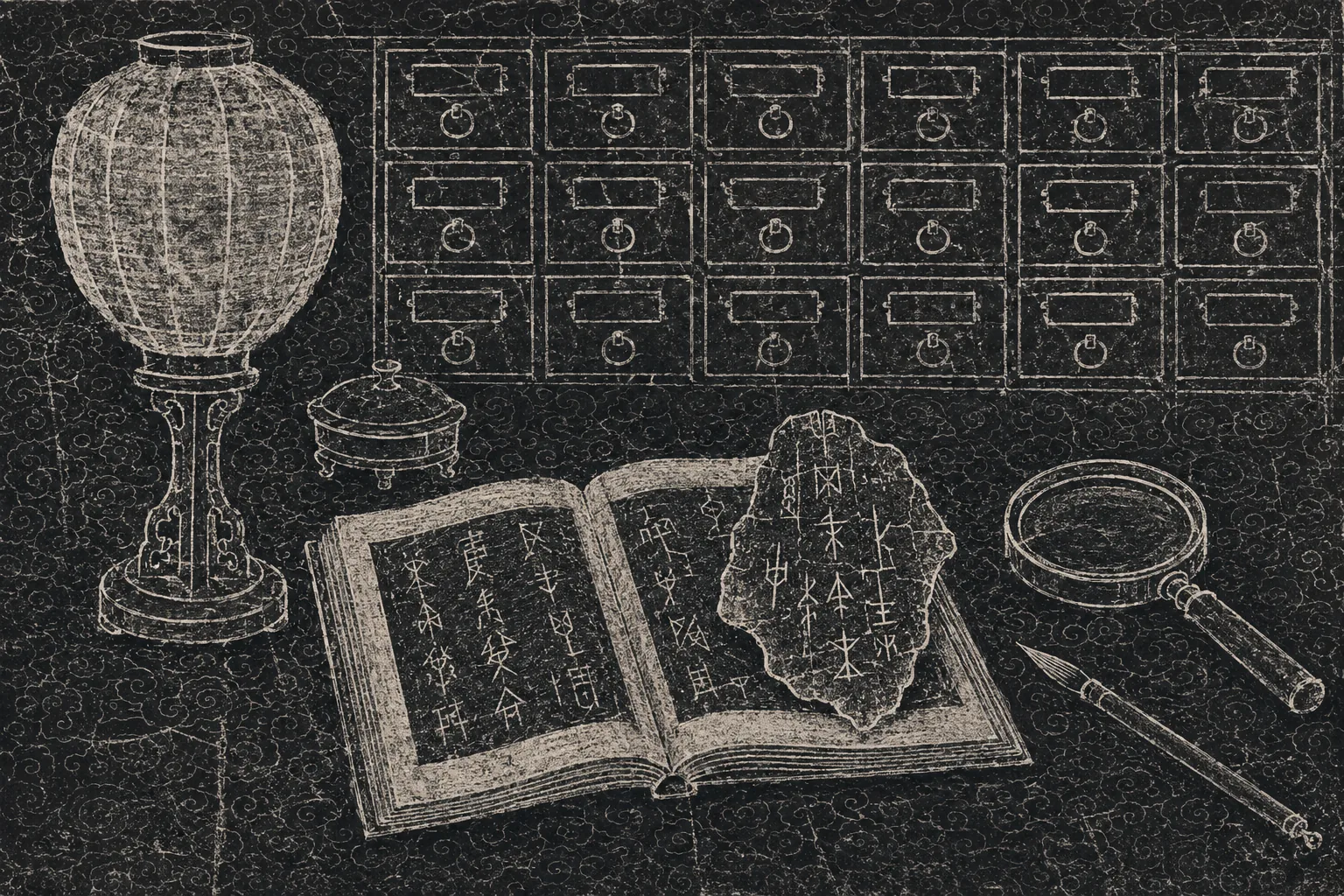
Generated illustration · Beijing, 1899, when a scholar recognised the marks as writing · after a Chinese ink rubbing (拓本) of an incised surface
08
Not in the song
1899: the marks identified
In 1899 fragments bought from a Beijing medicine shop reached the scholar Wang Yirong, who identified the marks as the earliest known Chinese writing. Excavation at Anyang followed within thirty years, and the Shang passed from semi-legend into documented history.
02
Warring States, 475–221 BCE
Words 70 lines
Five hundred years of war.
Seven states. One question.
How do we live.
Names first. Everything after that's a name.
Call a king a king or the kingdom's not the same.
If the word don't fit the thing then the thing won't hold,
and a country runs on language long before it runs on gold.
So bow to your father, and his father, and his,
'cause the dead outnumber us, that's just how it is.
Ritual ain't performance, ritual's the floor.
Take it up and tell me what your feet are standing for.
I walked fourteen years with a cart and a plan,
knocking on the gate of every warring-state man.
Not a single one hired me. Not a single one tried.
I died thinking I failed. Two thousand years replied.
Rén or wúwéi, tell me which one saves me.
One says hold the line, one says let it be.
Hundred schools screaming in a hundred years of war.
Nobody won the argument. Everybody kept score.
The way that you can say
isn't the way.
Soon as I name it, it's already
somewhere else.
Look at water. Softest thing in the world,
takes the shape of anything,
give it four hundred years
and it hollows out the mountain
without ever once
raising its voice.
You want to carve the block into something useful.
I'm telling you the block was already perfect
and the knife is the problem.
Gatekeeper stopped me at the western pass.
Said, old man, you can't leave till you write it down.
So I wrote five thousand characters, handed him the scroll,
climbed on a buffalo,
and nobody ever saw me again.
Which was, I think,
the point.
Mozi says love everybody equally, build the wall, defend the small.
Sunzi says the greatest win is the fight you never had at all.
Zhuangzi dreams he's a butterfly, wakes up and can't tell which is which.
Legalists say forget your heart, the law don't flinch, the law don't itch.
Shang Yang wrote the code so tight it strangled him in his own street,
torn apart by his own chariots. First man his own laws would meet.
Hundred flowers in a slaughterhouse, hundred voices in the smoke,
and the school that won was the one that came with a whip
and never told a joke.
Rén or wúwéi, tell me which one saves me.
One says hold the line, one says let it be.
Hundred schools screaming in a hundred years of war.
Nobody won the argument. Everybody kept score.
Register call, she gets to my name and she pauses.
Whole class already laughing before the sound comes out.
Confucius said if the name is wrong, the country cracks.
So tell me which one's mine,
the one on the paper or the one my grandmother breathes
like it costs her something.
Dad works six days. Wúwéi don't cover rent.
You can't do nothing when you crossed an ocean to get here,
you can't be the uncarved block when the whole point of the journey
was to get carved into something they'd accept.
And I am water in every room I walk into.
I take the shape of whatever they pour me into.
Every single time.
And I still can't tell you
if that's the wisdom
or if that's just the vanishing.
Five hundred years they argued about how a man should live.
Then one state stopped arguing.
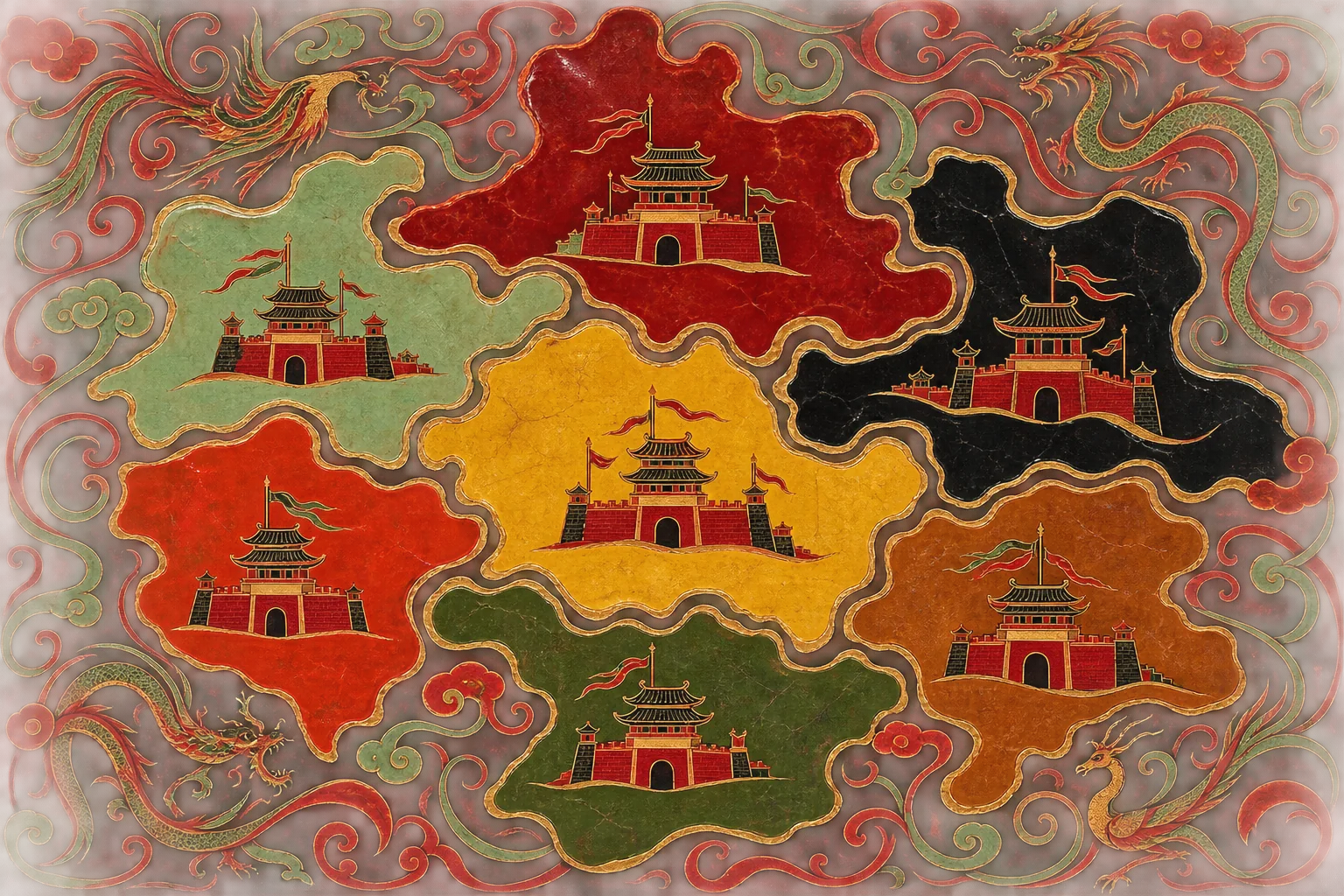
Generated illustration · the Warring States, c.300 BCE, down from dozens to seven · after Warring States Chu lacquer painting on wood · architecture stylised
01
Seven states. One question. How do we live.
The Warring States
By 300 BCE the Zhou king held only ceremonial authority, and warfare had reduced dozens of rival states to seven. The competing schools of thought that arose in this period were practical proposals, written by men seeking to persuade individual rulers to govern in a particular way.
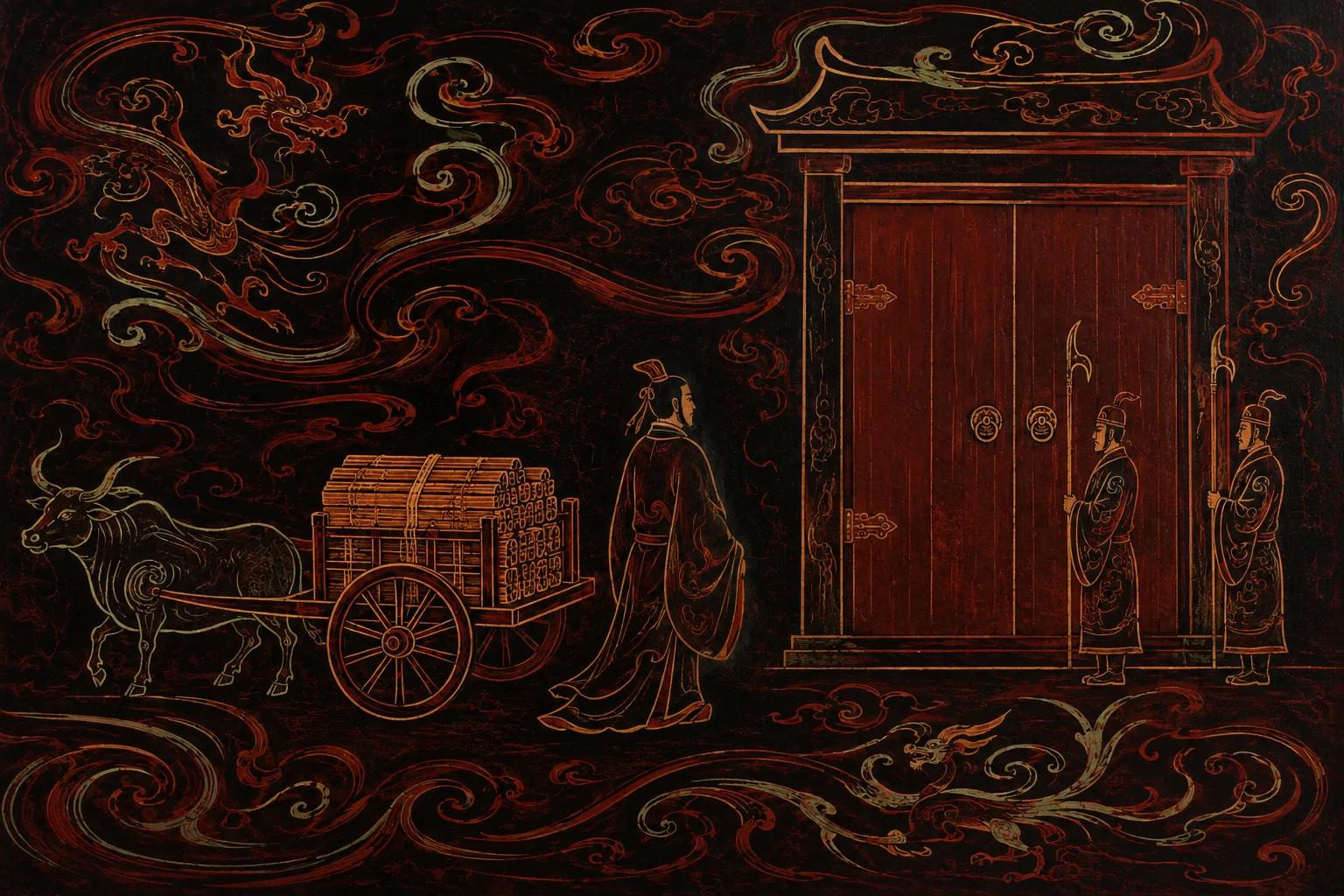
Generated illustration · Confucius travelling between courts for fourteen years, unemployed · after Warring States Chu lacquer painting on wood
02
knocking on the gate of every warring-state man
Confucius, c.551 to 479 BCE
Confucius left his home state of Lu around 497 BCE and spent some fourteen years travelling between courts, looking for a ruler who would govern by ritual and example. He found none, and died believing he had failed. The Qin later burned his followers’ books. The Han made his teaching the basis of the state examinations for the next two thousand years.
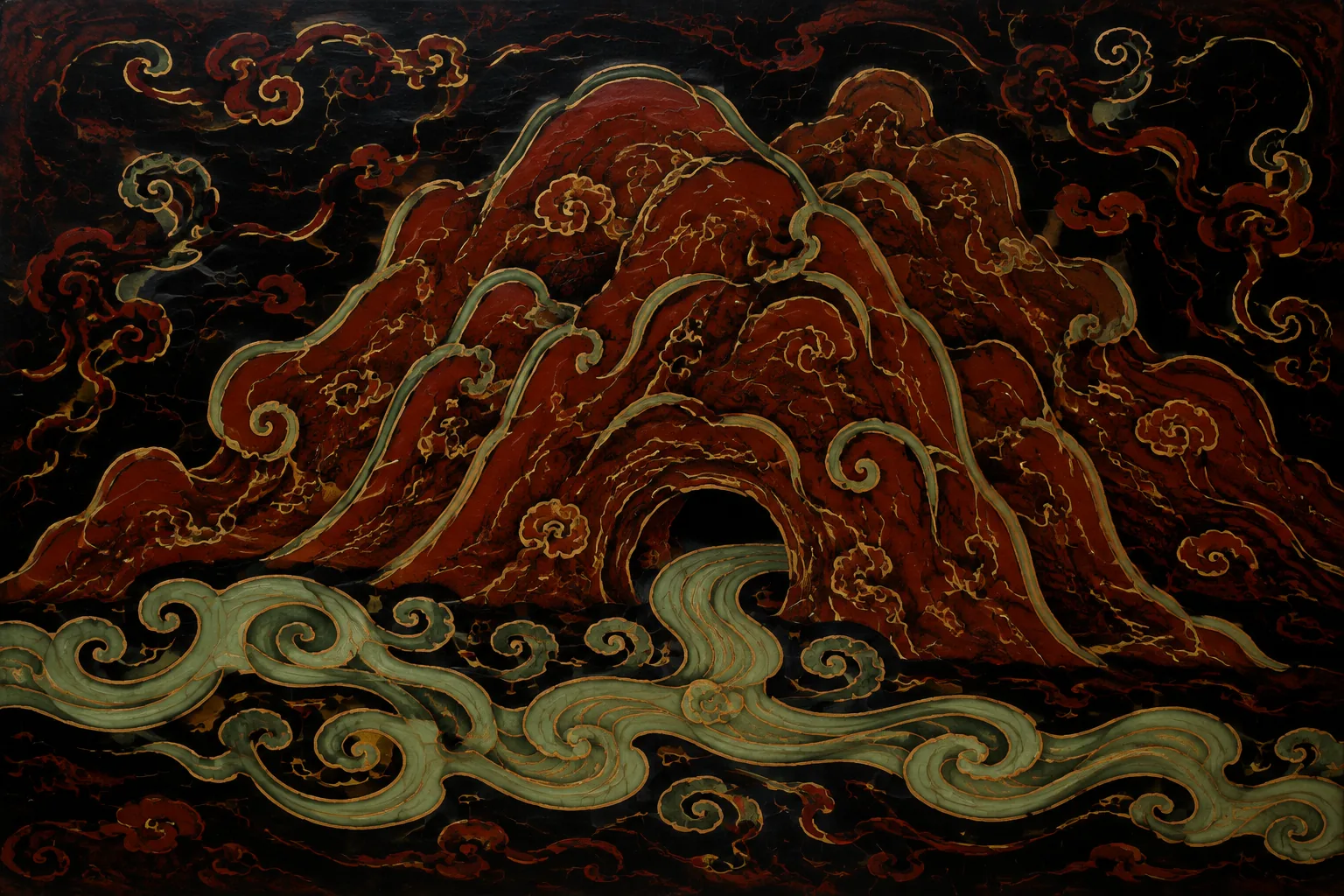
Generated illustration · the Daodejing on water: the soft outlasting the hard · after Warring States Chu lacquer painting on wood
03
and it hollows out the mountain without ever once raising its voice
Water, in the Daodejing
Water is the central image of the Daodejing. Chapter 78 states that nothing in the world is softer than water, and that nothing surpasses it at wearing down what is hard. The text presents yielding as a form of strength rather than an absence of it.
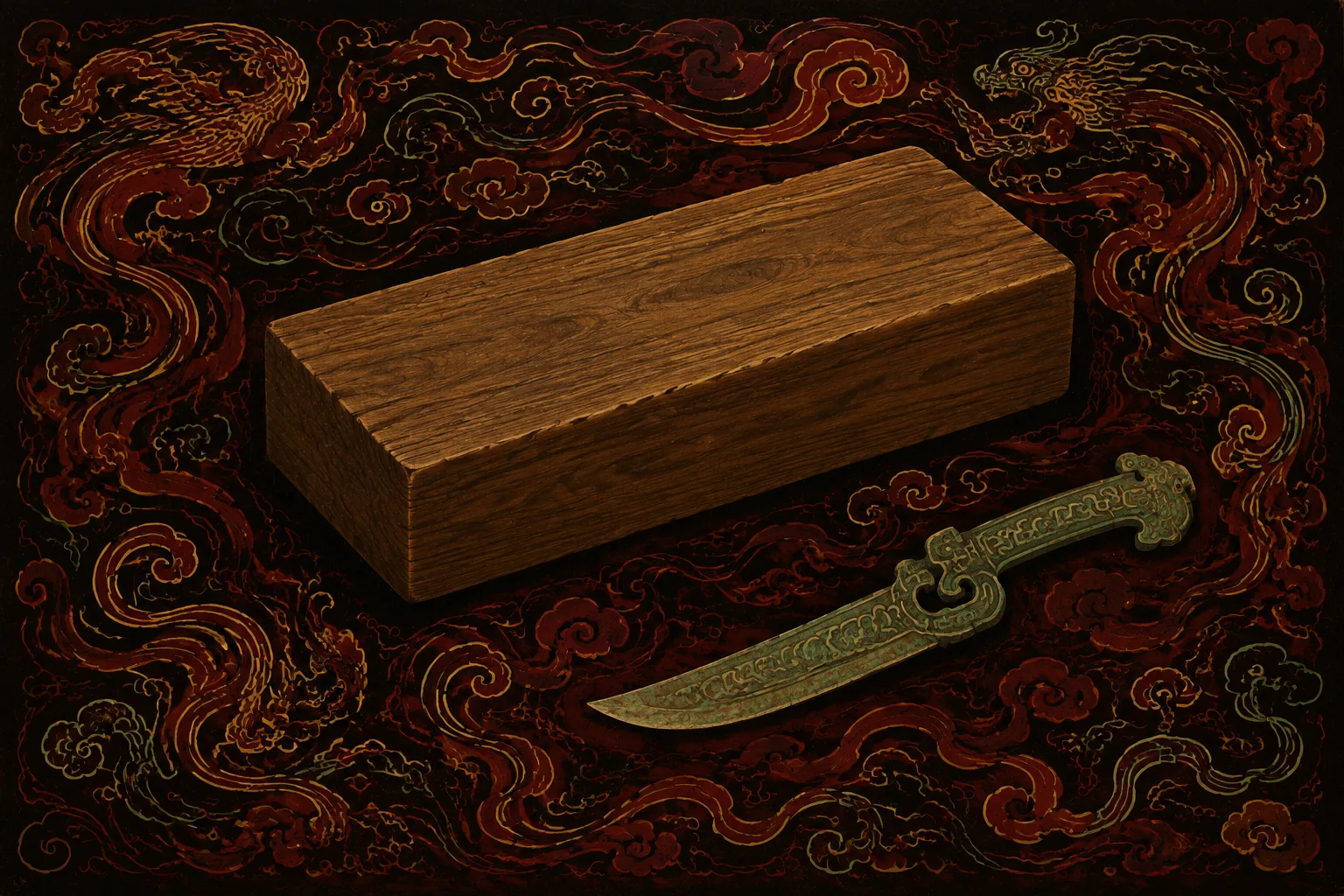
Generated illustration · pǔ, the self before it is made useful · after Warring States Chu lacquer painting on wood
04
I’m telling you the block was already perfect and the knife is the problem
樸, the uncarved block
Pǔ: timber before it has been worked into anything useful. In the Daodejing it stands for a self that has not yet been shaped into a role or a function, and it is one of the text’s recurring images for returning to an original state.
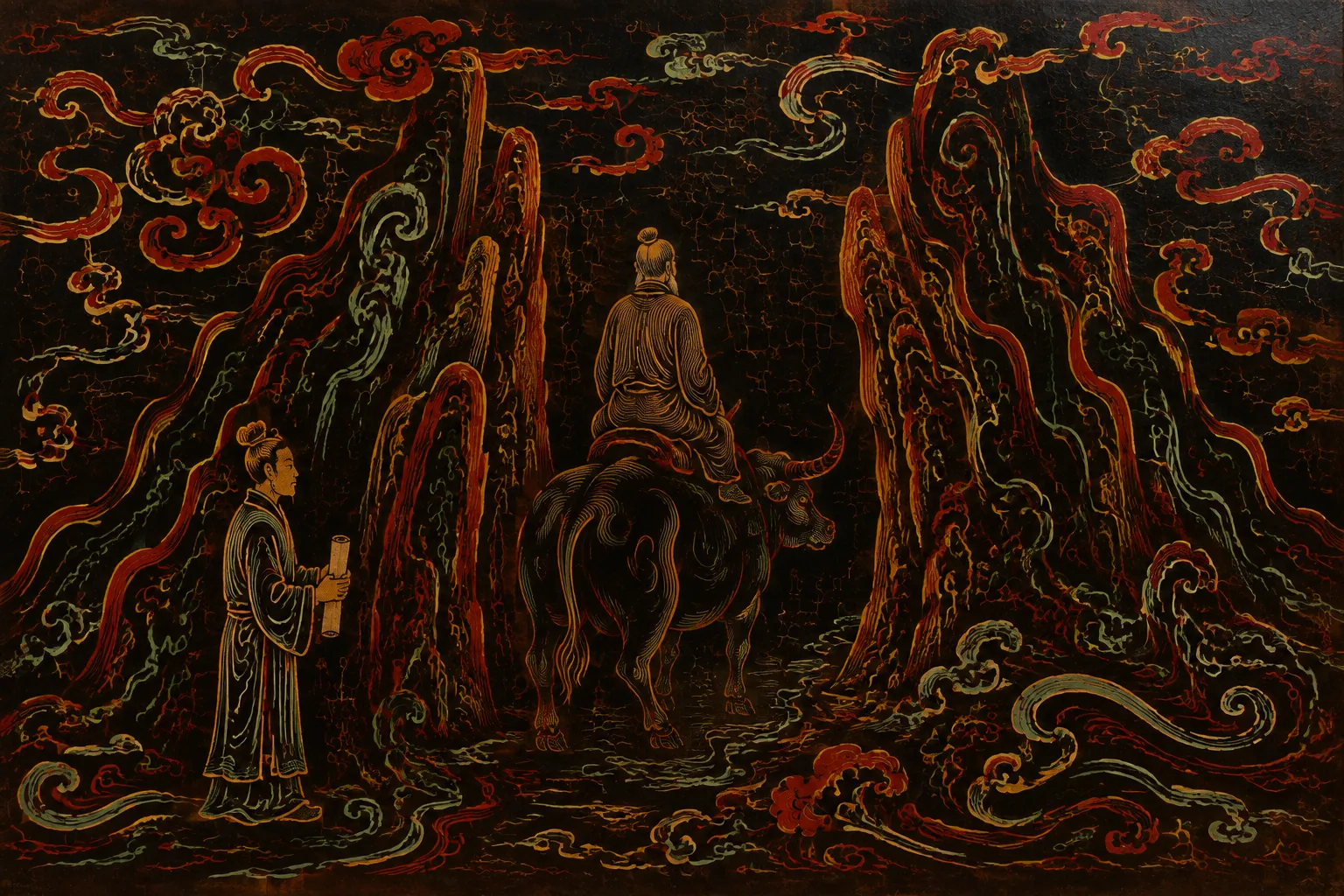
Generated illustration · the legend of Laozi leaving, and being made to write it down · after Warring States Chu lacquer painting on wood
05
Said, old man, you can’t leave till you write it down.
Laozi at the western pass: tradition
The tradition holds that Laozi, leaving a collapsing dynasty for the west, was stopped at the frontier pass by a gatekeeper who required him to write his teaching down before passing. He is said to have produced five thousand characters and then ridden away on a buffalo. Whether Laozi was a single historical person is unsettled, and the text is generally held to be layered.
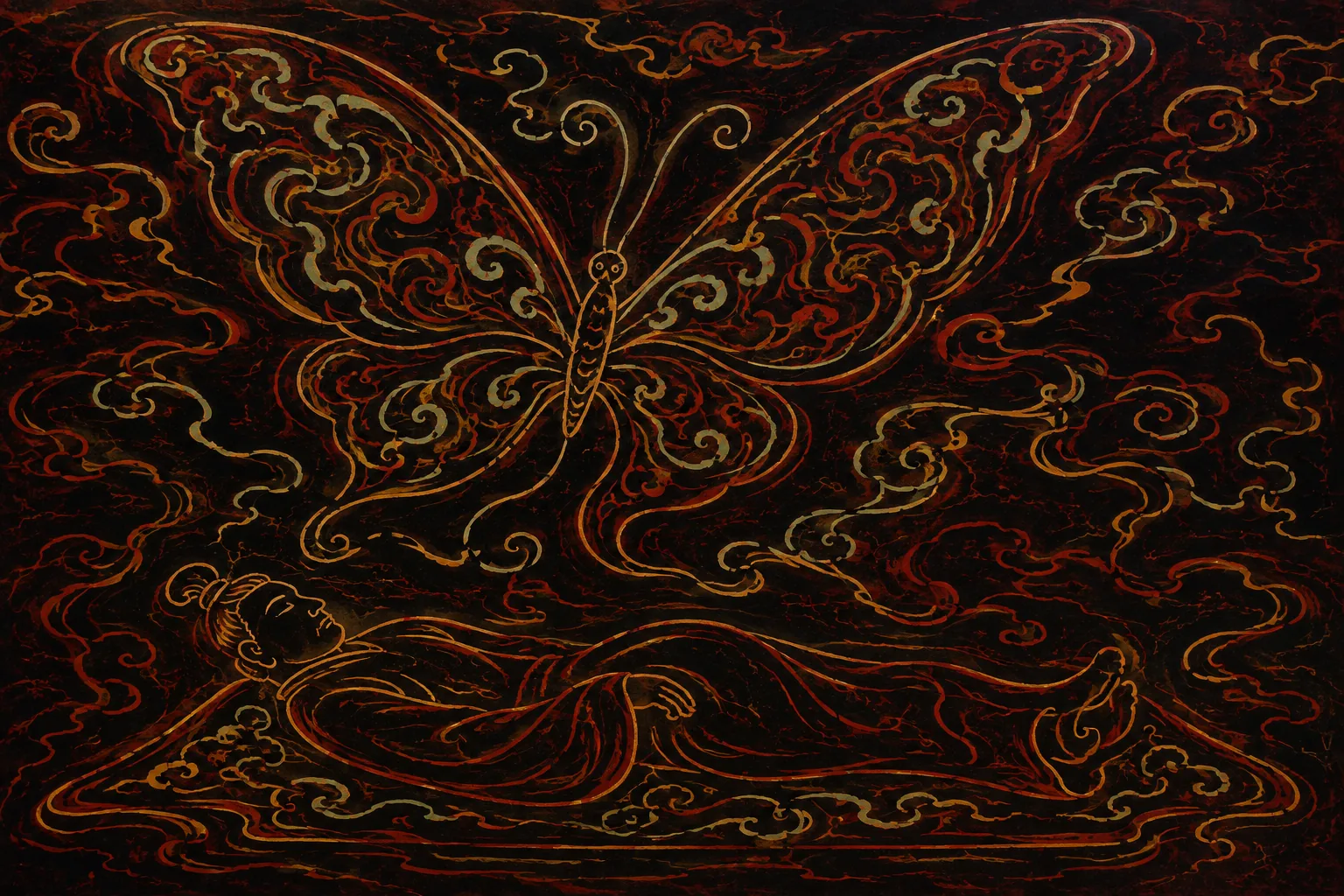
Generated illustration · Zhuangzi on the limits of being sure · after Warring States Chu lacquer painting on wood
06
Zhuangzi dreams he’s a butterfly, wakes up and can’t tell which is which.
The butterfly dream
From the second chapter of the Zhuangzi. He dreamt he was a butterfly, woke, and could not determine whether he was a man who had dreamt a butterfly or a butterfly now dreaming a man. The passage questions how far the feeling of certainty can be treated as evidence.
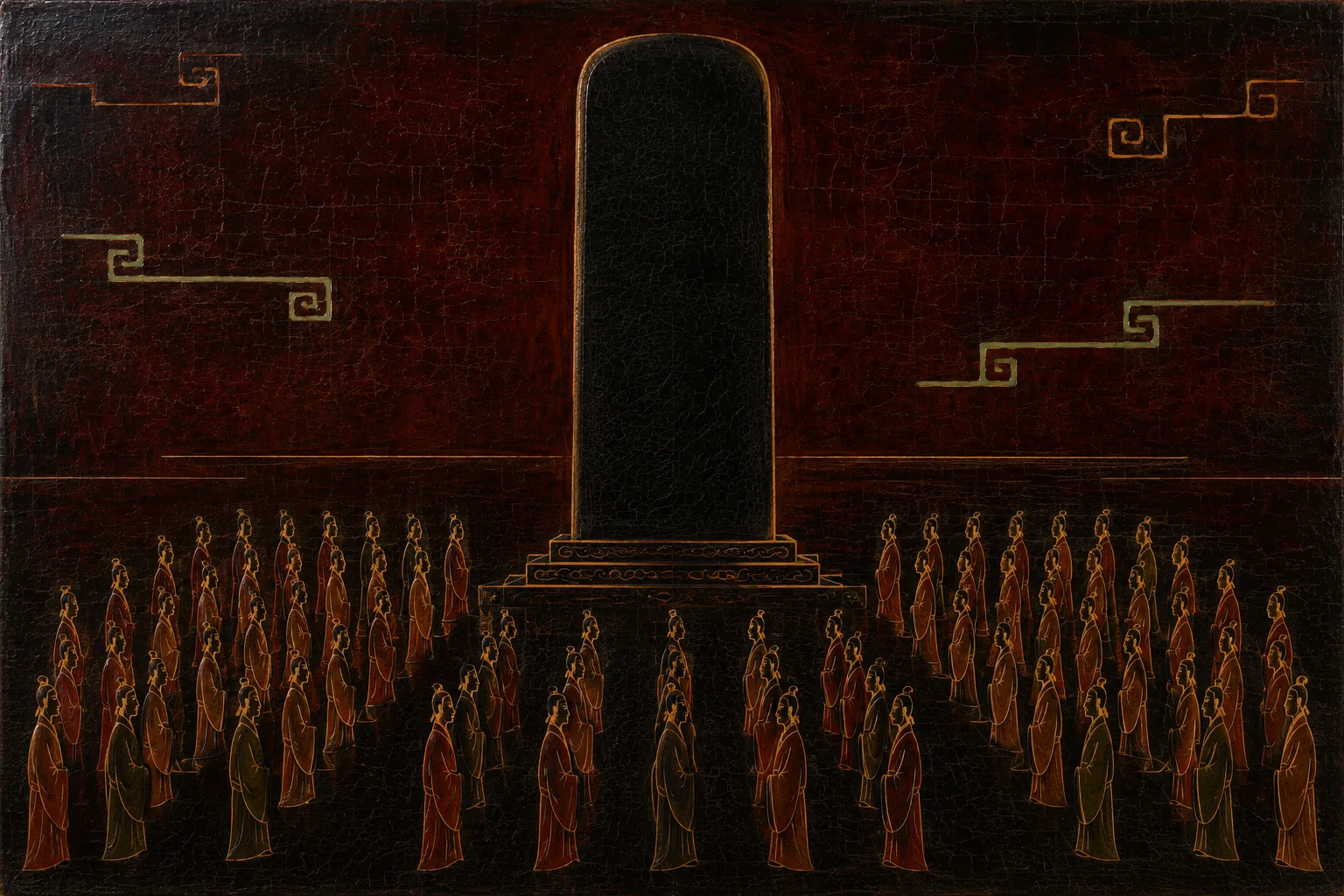
Generated illustration · Legalism: law published, applied identically, not up for discussion · after Warring States Chu lacquer painting on wood
07
Legalists say forget your heart, the law don’t flinch, the law don’t itch.
Legalism
Legalism assumed that people cannot be relied upon to be good, and built administration accordingly: law published openly, punishment applied without regard to rank, and informing rewarded. It proved more effective at governing than its rivals, and it was the doctrine under which China was unified in 221 BCE.
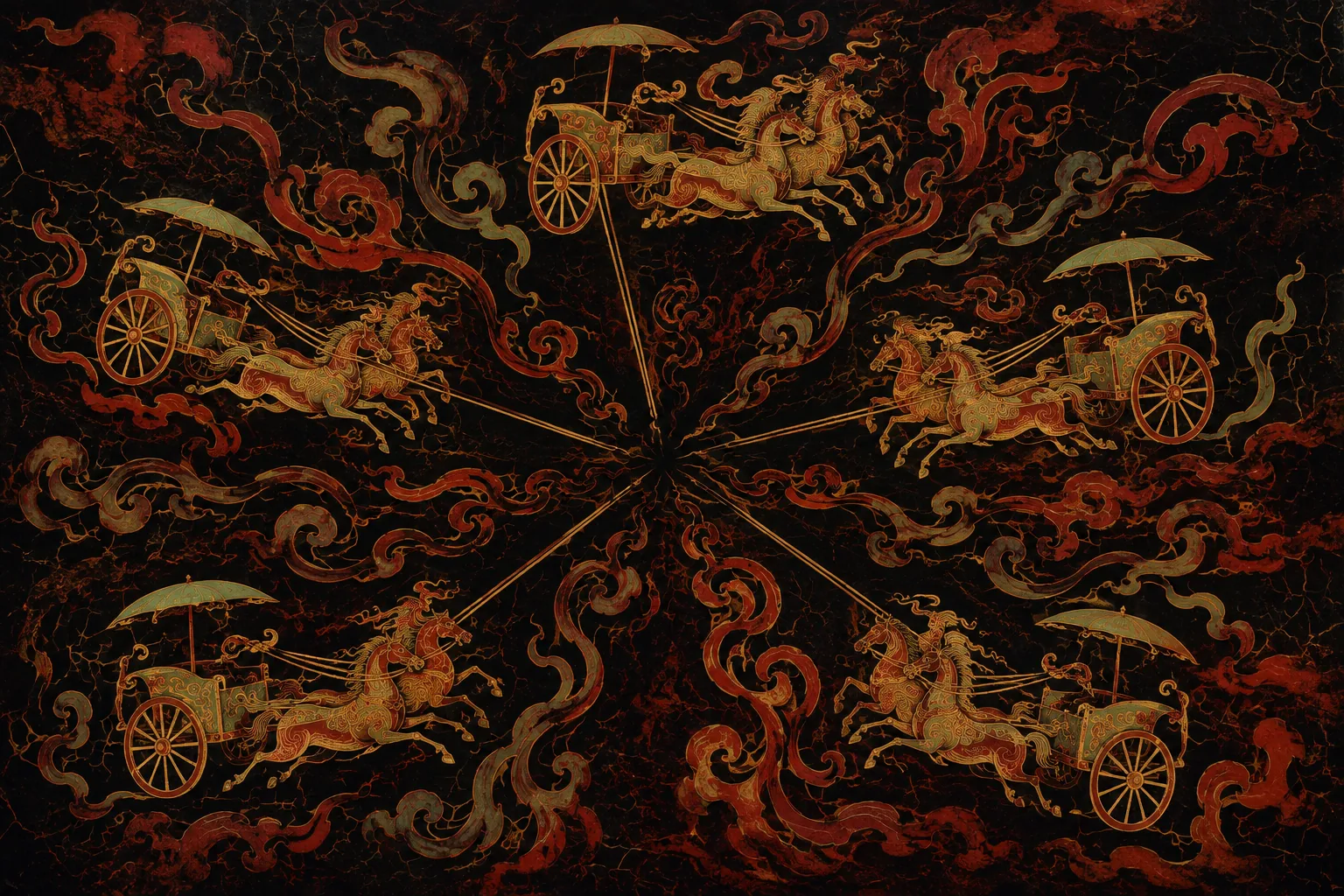
Generated illustration · Shang Yang, 338 BCE, executed under the statutes he wrote · after Warring States Chu lacquer painting on wood
08
torn apart by his own chariots. First man his own laws would meet.
Shang Yang, died 338 BCE
Shang Yang drafted the reforms that made Legalism work in the state of Qin: land reallocated, ranks awarded for military service, households grouped into units answerable for each other. When his patron died in 338 BCE he was charged under his own statutes, tried by the procedure he had designed, and executed. His family were killed with him.
03
Qin, 221–206 BCE
Words 58 lines
One writing. One coin. One road. One law.
One writing. One coin. One road. One law.
Six kings knelt. I don't count that as war.
Counting's for the ones that came before.
Zhao, Han, Wei, Chu, Yan, Qi, that's the list,
now it's one name, one fist, and none of them exist.
You wrote your letters your way, I made that a crime.
Same character, same stroke, same order, every time.
Measured out your grain sack, measured out your gold,
cut the axle width so every cart runs the same road.
That's not vanity. Watch what the standard does.
Two thousand years later you still write the way I was.
Your alphabet's my invoice. Your provinces, my map.
I killed the aristocracy and never took it back.
Burned the books. Buried the scholars in the field.
Said history starts at me, and everything before is sealed.
They call that tyranny. I call it a clean sheet.
Every country you love was built on somebody's defeat.
BUILD IT. Ten thousand li of stone.
BUILD IT. On a hundred thousand bones.
BUILD IT. Every brick's a man.
BUILD IT. Longest grave in the land.
Wall don't keep the northerners out. Never did.
Wall keeps the money in and the labour on the grid.
Conscript farmers, walk them north, they don't walk south again,
mortar's made of river silt and everybody's men.
Meng Jiangnü wept so hard the wall came down in pieces.
Found her husband in the rubble. That's the story that releases
every mother in the province who never got a letter,
and they told it for two thousand years 'cause the crying made it better.
I got eight thousand soldiers standing in the clay,
every face is different, sculpted from a man I made that way.
Archers, cavalry, generals, in ranks below the hill.
Buried them facing east. Toward the six kings.
Still.
BUILD IT. Ten thousand li of stone.
BUILD IT. On a hundred thousand bones.
BUILD IT. Every brick's a man.
BUILD IT. Longest grave in the land.
I sent a fleet east to find the island where nobody dies.
Three thousand children on the boats. They never came back.
So I sent alchemists. They brought me cinnabar.
Mercury.
Bright and heavy and sweet, and they said this is the one,
this is the metal that doesn't rot,
so I drank it.
Every day, I drank it.
Forty-nine years old, on a road in Shaqiu,
and the empire didn't know for two months
because they packed the carriage with rotting fish
so nobody could smell the emperor going off.
That's the ending.
Salted fish and a sealed cart.
I standardised the language, the coin, the road, the year.
Only thing I couldn't standardise
was me.
Fifteen years. That's how long it lasted after I died.
Fifteen.
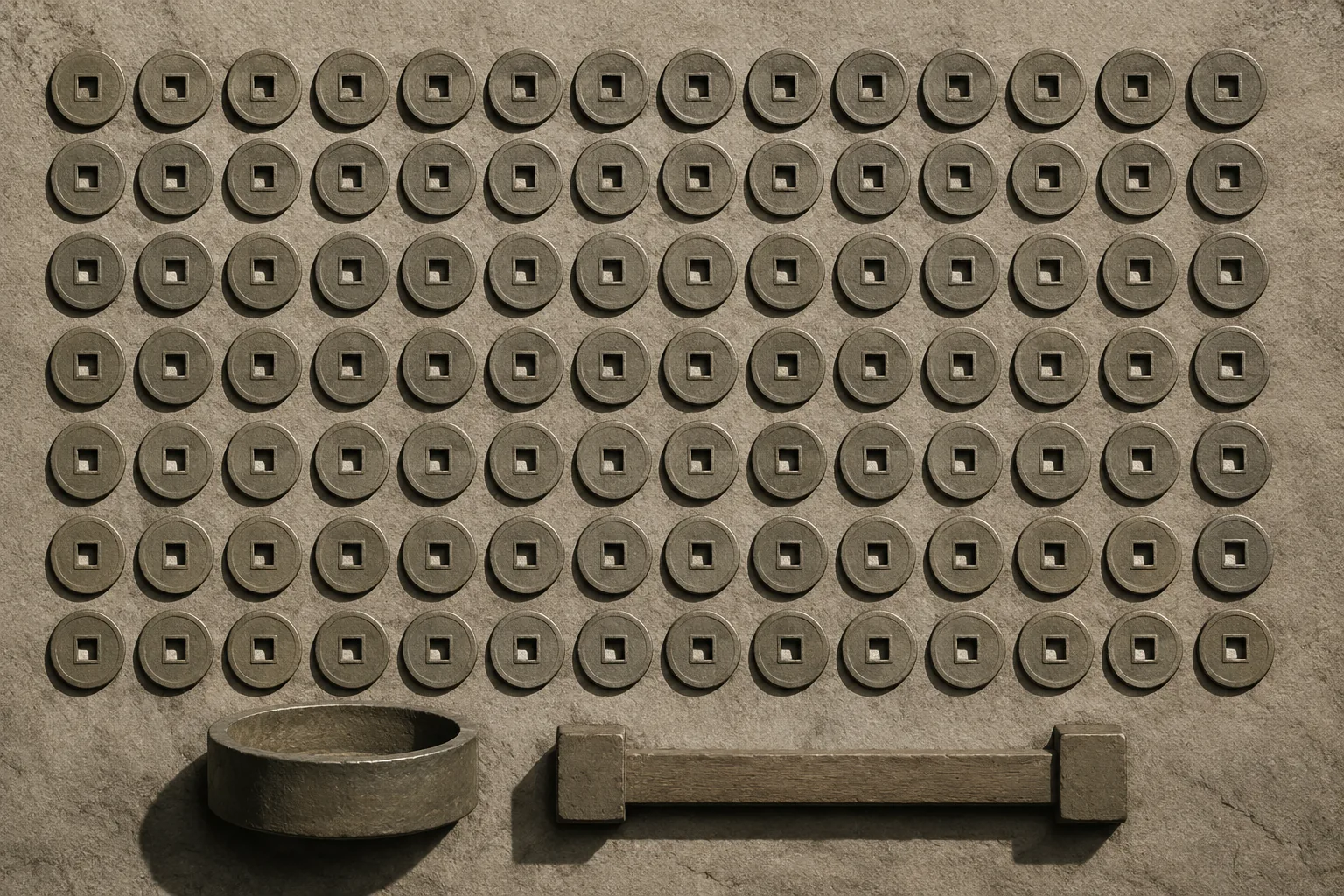
Generated illustration · the Qin standards — one script, one coin, one axle width · after Qin dynasty grey terracotta and low-relief carved stone
01
One writing. One coin. One road. One law.
Qin standardisation, from 221 BCE
The Qin imposed a single script, and single systems of weight, measure and coinage, across the territory it had conquered. Cart axles were fixed to one width so that a vehicle fitted the ruts of the whole road network. Every Chinese character written since descends from the forms this administration set.
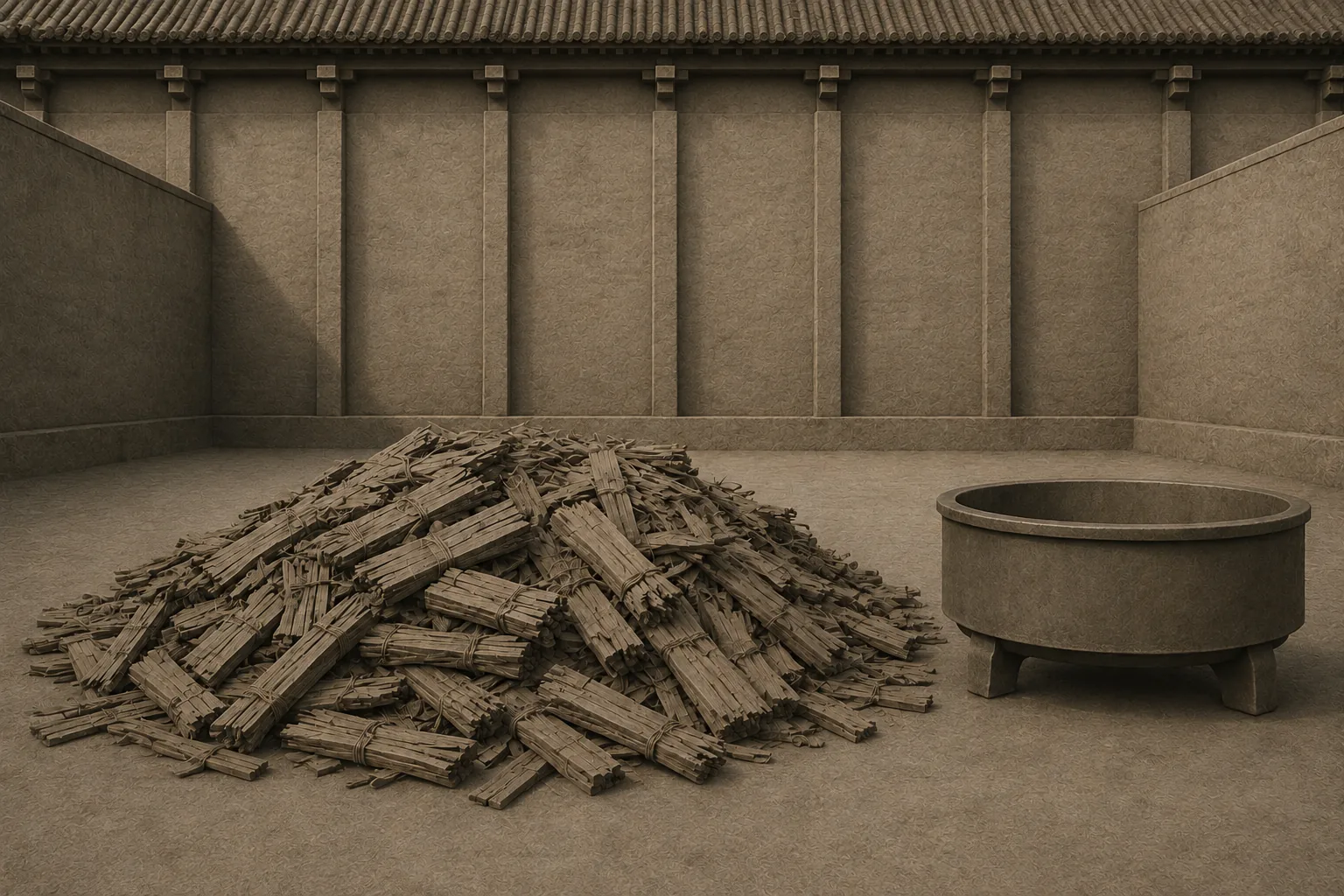
Generated illustration · the proscription of 213 BCE, before the fire · after Qin dynasty grey terracotta and low-relief carved stone
02
Burned the books. Buried the scholars in the field.
The proscription of 213 BCE
Texts outside the approved canon were called in and destroyed, with the histories of the conquered states a particular target. The execution of scholars alongside them is reported by Sima Qian a century later and the details are disputed. A book at this date was a bundle of bamboo slips, heavy and copied by hand.
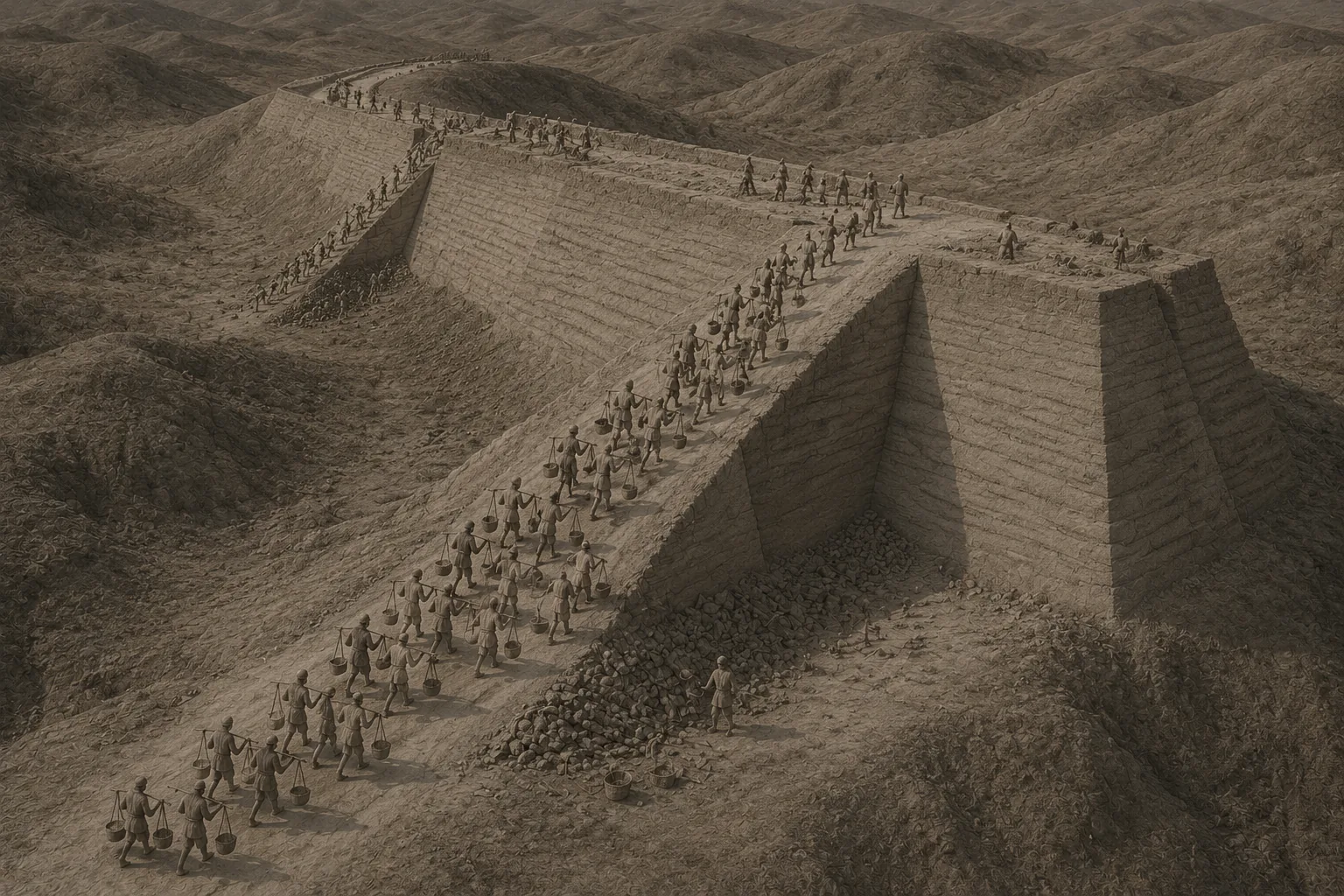
Generated illustration · the Qin wall: rammed earth, not the Ming brick in photographs · after Qin dynasty grey terracotta and low-relief carved stone
03
BUILD IT. Ten thousand li of stone.
The Qin wall: rammed earth
The Qin frontier wall was built of earth tamped down in layers between wooden forms, joining defences the conquered states had already raised. Almost none of it survives. The brick and stone wall familiar from photographs is Ming work of some fifteen centuries later, on a different line.
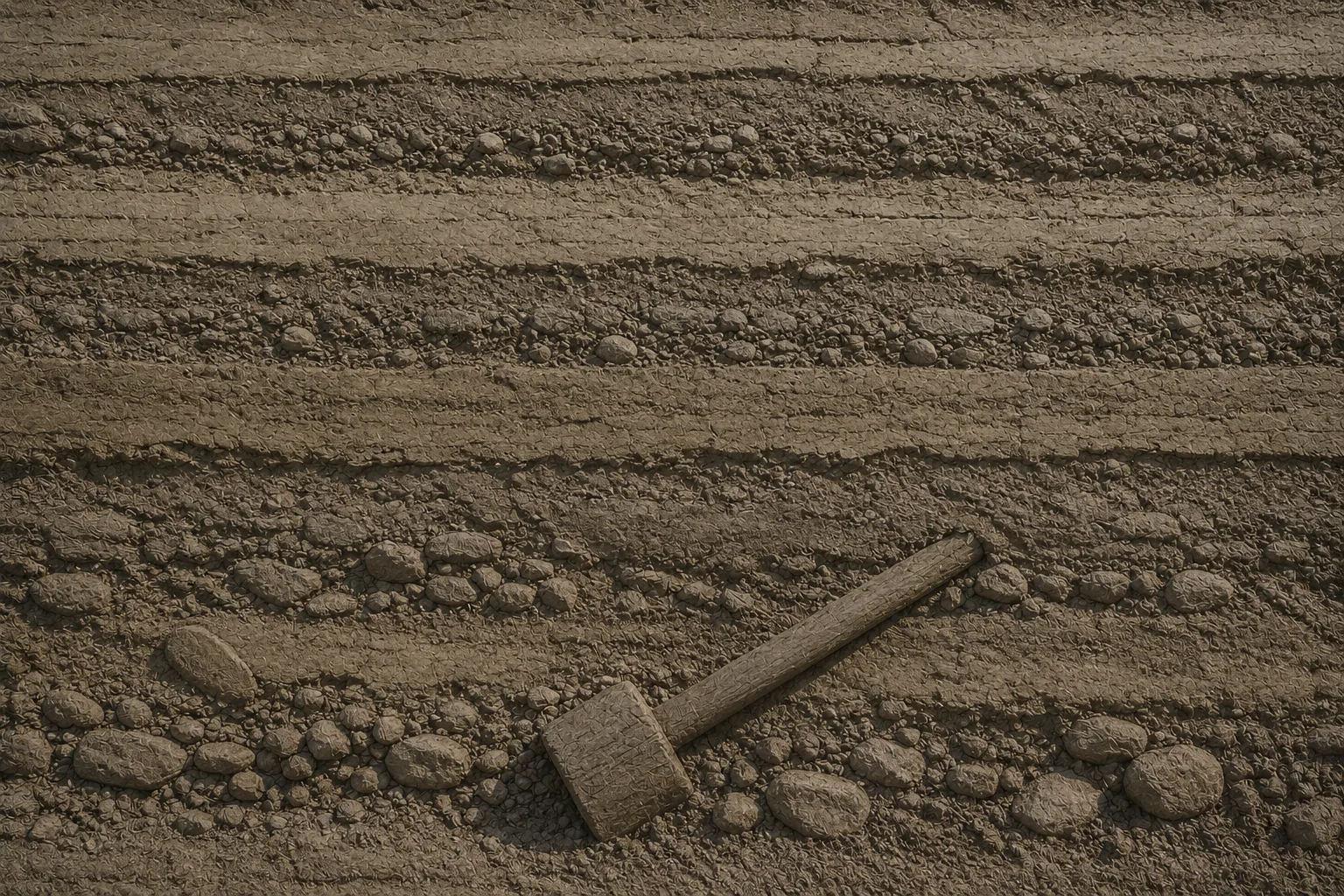
Generated illustration · conscript labour, and deaths nobody counted · after Qin dynasty grey terracotta and low-relief carved stone
04
BUILD IT. Every brick’s a man.
Conscript labour
The work was carried out by conscripted farmers, convicts and soldiers, moved north in their hundreds of thousands. No count of the dead was kept. Burials have been found near the works. There is no evidence that bodies were used as fill in the wall itself; that detail belongs to folklore.
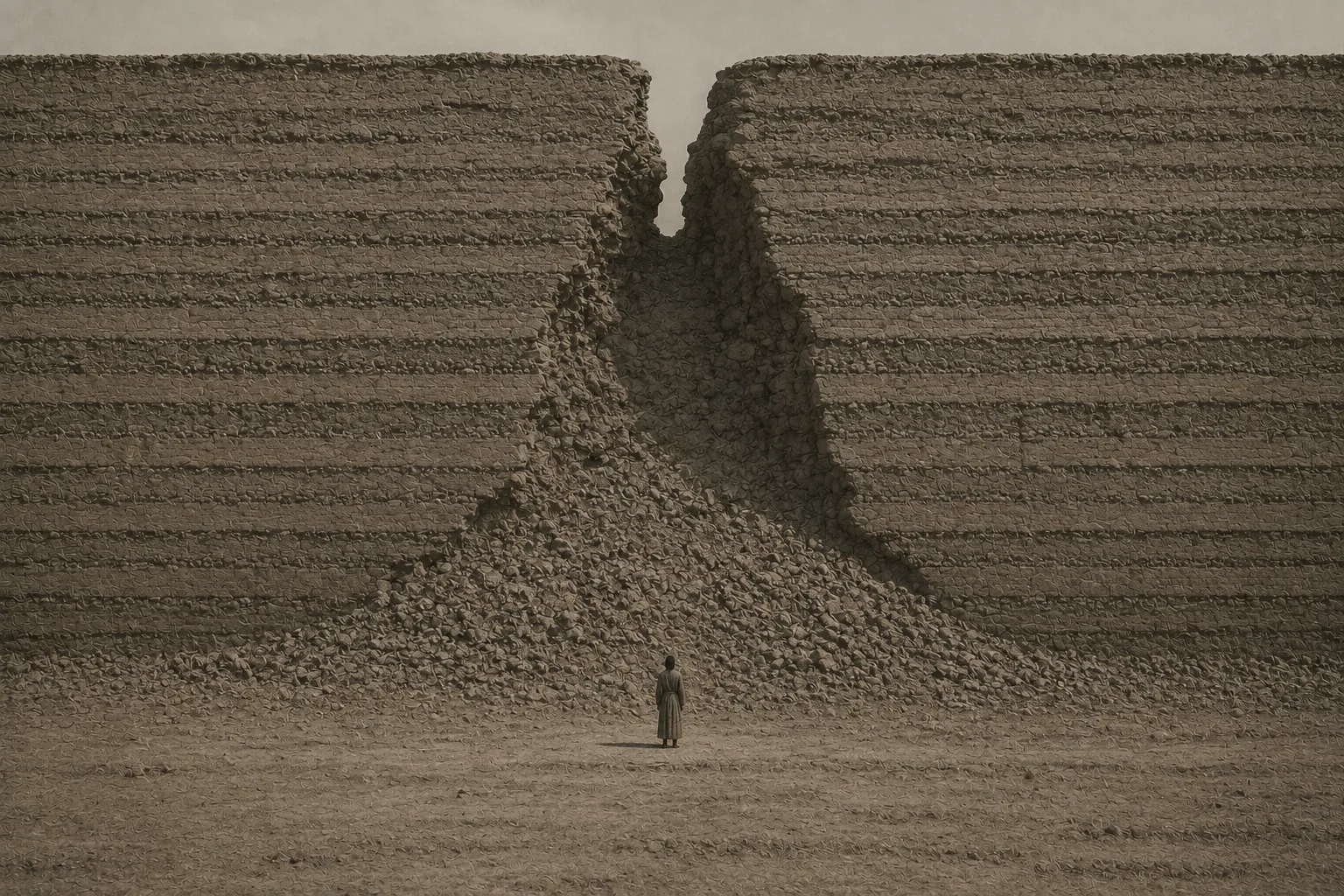
Generated illustration · a legend told for two thousand years, because the state kept no list · after Qin dynasty grey terracotta and low-relief carved stone
05
Meng Jiangnü wept so hard the wall came down in pieces.
Meng Jiangnü: legend
In the story, Meng Jiangnü travels north with winter clothes for her conscripted husband, learns that he is dead, and weeps until the wall opens and returns his body. It is a legend rather than a record, told for some two thousand years. The state kept no register of the men who died on the works.
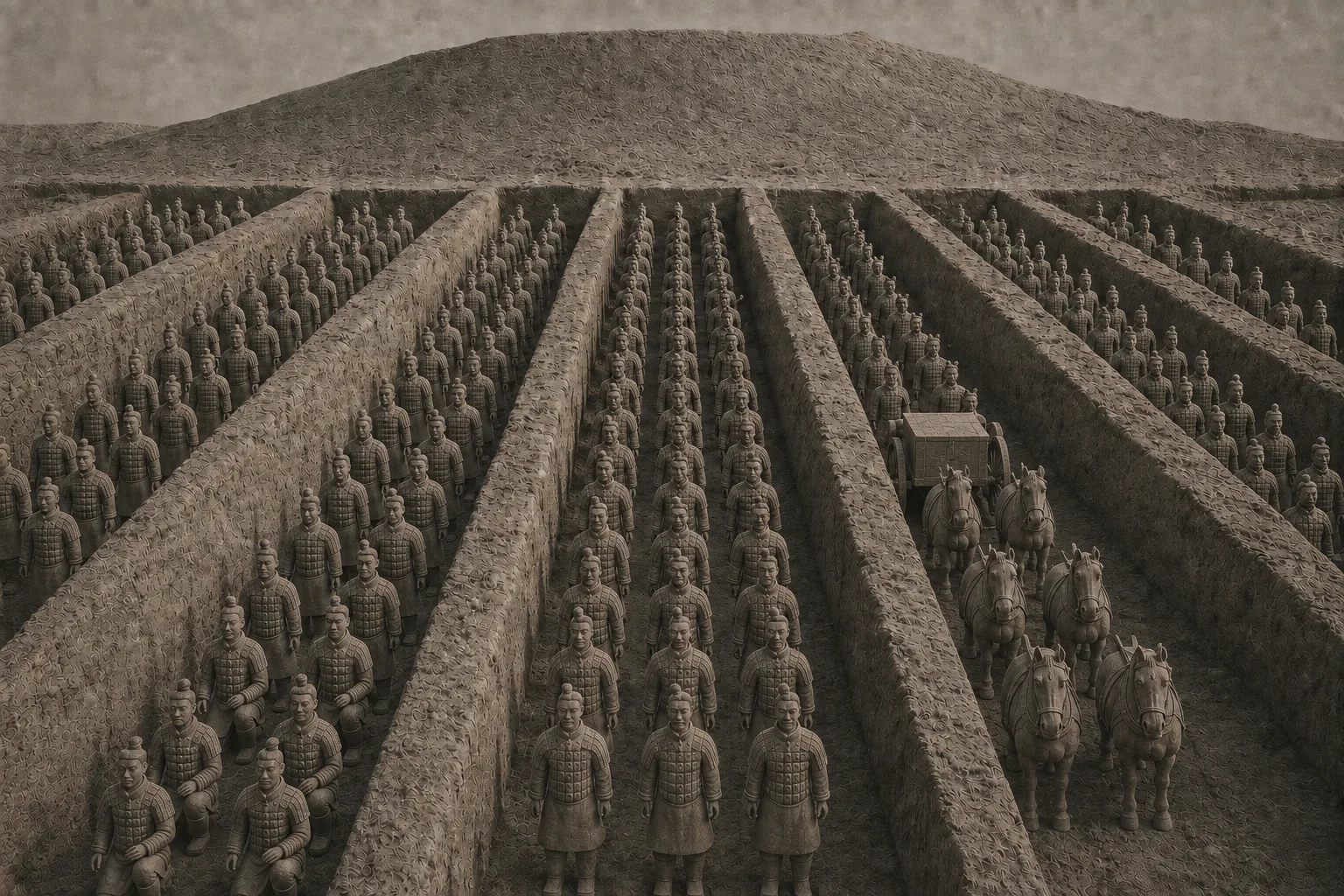
Generated illustration · the tomb army, arrayed east toward the conquered states · after Qin dynasty grey terracotta and low-relief carved stone
06
Buried them facing east. Toward the six kings.
The terracotta army
Found by well-diggers in 1974 and still under excavation: approximately eight thousand figures in battle order, east of the tomb of Qin Shi Huang, facing the six kingdoms the Qin had conquered. No two faces are alike. Heads were assembled from a small set of moulded components and then finished individually by hand. None is a portrait.
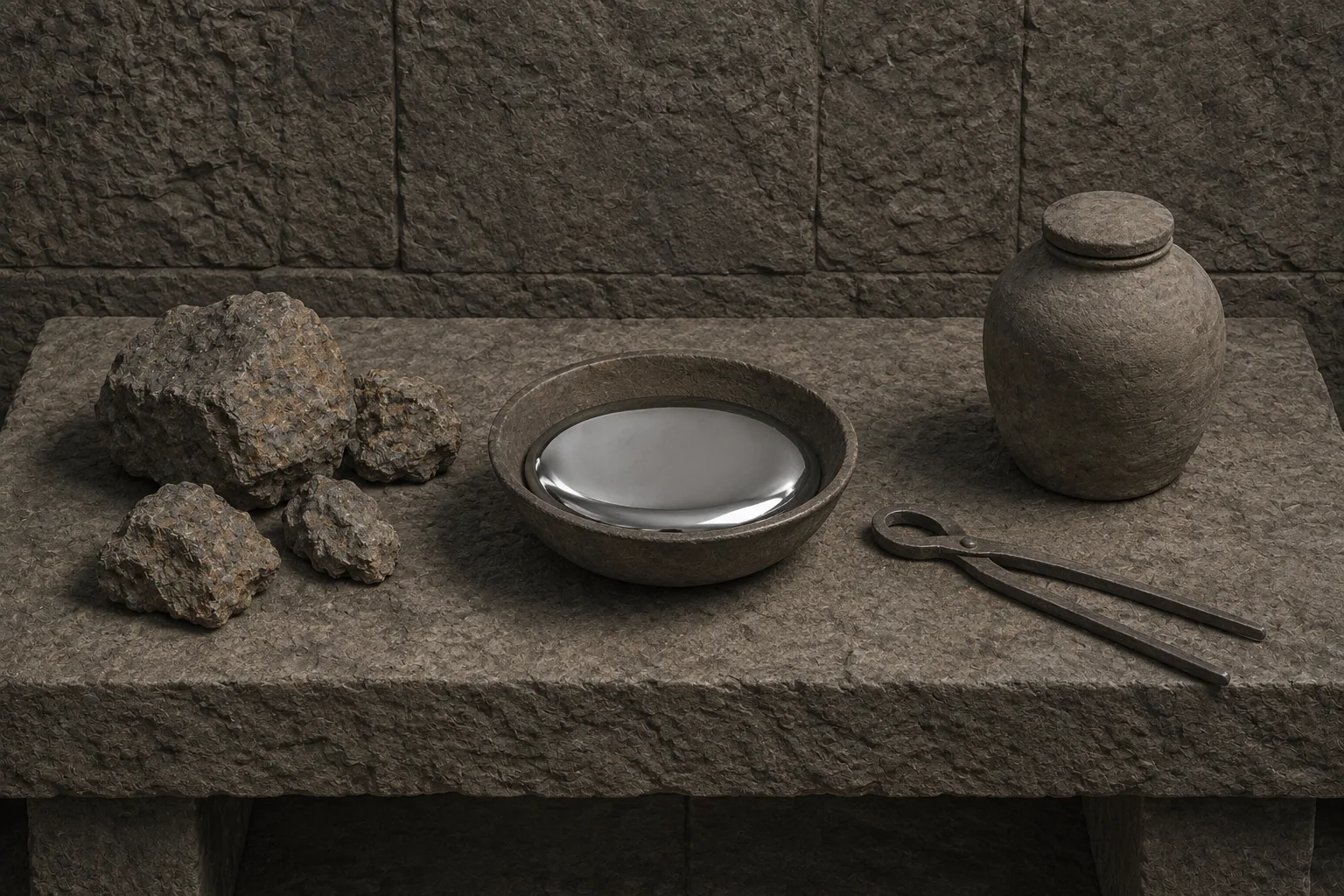
Generated illustration · the elixir that killed him: cinnabar, which is mercury sulphide · after Qin dynasty grey terracotta and low-relief carved stone
07
so I drank it. Every day, I drank it.
Cinnabar and mercury
Cinnabar is mercury sulphide. Court alchemists prescribed it as an elixir of immortality because it is brilliant in colour and does not corrode, and the emperor took it. Soil surveys of the tomb mound record mercury concentrations far above the surrounding ground, consistent with the account of mercury rivers sealed inside.
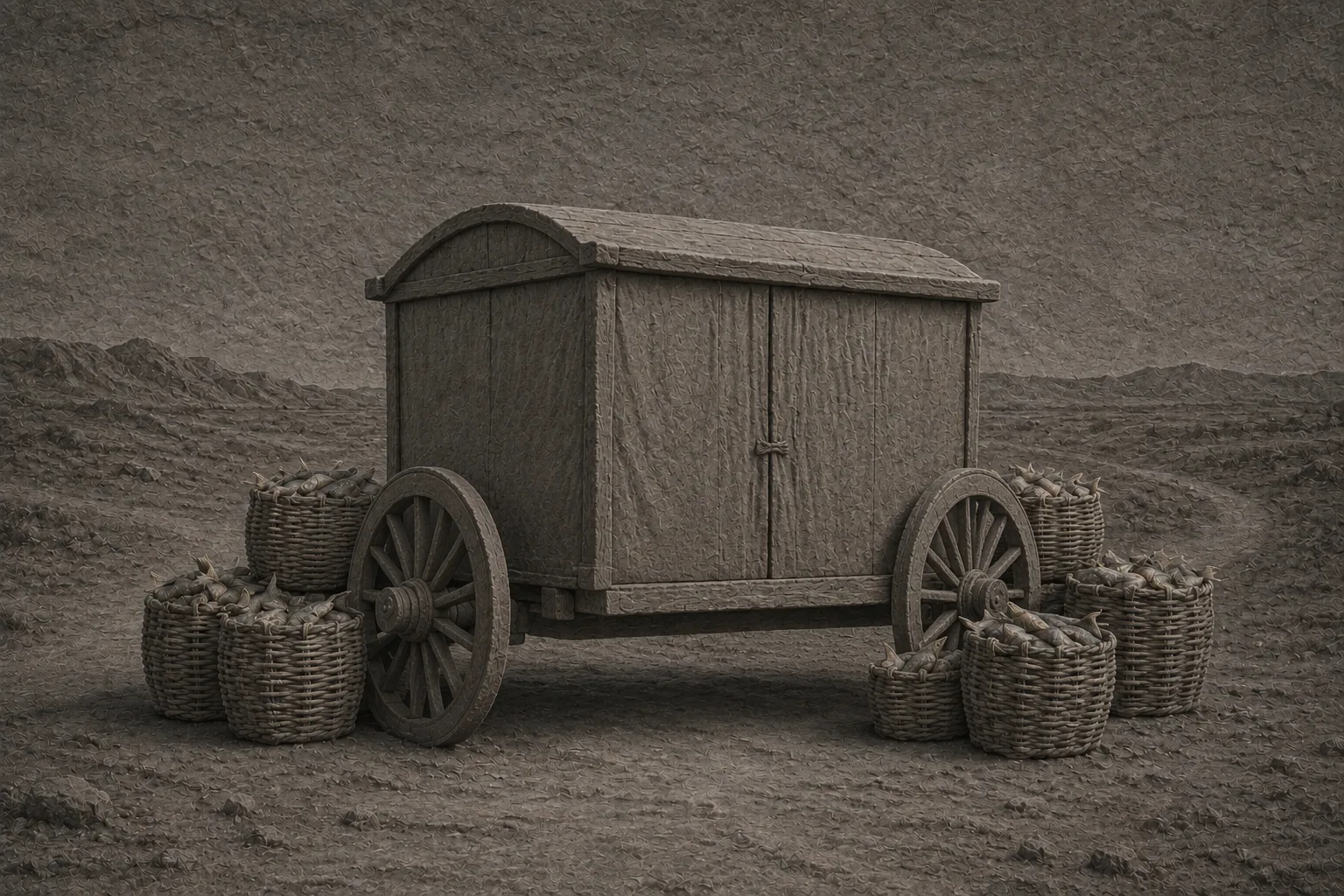
Generated illustration · Shaqiu, 210 BCE, and a death concealed for the journey home · after Qin dynasty grey terracotta and low-relief carved stone
08
Salted fish and a sealed cart.
The death of Qin Shi Huang, 210 BCE
The emperor died at Shaqiu, on the road, aged forty-nine. His death was concealed for the journey back to the capital while the succession was settled: the carriage was kept curtained and packed with fish so that the smell could be accounted for. The dynasty fell four years later.
04
Han, 206 BCE – 220 CE
Words 83 lines
Two hundred and six BC.
On the other side of the world, Rome is doing the same thing.
Neither one of them knows the other one exists.
Not yet.
Wu wants an ally on the far side of the sand,
somebody who hates the Xiongnu enough to take my hand.
Hundred men, one staff, one direction, due west.
Made it two hundred miles before the horsemen made the arrest.
Ten years a prisoner. Ten years. Took a wife.
Had a son in the enemy camp, built an actual life.
Never let go of the staff. Yak tail rotted to the bone,
still the emperor's word in my fist, so I'm never alone.
Slipped the guard in year ten, and I could have turned east,
gone home a hero with a story, sat down, had a feast.
Went west instead. Ferghana. Bactria. Sogdian towns
where they weighed my silk like it was moonlight and they wrote the number down.
Thirteen years gone. Two of us left alive.
Emperor thought I was buried. I said: there's a world out there. It's wide.
No ally. I failed the mission I was sent out to complete.
But I drew the road.
And the road is what they eat.
Road runs both ways, road runs both ways,
silk going out and the gold coming in.
Road runs both ways, road runs both ways,
nobody told the road what it's carrying in.
Worm eats a mulberry leaf, spins a thread with no end,
boil it, reel it, weave it, now an emperor's got something to send.
Death sentence to take an egg past the border, that's the law,
'cause the secret is the product and the product is the draw.
Rome thinks it grows on trees. Rome is losing its mind.
Senators writing angry letters about the gold they can't find.
Pliny doing the maths, saying we bleed out west to east.
Seneca says it's indecent, says the cloth don't cover the beast.
Meanwhile what's coming home? Grapes. Alfalfa. Glass.
Horses out of Ferghana that sweat blood and never get passed.
Wu went to war for those horses. Two campaigns. Thousands dead.
Over a stallion. Heavenly horses. Get it through your head,
we killed for the animal that could outrun the steppe.
And something walked in behind the caravans and crept,
a monk with a quiet idea about suffering and release.
Buddhism came in on a camel.
And it never left.
Road runs both ways, road runs both ways,
silk going out and the gold coming in.
Road runs both ways, road runs both ways,
nobody told the road what it's carrying in.
Sima Qian defended a general who surrendered.
Emperor gave him a choice. Die, or be cut.
Any man with honour picks death. Everyone knew that.
He picked the knife.
Lived twenty more years in a body they had unmade,
and finished the book.
Half a million characters. Every dynasty before him,
every traitor, every fool, every emperor's bad night.
He said a man dies once, and the death can weigh like a mountain
or it can weigh like a feather.
He chose the mountain.
Somebody always has to write it down.
And it is never free.
Four hundred years, and what they left me was a word.
Not a wall, not a tomb, not a road. One syllable. Hàn.
It's in my language. Hànyǔ.
It's in the letters on my grandmother's envelope. Hànzì.
A billion people carry it around like a surname
and most of them never once think about a desert,
or a rotting staff, or a worm.
That's what winning actually looks like.
When the name stops feeling like a name
and starts feeling like the air.
Teacher asked me where I'm from. I said here.
She said no, where are you really from.
And for the first time in my life
I had an answer with a date on it.
Two hundred and six BC.
Same century as Rome. Same size. Same weight.
We just didn't fall the same way.
Then the salt gets taxed and the rivers get high,
Yellow Turbans in the wheat with a rag round the eye,
eunuchs in the palace and the generals at the door,
and the four hundred year house comes down in a civil war.
Road's still open though.
Road's always open.
Road don't care whose name is on the throne.
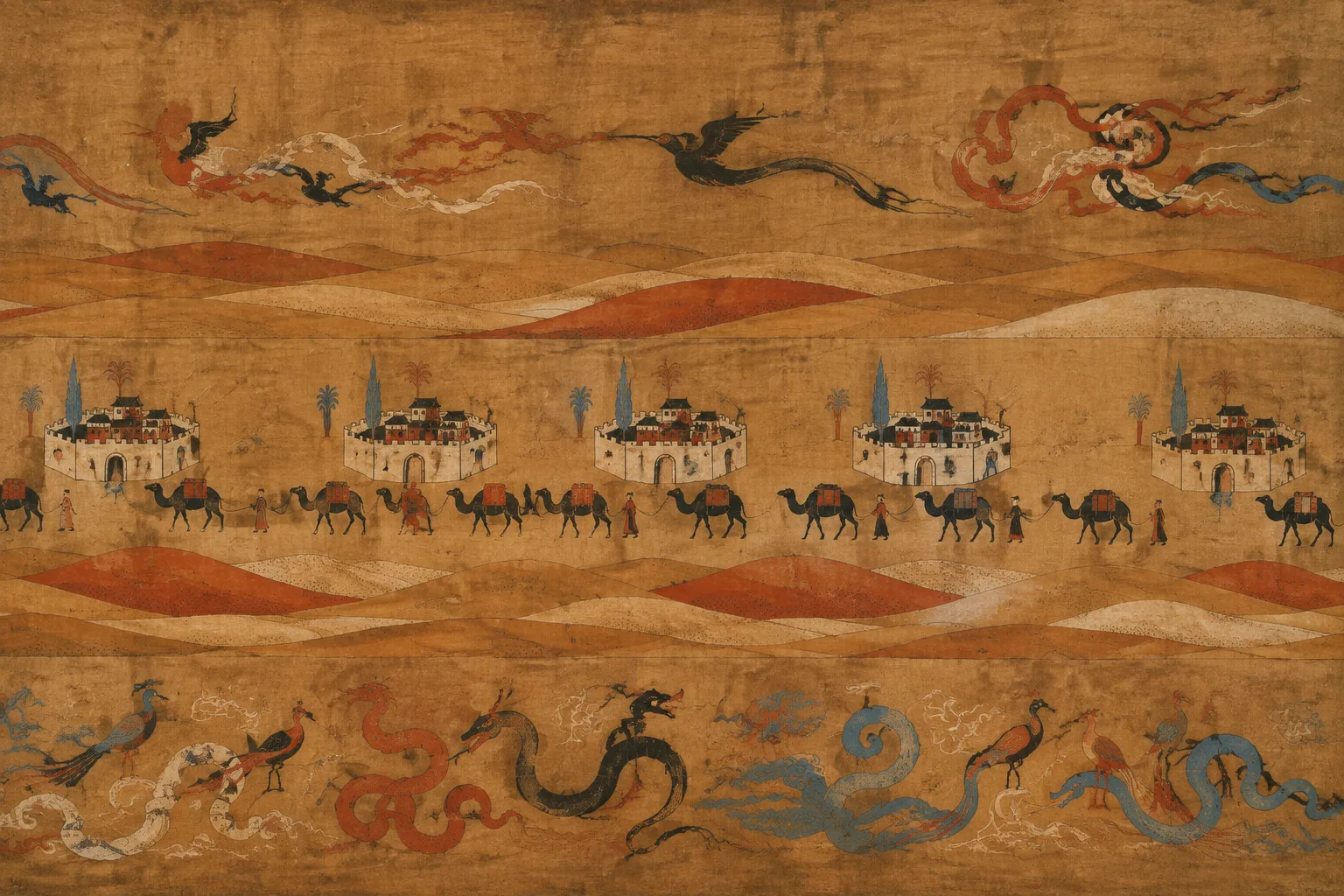
Generated illustration · Zhang Qian’s route west, c.126 BCE — the mission that failed usefully · after a Han dynasty painted silk funerary banner
01
But I drew the road. And the road is what they eat.
Zhang Qian’s embassy, from 138 BCE
Zhang Qian was sent west to seek an ally against the Xiongnu. He found none. What he brought back was a description of the states, routes and markets beyond the desert, and Han policy in the region was built on it. The term Silk Road was coined by the German geographer Ferdinand von Richthofen in 1877.
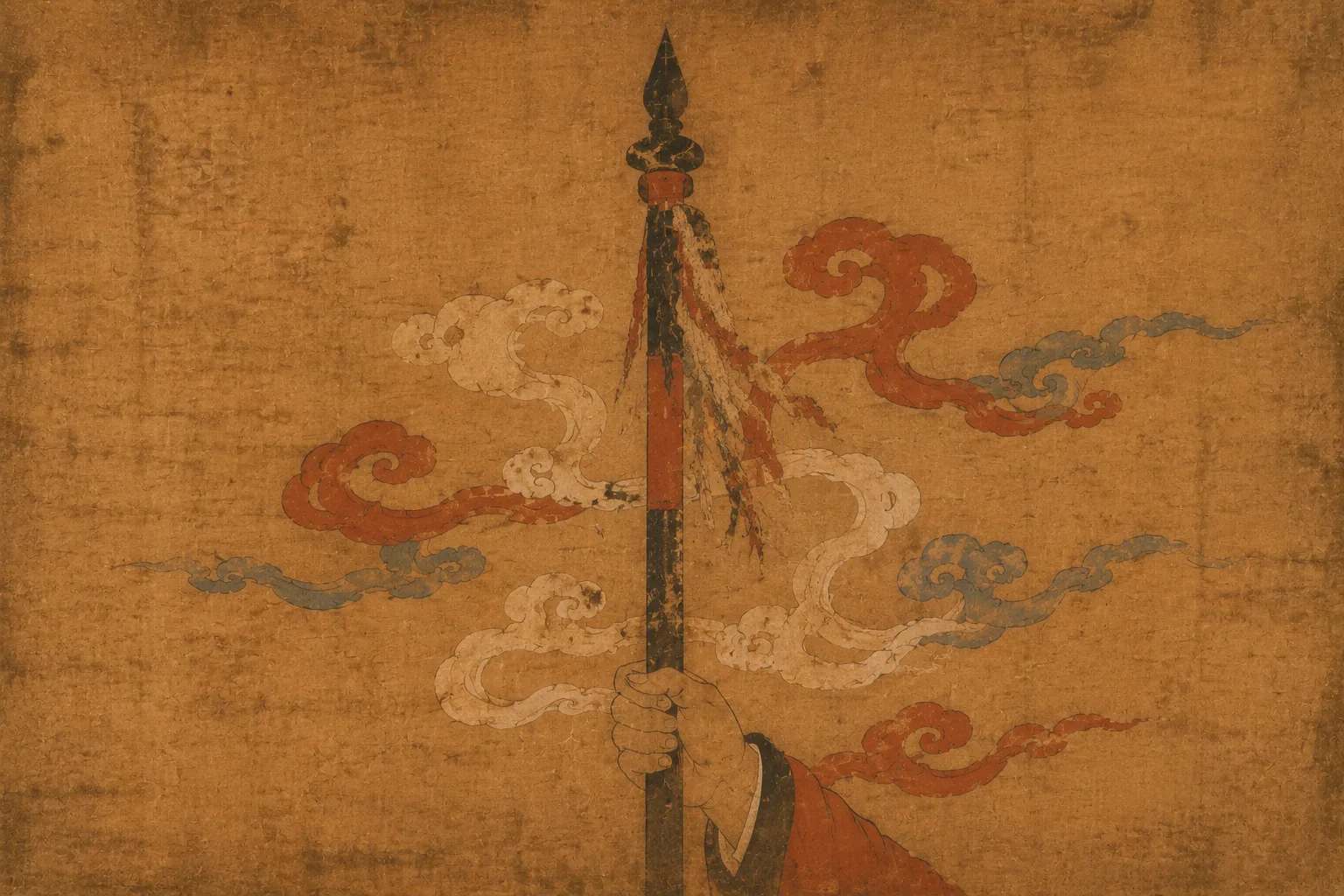
Generated illustration · an envoy’s credential, and Su Wu’s nineteen years of refusing to defect · after a Han dynasty painted silk funerary banner
02
Never let go of the staff. Yak tail rotted to the bone,
The envoy’s staff
An envoy carried a staff as his credential, standing for the emperor’s authority in physical form. The staff with the rotted yak-tail belongs to Su Wu, held by the Xiongnu for nineteen years from 100 BCE, who refused to defect and kept it until it fell apart. Su Wu and Zhang Qian were two different men; the song gives them one voice.
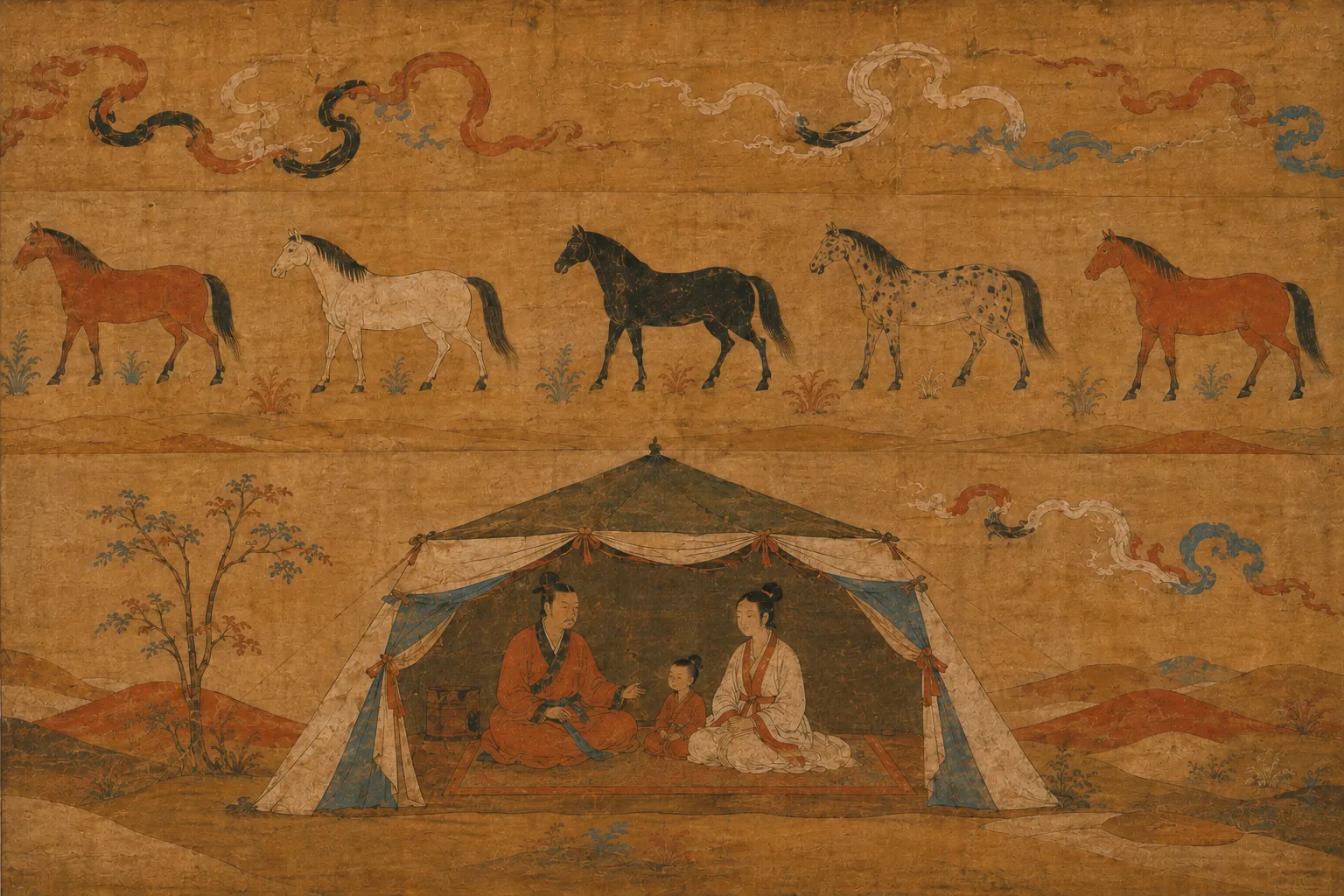
Generated illustration · a Han envoy’s decade as a Xiongnu prisoner, with a wife and a son · after a Han dynasty painted silk funerary banner
03
Ten years a prisoner. Ten years. Took a wife.
Captivity among the Xiongnu
Zhang Qian was captured within months of setting out and held for about a decade. He married, had a son, and was trusted enough to move freely. When he escaped he continued west rather than returning home, taking his wife and his Xiongnu guide with him. He reached the capital thirteen years after leaving it, with two survivors.
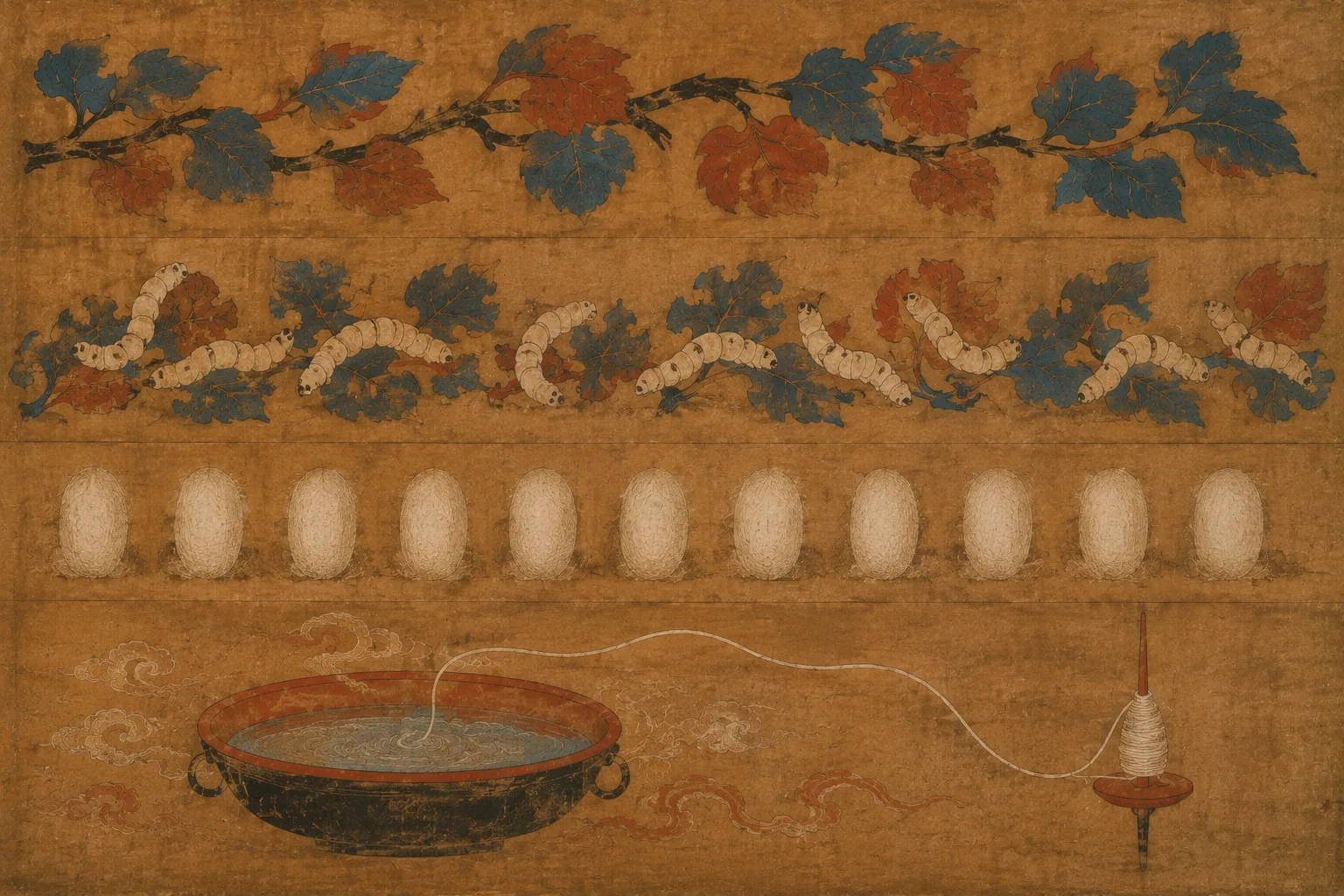
Generated illustration · sericulture: one cocoon, one unbroken filament, a capital secret · after a Han dynasty painted silk funerary banner · foliage stylised
04
Worm eats a mulberry leaf, spins a thread with no end,
Sericulture
The domesticated silkworm feeds only on mulberry. Each cocoon is a single continuous filament, up to a kilometre long, which is unwound in hot water rather than spun, and this is what gives the cloth its properties. Removing eggs or the method from Han territory was a capital offence.
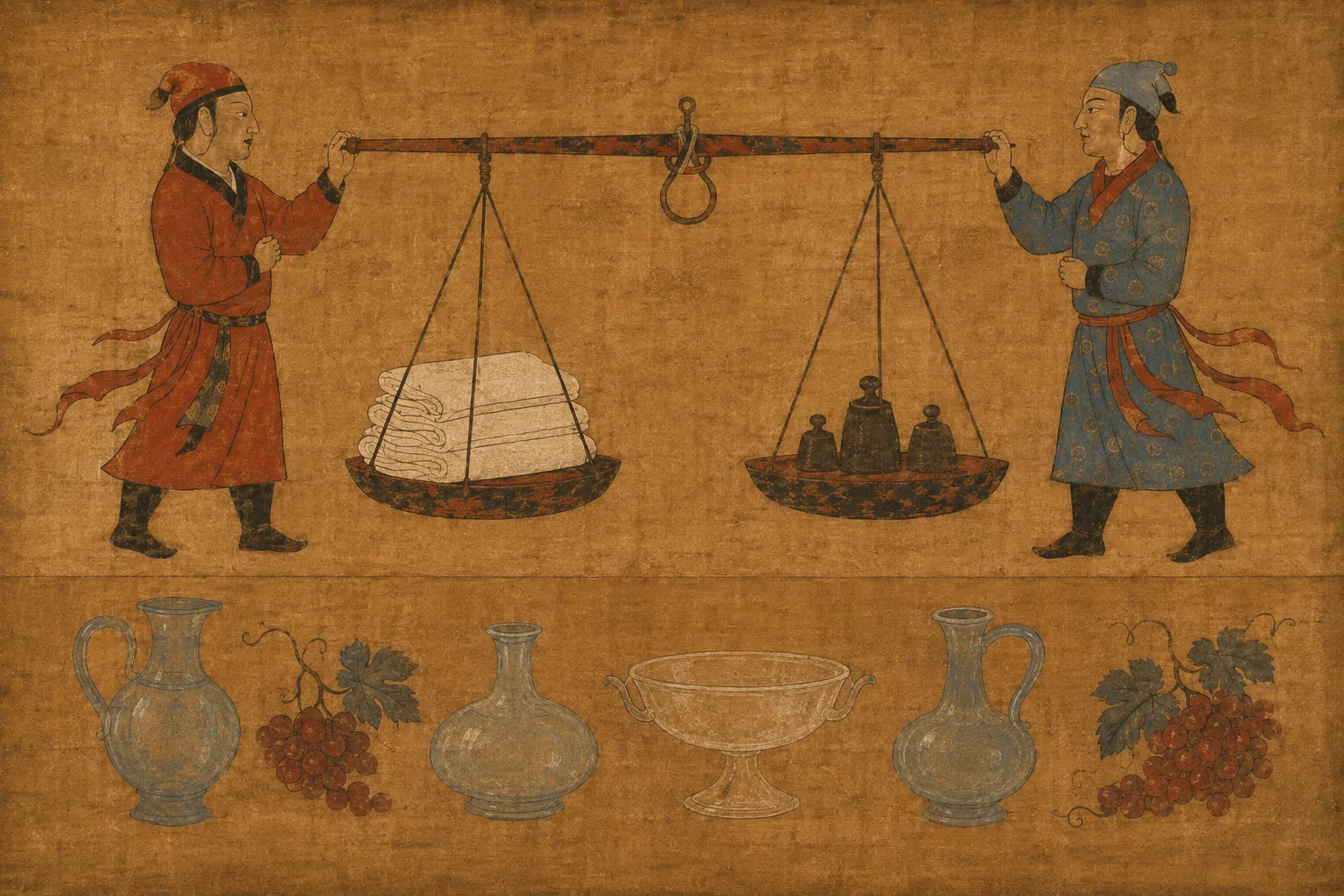
Generated illustration · silk traded by weight, and Rome complaining about the bill · after a Han dynasty painted silk funerary banner
05
where they weighed my silk like it was moonlight and they wrote the number down
Silk as currency
The Han paid officials and frontier garrisons in bolts of silk, and along the trade routes it was weighed like bullion. Roman writers recorded the cost of importing it: Pliny put the outflow east at a hundred million sesterces a year. Goods travelling the other way included glass, grapes and alfalfa.
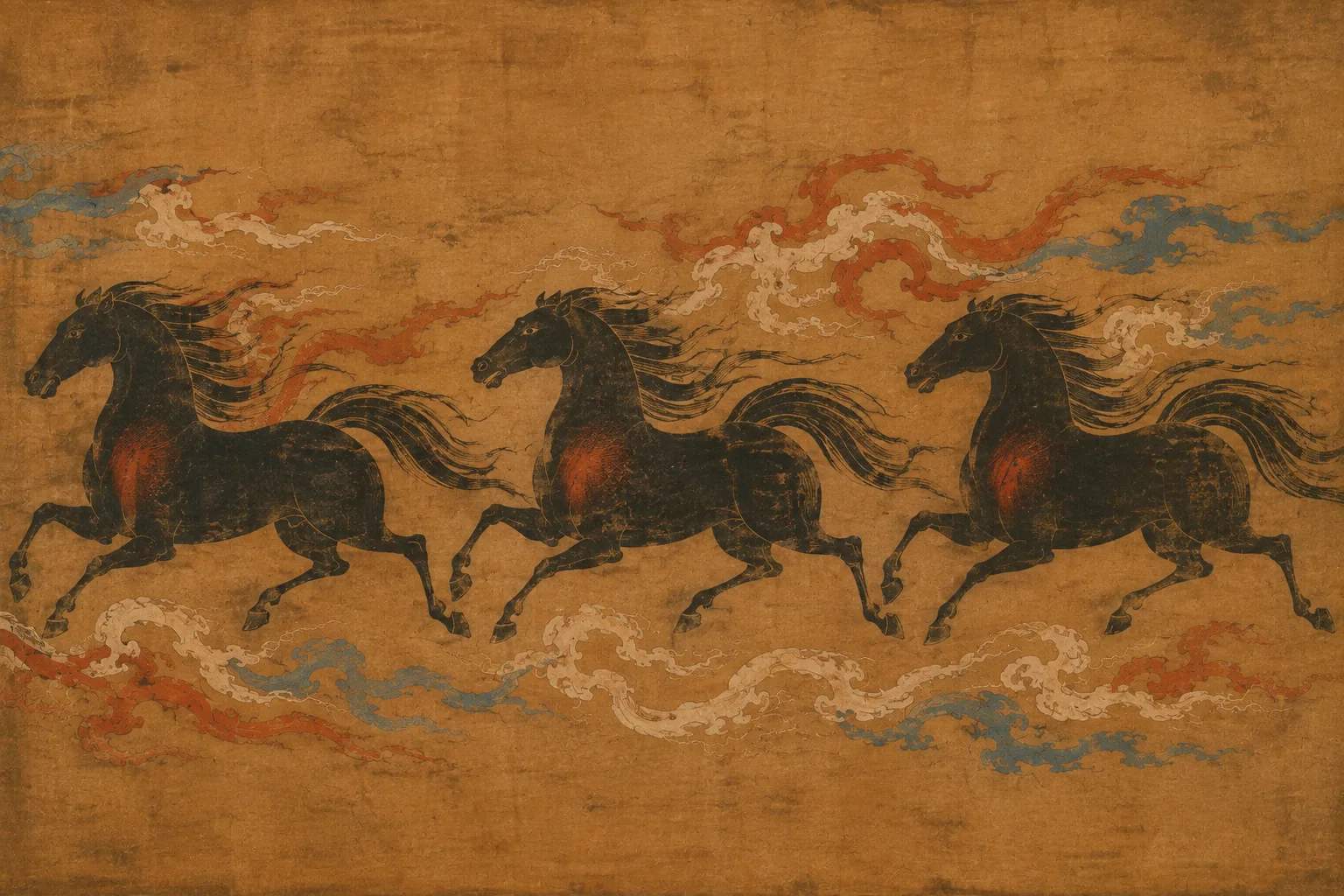
Generated illustration · the Ferghana horses Emperor Wu sent two armies to buy · after a Han dynasty painted silk funerary banner
06
we killed for the animal that could outrun the steppe.
The Ferghana horses
The horses of Ferghana were larger and faster than those bred in Han territory, and were reported to sweat blood, probably owing to a parasite that causes bleeding under the skin. Emperor Wu asked to buy them, was refused, and sent two armies. The second, around 101 BCE, returned with a few dozen animals.
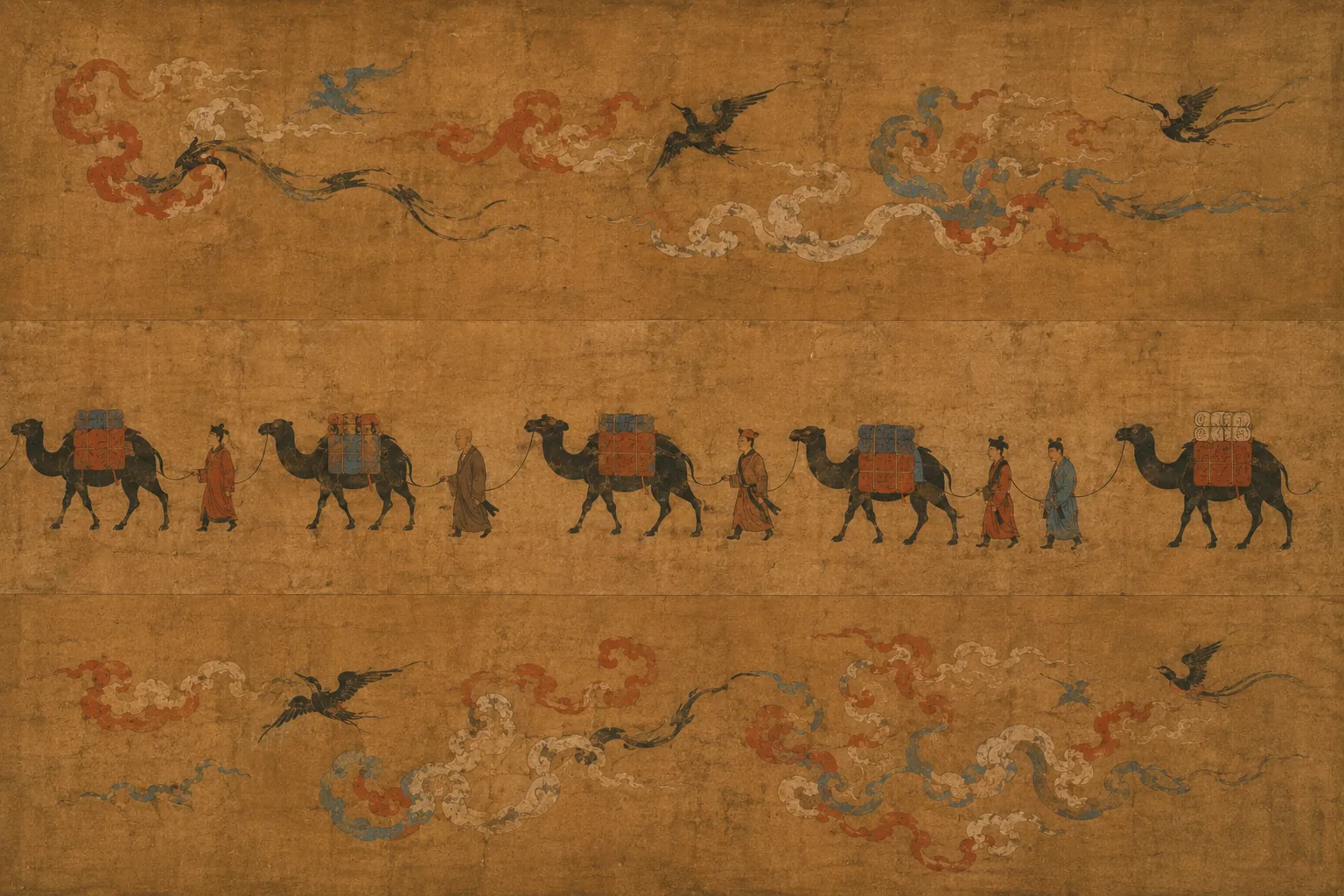
Generated illustration · Buddhism arriving as cargo among cargo, first and second centuries CE · after a Han dynasty painted silk funerary banner
07
Buddhism came in on a camel. And it never left.
Buddhism on the trade routes
Buddhism reached Han territory along the trade routes in the first and second centuries CE, carried by merchants before monks and by monks before the state took an interest. It arrived as one cargo among others, and outlasted every later attempt to suppress it.
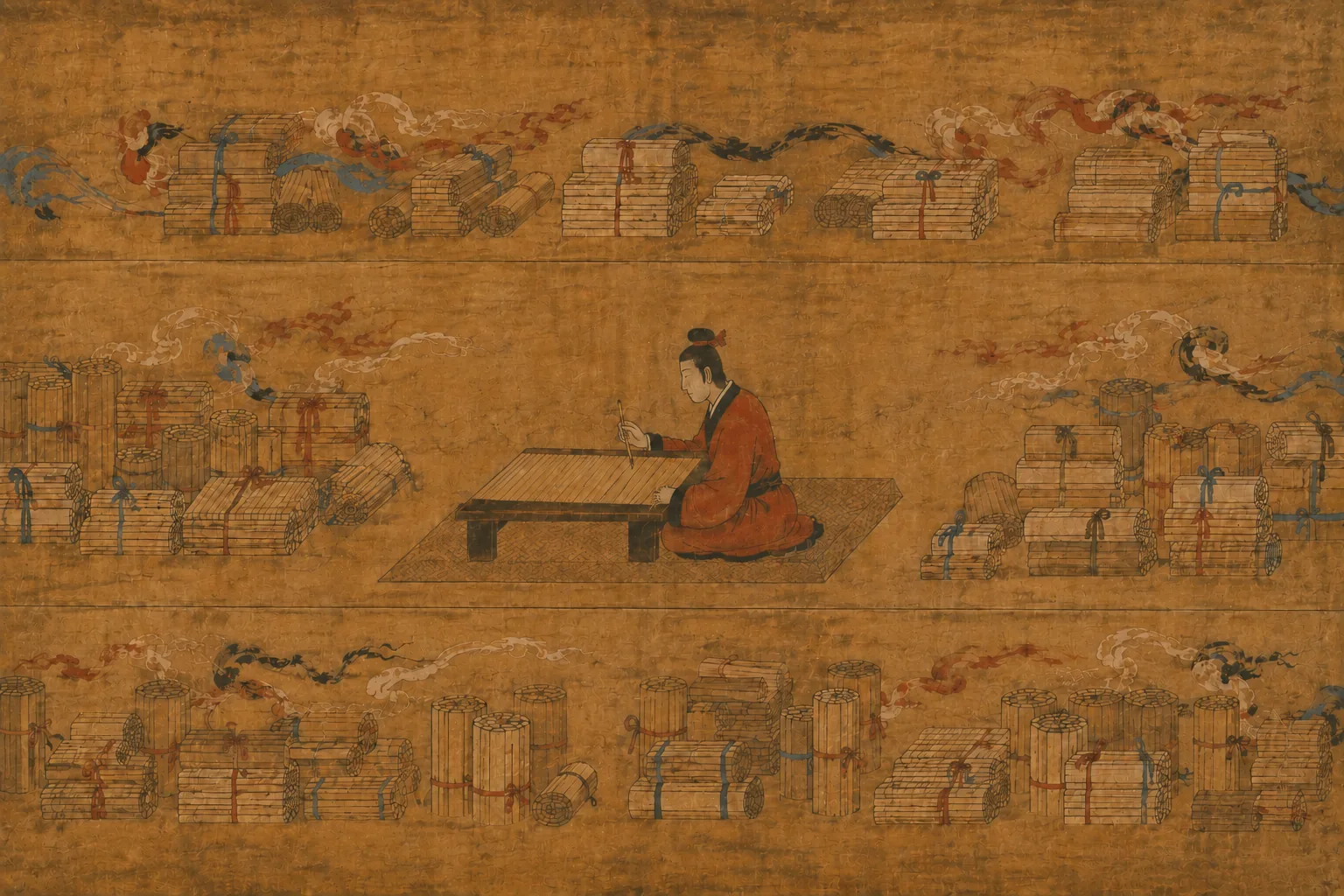
Generated illustration · Sima Qian finishing the Shiji after choosing mutilation over death · after a Han dynasty painted silk funerary banner
08
Somebody always has to write it down. And it is never free.
Sima Qian and the Shiji
Sima Qian defended a general who had surrendered and was offered the choice of death or castration. He chose the second, which cost him his standing at court, and spent some twenty years completing the Shiji: 130 chapters and roughly half a million characters, the model followed by Chinese historians since.
05
Three Kingdoms, 220–280
Words 79 lines
We were not born on the same day.
Say it with me.
We were not born on the same day.
Peach garden. Three men. Black cow, white horse, one flame.
We were not born on the same day but we'll go out the same.
Straw sandal seller with a claim to the imperial line,
butcher with a beard down his chest, and a red-faced man with a blade like mine.
Han's coming apart at the seams, eunuchs running the throne,
so we swore on the fruit trees, and none of us went home.
Understand what an oath was worth in a house with no floor.
When the mandate goes quiet, a promise is the only law.
Not a contract. Not a wage. Nobody's writing it down.
Just three men in the blossom saying I'll die for you now.
And the thing about that word, brother, it don't have an exit,
so when one of us goes, the other two follow. That's the text. That's the debt.
Same day, same hour, same breath, same ground.
Didn't ask to be born together, gonna go out bound.
Oh, and the blossom keeps falling on the garden floor.
Loyalty don't ask you what it's costing you for.
Cute. Real cute. Three men and a tree.
I had a hundred thousand men and the emperor sat with me.
I don't do brothers. I do results. I do grain in the field,
I do surrendered generals promoted, I do wounds that actually heal.
Killed my father's friend and his whole house on a sound in the dark,
he was slaughtering a pig for my dinner. I heard steel. Left my mark.
Man said I'd made a mistake. He was right. Didn't matter.
I'd rather betray the world than let the world betray the latter.
Wrote poetry too, by the way. Short Song Style. Look it up.
Talked about crows circling, finding nowhere to land, and the cup.
Your Guan Yu? Captured him once. Fed him. Gave him a horse.
Let him ride back to your beggar king. That's a kindness, not remorse.
When they sent me his head in a box, I gave it a lord's grave.
'Cause I understood the man. I just never needed to be saved.
You built a kingdom on feelings. I built one on the ground.
Mine had the north, the men, the wheat.
Guess which one's still around.
Same day, same hour, same breath, same ground.
Didn't ask to be born together, gonna go out bound.
Oh, and the blossom keeps falling on the garden floor.
Loyalty don't ask you what it's costing you for.
Red Cliffs. Two against the north and the north's got the numbers.
Chained his ships together so the northern boys don't get seasick, and then summer
wind turns southeast for one night in the middle of a cold December,
fire boats in the dark, and that's the night the whole map remembers.
Zhuge Liang comes down from the hills after three separate calls,
draws the empire in three on a table and puts up the walls.
For a minute it works. For a minute there's actually a throne.
Then Guan Yu gets greedy in the north and Wu takes him alone.
Head in a box. And Liu Bei, who is now technically a king,
with advisors and armies and a state and an actual ring,
looks at the map, looks at the plan, looks at the twenty-year climb,
and burns all of it down to avenge one man. In his prime.
Marched east. Lost everything at Yiling in the summer heat.
Died in a border town telling Zhuge Liang, take the seat.
Zhuge wouldn't. Zhuge served the son, who was useless, for years,
wrote the emperor a memo before marching north through the tears:
I'll give my all until my heart stops, then I'll give the rest.
Died in a camp in the mountains. Sixth campaign. Never took the west.
Zhang Fei? Beat his own men so hard for the funeral white
that they came into his tent with a knife on the second night.
All three gone. Oath complete.
Every one of them kept it.
And the family that took the empire in the end
was the one that just waited, and watched them all bleed,
and never swore a thing.
Back of my uncle's takeaway, past the fryers, by the till,
there's a little red shrine with an orange on it and a red-faced man, and I still
thought he was a cartoon. Thought he was a lucky cat with a beard.
Uncle put fresh oranges out every week for twenty years.
Coppers pray to him. Triads pray to him. Same god. Same face.
Half of Asia's got him standing in a doorway holding the place.
Nobody deified the ones who won. Sima's not on a wall.
They made a god out of the man who lost his head. That's all.
And I get it now, standing there with the fryers going and the extractor loud.
You don't build a temple to the smartest.
You build it to the one who wouldn't move.
Not the same day.
Not the same day.
Not the same day.
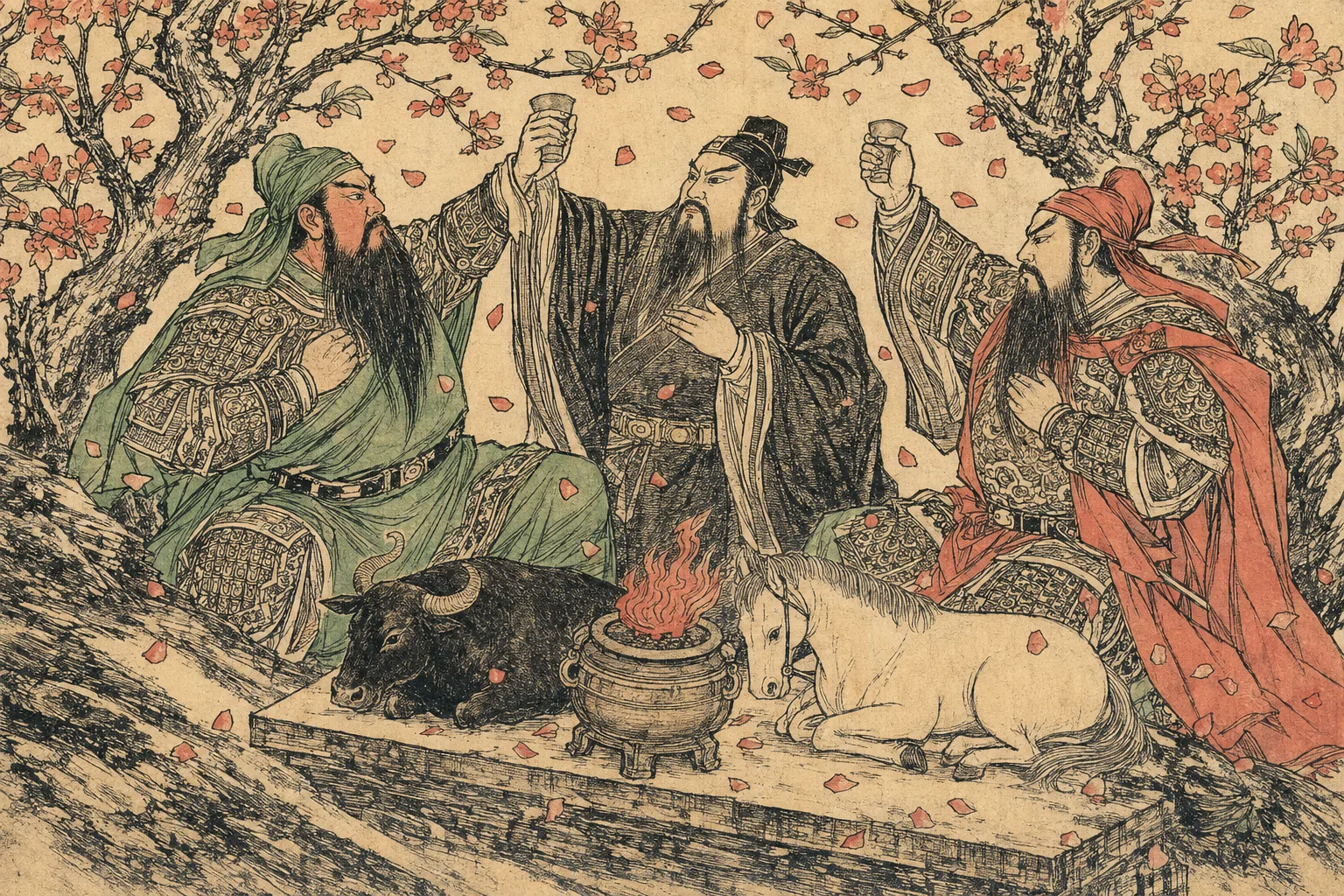
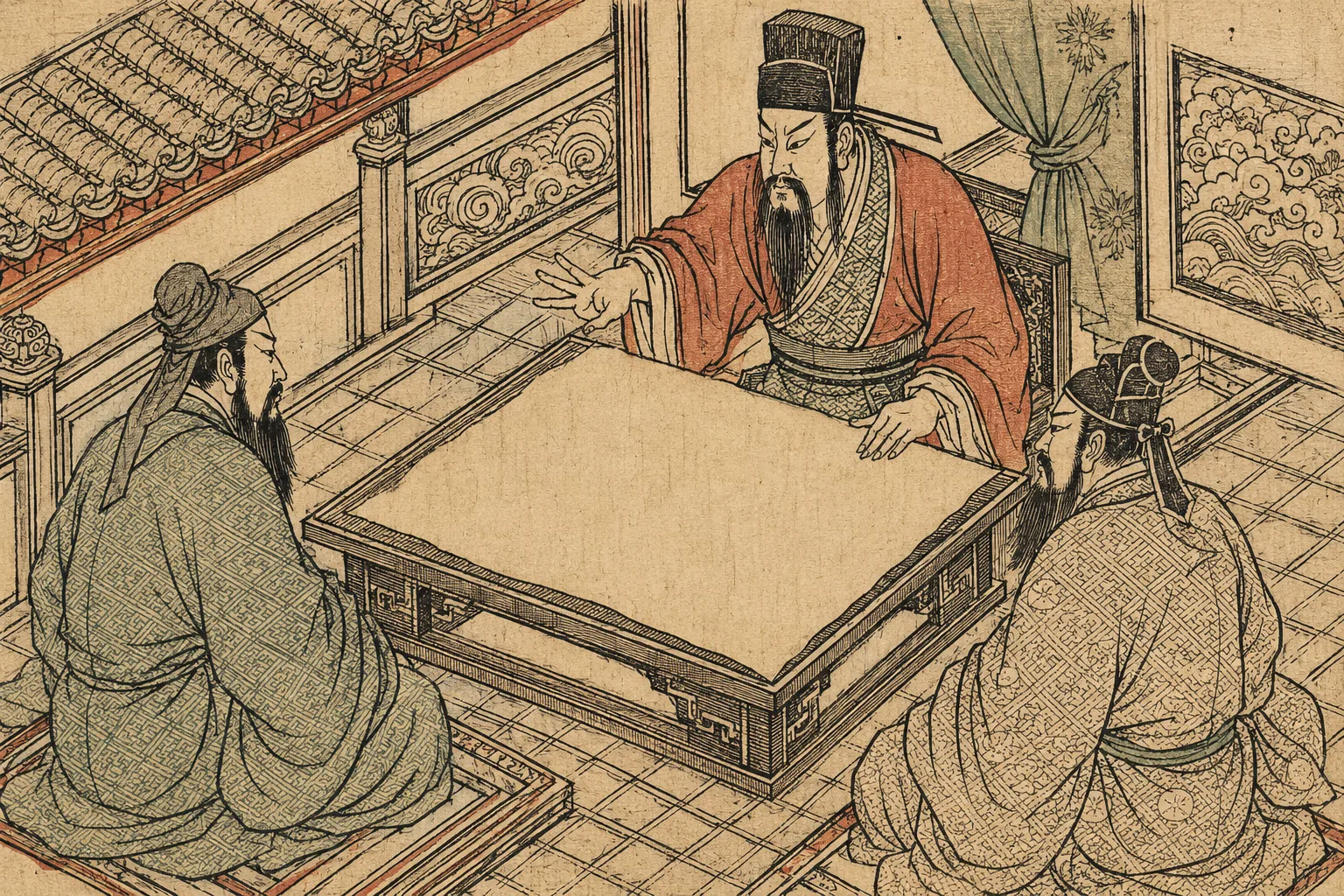
Generated illustration · the oath as the fourteenth-century novel tells it, not the record · after a Ming dynasty woodblock print illustration · style later than the subject
01
Peach garden. Three men. Black cow, white horse, one flame.
The Peach Garden Oath: fiction
The alliance was real: three men who fought together as the Han dynasty came apart. The oath in the peach garden is not. It comes from Romance of the Three Kingdoms, a novel written around 1400, more than a thousand years after the events. This room is drawn in the style of the book rather than of the period.
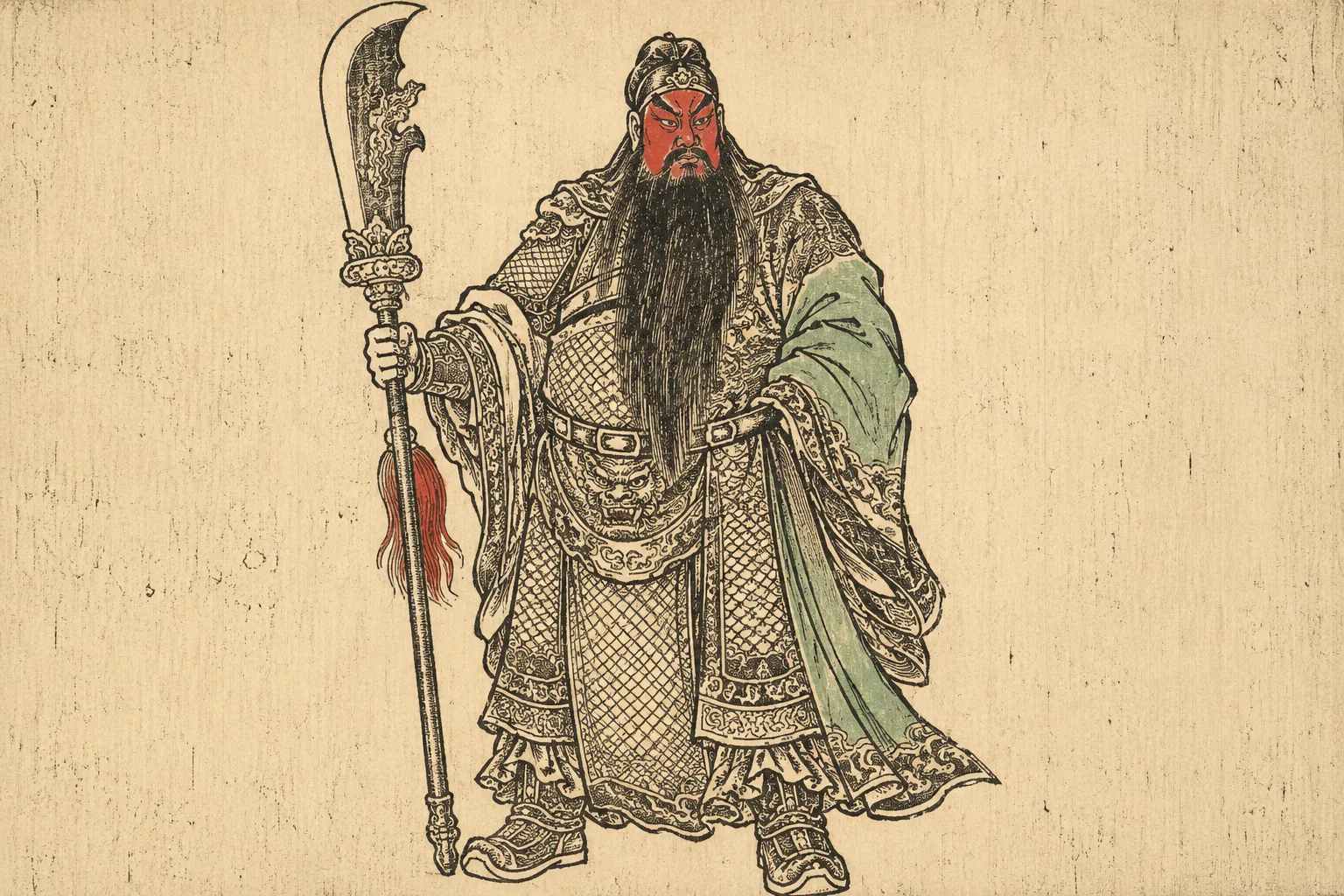
Generated illustration · Guan Yu, whose red face is opera make-up rather than description · after a Ming dynasty woodblock print illustration
02
and a red-faced man with a blade like mine.
Guan Yu, died 220
Guan Yu was a general in the service of Liu Bei. The red face is not a description of his appearance but stage make-up: in Chinese opera convention red signifies loyalty and courage, and it was applied to him centuries after his death. He is now among the most widely recognised figures in Chinese culture.
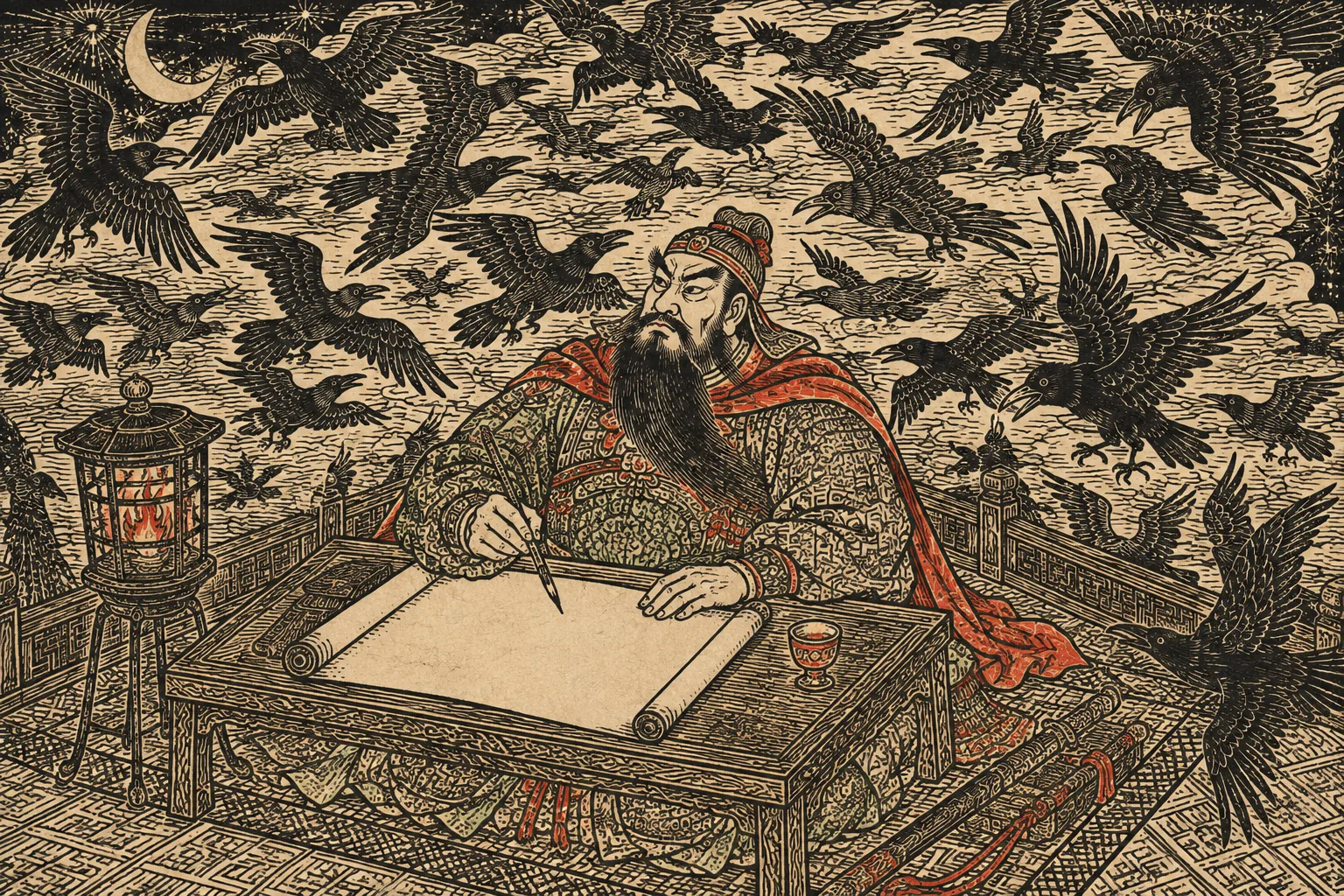
Generated illustration · Cao Cao, warlord of the north and a major poet of his century · after a Ming dynasty woodblock print illustration
03
Talked about crows circling, finding nowhere to land, and the cup.
Cao Cao, 155 to 220
Cao Cao held the north, its grain and the Han emperor, and the novel cast him as the villain of the age. He was also one of the significant poets of his century. His Short Song Style, with its cup of wine and its crows crossing a bright moon and finding nowhere to land, is still anthologised.
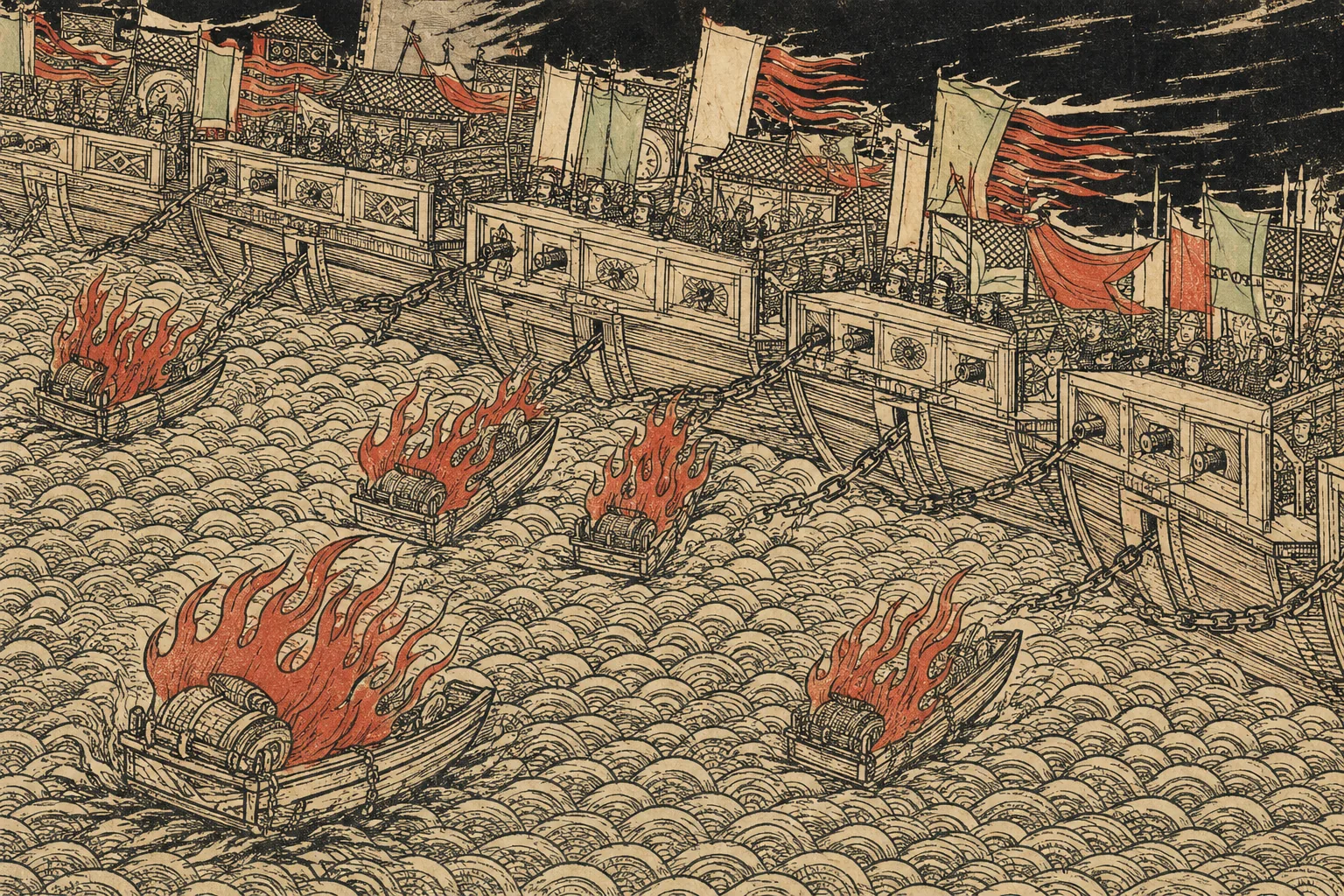
Generated illustration · Red Cliffs, 208: fire on the Yangtze, and the north stopped · after a Ming dynasty woodblock print illustration
04
Chained his ships together so the northern boys don’t get seasick
Red Cliffs, 208
A much smaller southern alliance defeated Cao Cao’s northern fleet on the Yangtze, using fire ships. The best-known details, including the ships chained together and the wind turning at the decisive moment, reach us through the novel and are disputed. The outcome is not: the northern advance was halted and China remained divided for some seventy years.
Generated illustration · Zhuge Liang’s plan to hold a third and outlast the rest · after a Ming dynasty woodblock print illustration
05
draws the empire in three on a table and puts up the walls.
Zhuge Liang’s strategy, c.207
The plan Zhuge Liang put to Liu Bei was not to conquer the country but to hold a third of it, ally with a second third, and outlast the north. It held for several decades. The account of his refusing to serve until asked three times comes from the novel.
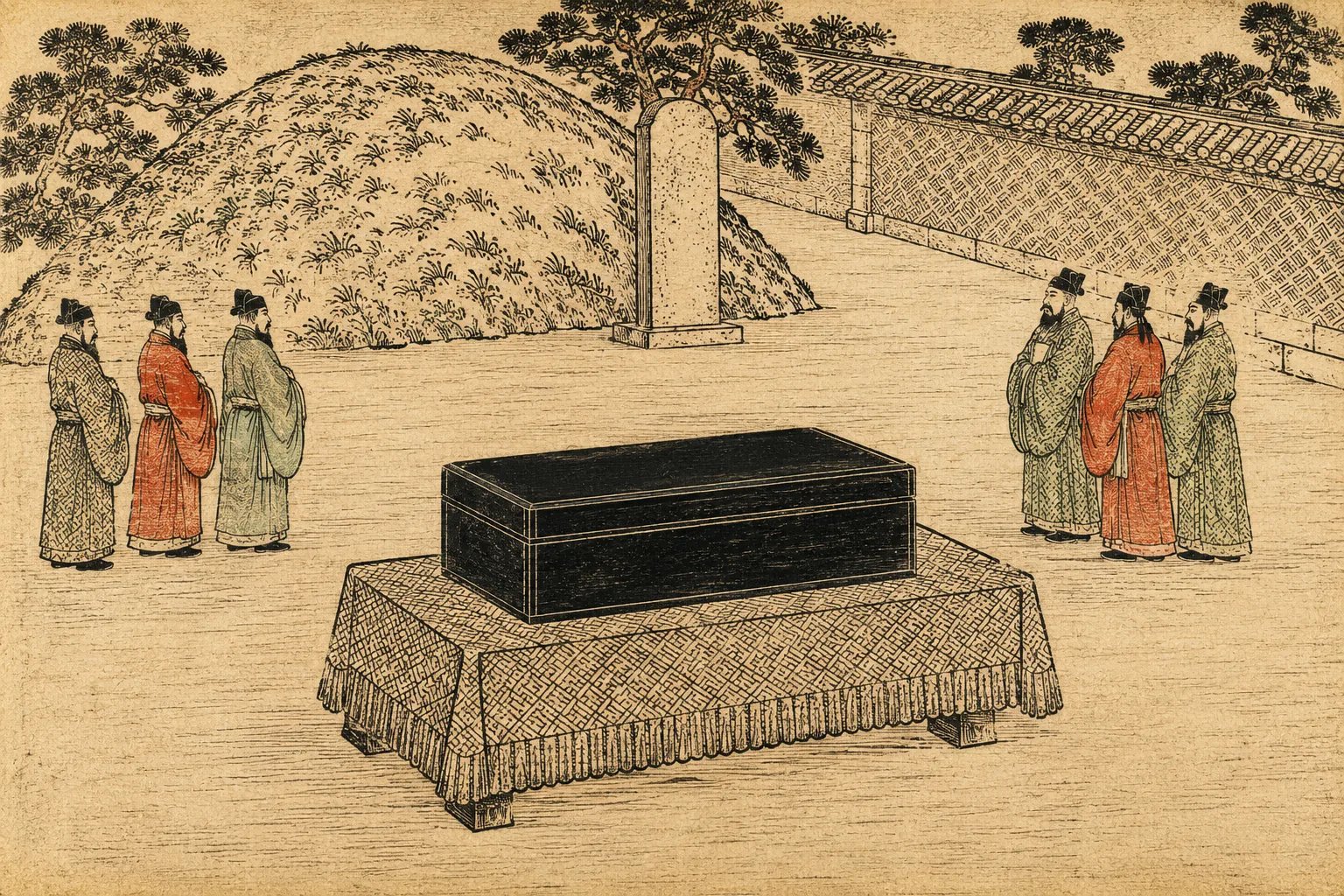
Generated illustration · Guan Yu’s head, sent north in 220 and buried with honours · after a Ming dynasty woodblock print illustration
06
When they sent me his head in a box, I gave it a lord’s grave.
The death of Guan Yu, 220
Guan Yu was captured and executed by the southern state of Wu in 220 and his head was sent north. The tradition holds that Cao Cao, his opponent for twenty years, had it buried with the rites due to a nobleman.
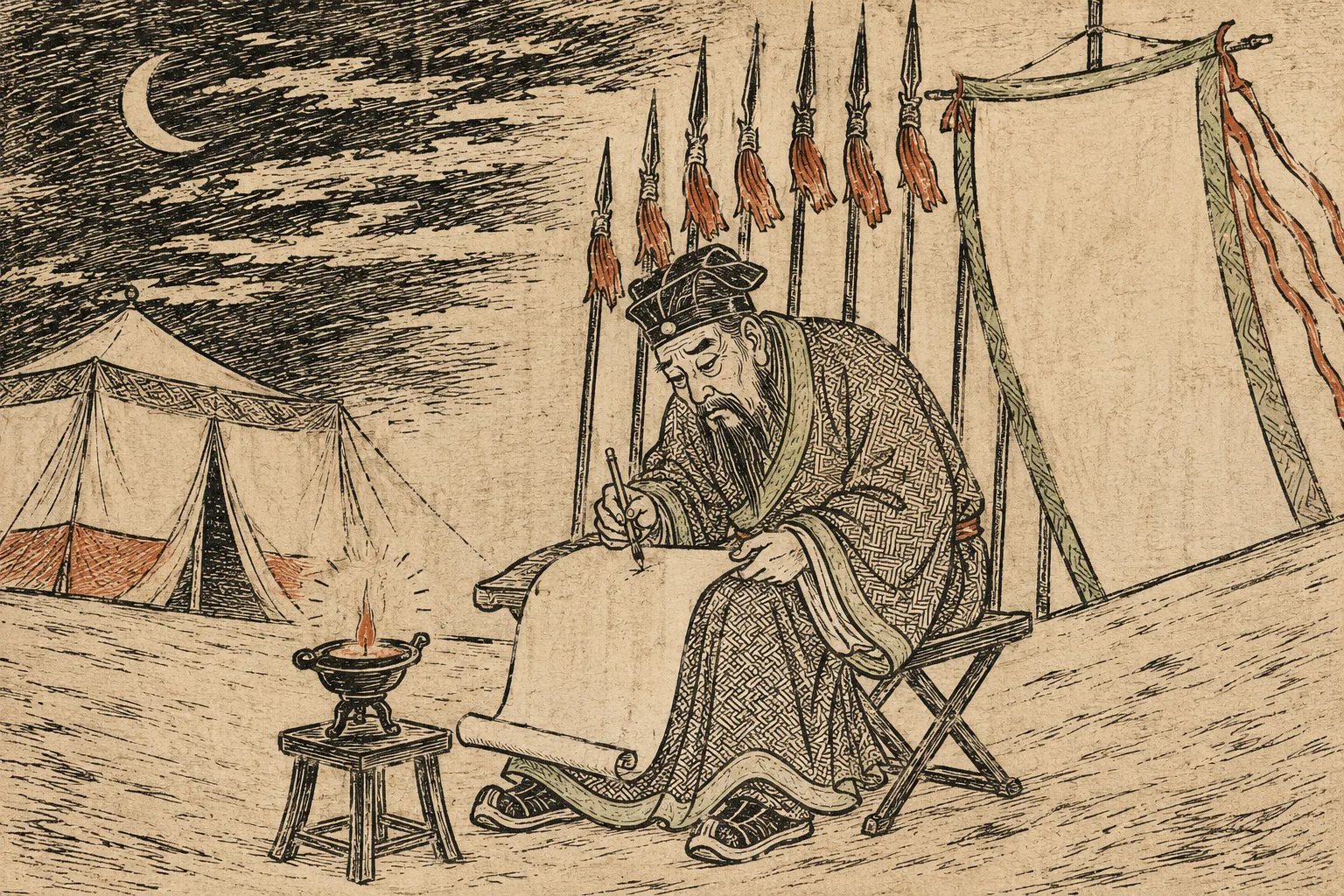
Generated illustration · the memorial of 227, still set in Chinese schools · after a Ming dynasty woodblock print illustration
07
I’ll give my all until my heart stops, then I’ll give the rest.
The Chu Shi Biao, 227
Before marching north, Zhuge Liang submitted a memorial to his ruler’s son setting out his obligations to the dead and his intentions. It is still taught in Chinese schools. He died in camp at the Wuzhang Plains in 234, during his fifth Northern Expedition, campaigning north rather than west; he was already based in the west, in Shu. The song follows the novel, which gives him six campaigns.
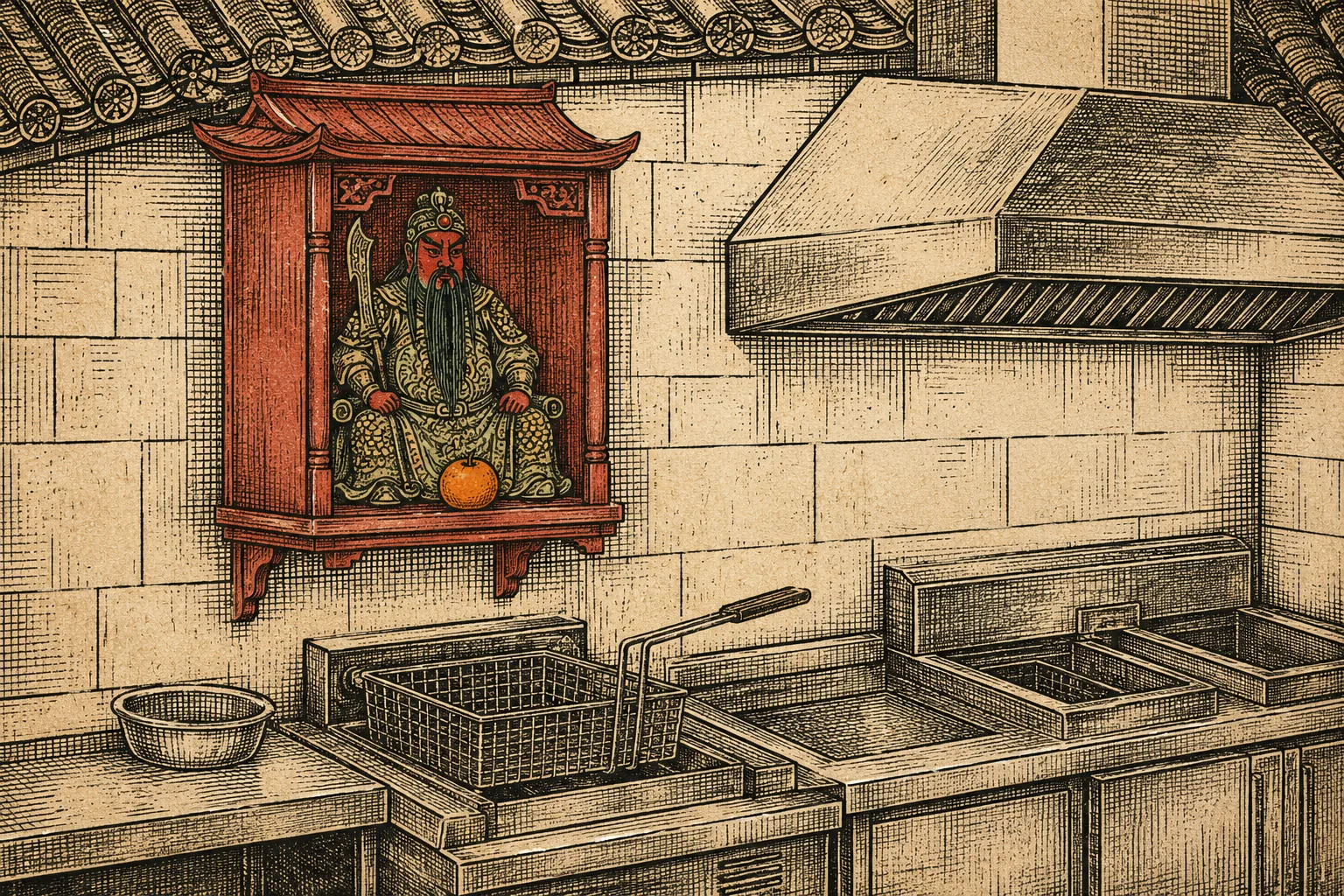
Generated illustration · the same god, eighteen centuries on, above a fryer · after a Ming dynasty woodblock print illustration · style later than the subject
08
They made a god out of the man who lost his head. That’s all.
The cult of Guan Yu
Guan Yu was deified by stages: local cult, then Daoist and Buddhist adoption, then imperial decree. He is still worshipped across East and Southeast Asia, in temples and in shops and restaurants, and by police forces and criminal organisations alike. The Sima family, which took the empire in the end, has no comparable cult.
06
Tang, 618–907
Words 75 lines
Chang'an. Seven hundred and fifty AD.
A million people inside the walls.
Biggest city on earth.
Persians in the market, Japanese monks in the temples,
Sogdian girls dancing in the wine shops on the west side.
Everybody came here.
Everybody thought it would last.
Grape wine in a jade cup, moon coming over the wall,
I don't drink alone, I drink with three: me, the shadow, and the tall
white face up there that never says a word back but never leaves,
so we dance until the shadow's a mess and the moon's up in the eaves.
Emperor called me to court. Said write me something nice.
Made me his poet, gave me silk, gave me the good rice.
I made the chief eunuch pull my boots off. Drunk. In front of the room.
Wrote three poems for his favourite in about the time it takes to bloom,
compared her to a peony, compared her to a cloud,
and they loved it, and they hated me, and they said it too loud.
Lasted two years. Gave me gold and sent me down the road.
I said fine. The mountains take me. Green water and no load.
Rivers don't need a patron. The moon don't check my rank.
I'd rather be nobody in a boat than somebody at the bank.
Raise it to the sky, raise it to the ground,
raise it to the one thing that's still here when nobody's around.
Oh, the moon, the moon, the moon.
Everybody I ever loved is looking at the same moon.
I met him once. One autumn. We drank, we walked, we climbed.
I was thirty-three, he was forty-four and already the most famous man alive.
I wrote him a dozen poems after. Wrote about his face.
Dreamed about him three nights running, wrote that down too, every trace.
He wrote me back once. Maybe. That's the whole exchange.
And I don't say that bitter. I say it 'cause it's strange
how you can love a man's mind so hard it becomes your own weather
and he barely notices, and you carry both of you together.
Failed the exam. Twice. Failed it in a rigged year
where the minister passed nobody and called it a success. Sincere.
Took a job storing weapons. Went home. My son was dead.
Starved, in a house with a scholar's name on it. Not enough bread.
I wrote it down. Didn't dress it. Just the fact and the room.
That's my whole method: the small thing, in the actual gloom.
He wrote the moon.
I wrote the man underneath it.
Now the emperor's sixty and in love and he's stopped reading the reports.
Yang Guifei's cousin runs the state. Lychees ride post horses from the southern ports,
riders killing animals to get fruit to a woman while it's cold.
And out on the northeast frontier there's a general getting bold,
half-Sogdian, half-Turk, enormous, funny, danced for her at court,
she adopted him as a son. Made a joke of it. Good sport.
Hundred and sixty thousand men. December. He moves.
Luoyang falls in a month. Chang'an falls in a year.
Emperor runs for Sichuan in the dark with the household in the rear,
and at Mawei post station the guard stops and will not walk.
Say the woman has to die. And the emperor doesn't talk.
They strangle her with a silk cord in a Buddhist chapel by the road.
Seventy-one years old, he watched it, then got back on and rode.
Li Bai backed the wrong prince. Exiled. Pardoned halfway.
Died a couple of years later. The story people say
is he leaned out of a boat to hold the moon on the water's face
and went in. Probably wasn't that. Probably just the drink and the place.
But nobody wants the real one, and I don't blame them, and I'd lie too.
Du Fu died on a boat. Broke. In the rain. Alone. Age fifty-nine.
Wrote the greatest poem in the language about a wrecked house in the wind.
The census before: fifty-two million.
The census after: seventeen.
That is not a war statistic. That's a hole in the world.
Dynasty limped on a hundred and fifty more years
but it never had a capital that meant anything again.
My grandmother knew four hundred of these by heart.
Couldn't read a bus timetable in English. Knew four hundred poems.
Taught me one. The short one. Everybody knows the short one.
Moonlight at the foot of the bed, looks like frost on the ground,
lift your head to the moon, lower your head, think of home.
Twenty characters. A thousand two hundred years.
And I can still only say it in her accent.
Not mine.
Hers.
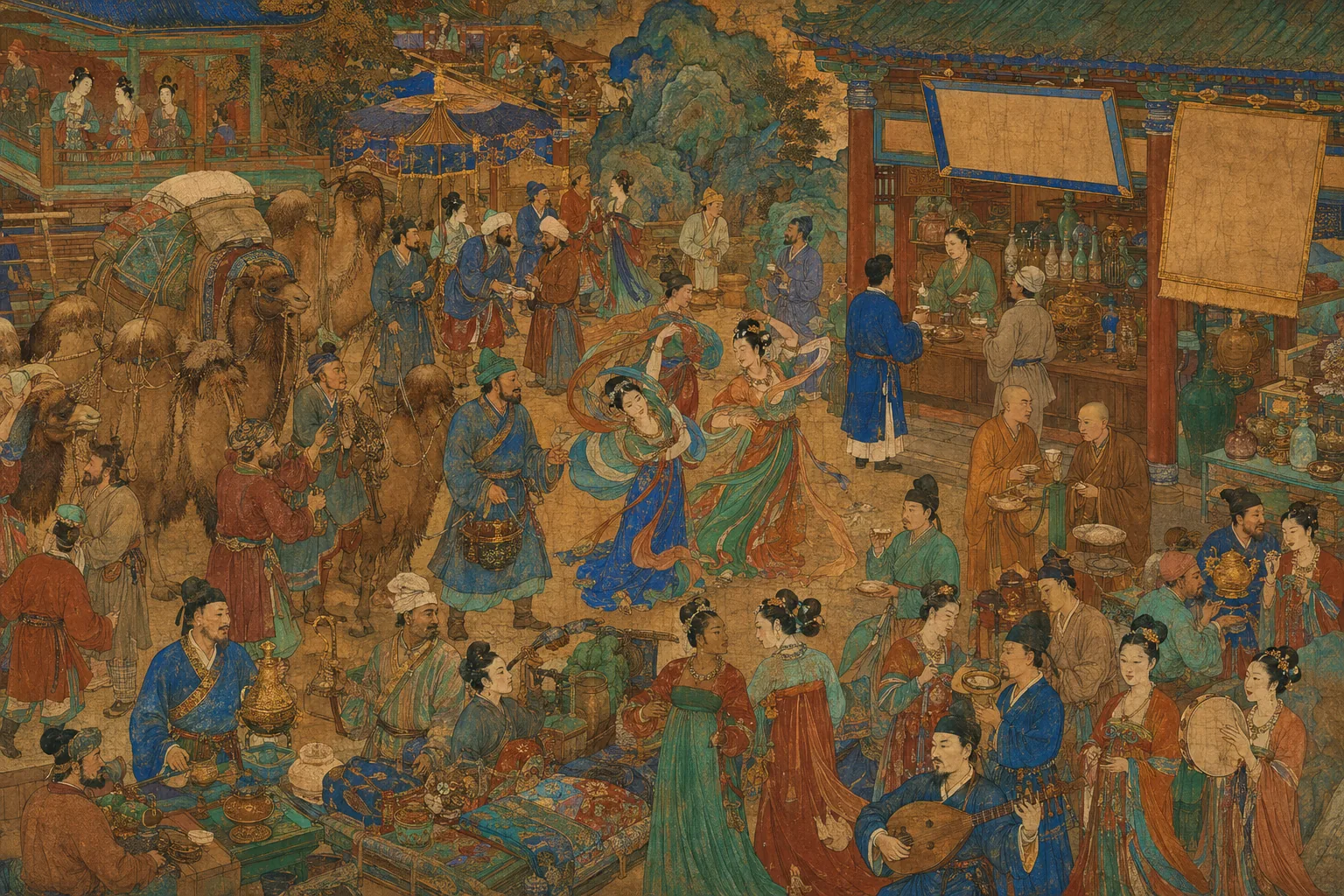
Generated illustration · Chang’an around 750, a million people and the most foreign city on earth · after a Tang dynasty court painting on silk with Dunhuang colouring
01
Everybody came here. Everybody thought it would last.
Chang’an, c.750
The Tang capital held around a million people inside its walls and was the largest city in the world. Sogdian wine shops, Persian merchants and Japanese monks were resident, and Nestorian Christian and Zoroastrian temples stood in the city. The examination system admitted men from the provinces into government office.
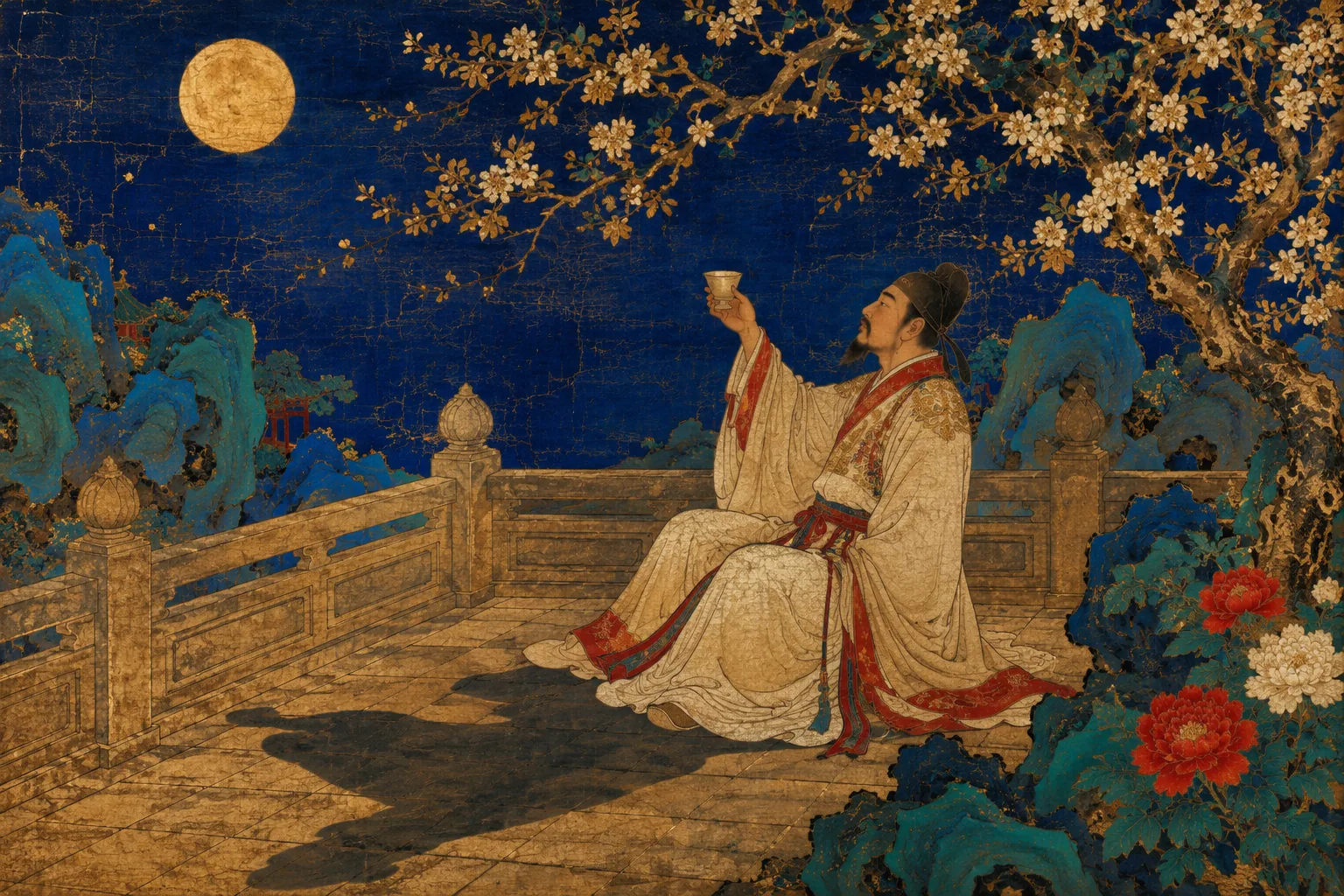
Generated illustration · Li Bai’s drinking poem, counting the moon and his shadow as company · after a Tang dynasty court painting on silk with Dunhuang colouring
02
I don’t drink alone, I drink with three: me, the shadow, and the tall
Li Bai, 701 to 762
Li Bai is the most quoted poet in the Chinese language and around a thousand of his poems survive. His best-known drinking poem counts the company as three: the poet, the moon and his own shadow. Tang painting does not use cast shadows; this picture departs from that convention because the shadow is the subject.
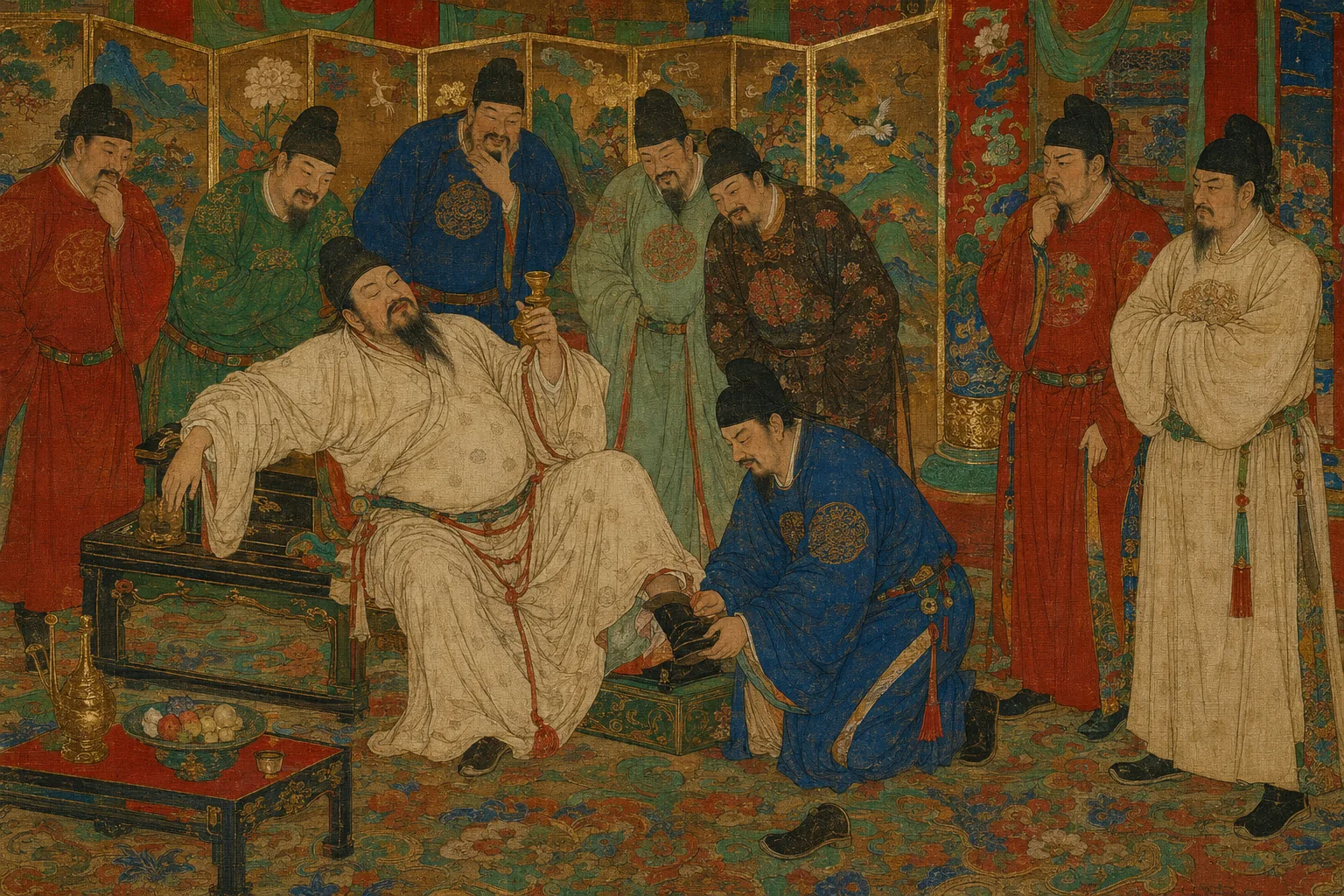
Generated illustration · two years as a court poet, and the legend of the eunuch’s boot · after a Tang dynasty court painting on silk with Dunhuang colouring
03
I made the chief eunuch pull my boots off. Drunk. In front of the room.
Li Bai at court, c.742 to 744
Li Bai was summoned to the palace as a poet rather than an official and remained about two years. He left with gifts and no post. The story that he made the powerful eunuch Gao Lishi pull off his boots belongs to the legend rather than the record.
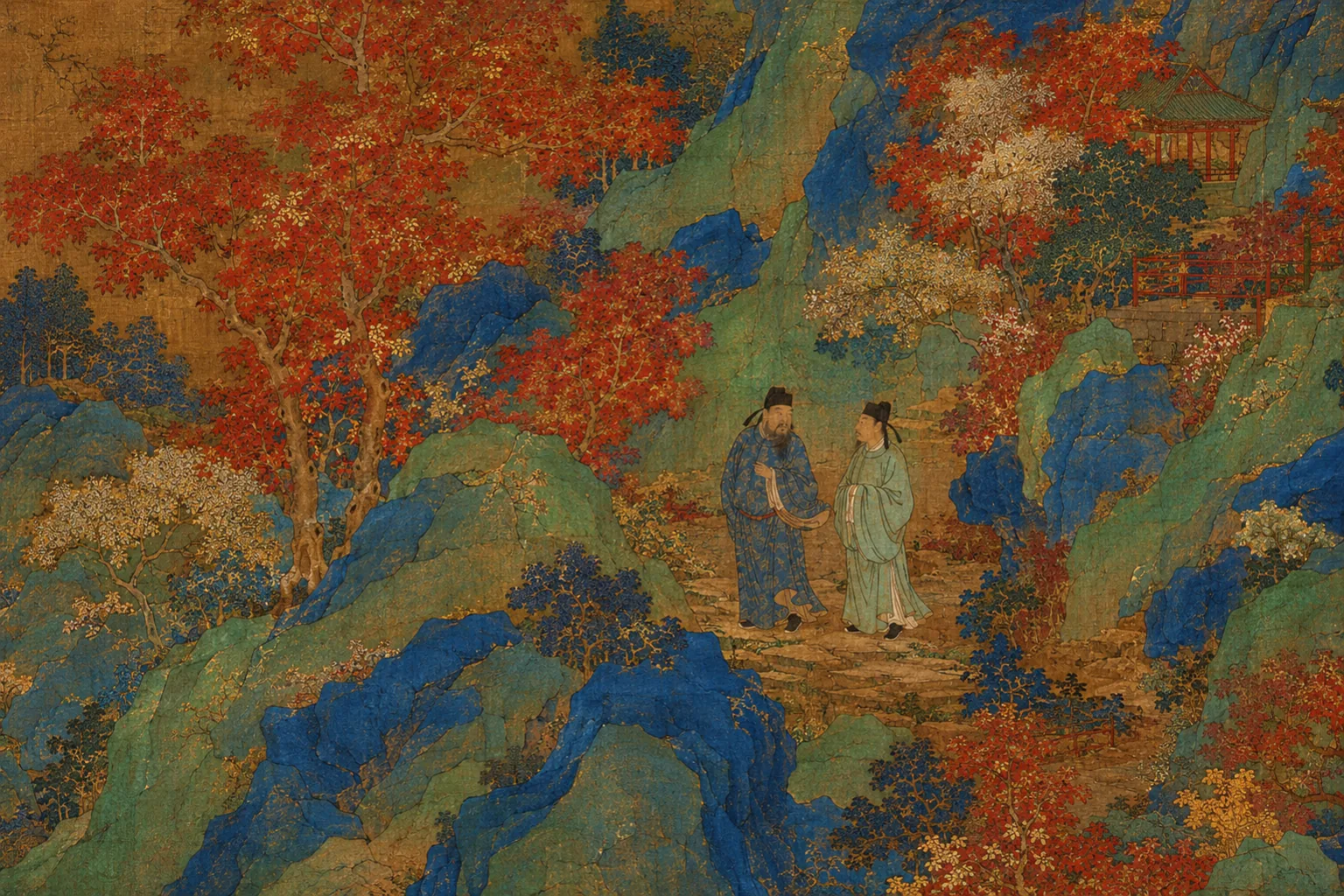
Generated illustration · Li Bai and Du Fu, who met in 744 and barely wrote back · after a Tang dynasty court painting on silk with Dunhuang colouring
04
I met him once. One autumn. We drank, we walked, we climbed.
Li Bai and Du Fu
The two poets met in 744 and spent parts of two autumns in company. Du Fu, eleven years younger and then unknown, wrote repeatedly about Li Bai for the rest of his life, including a poem about dreaming of him three nights in succession. One reply from Li Bai survives. They are now ranked together as the two greatest poets of the Tang.
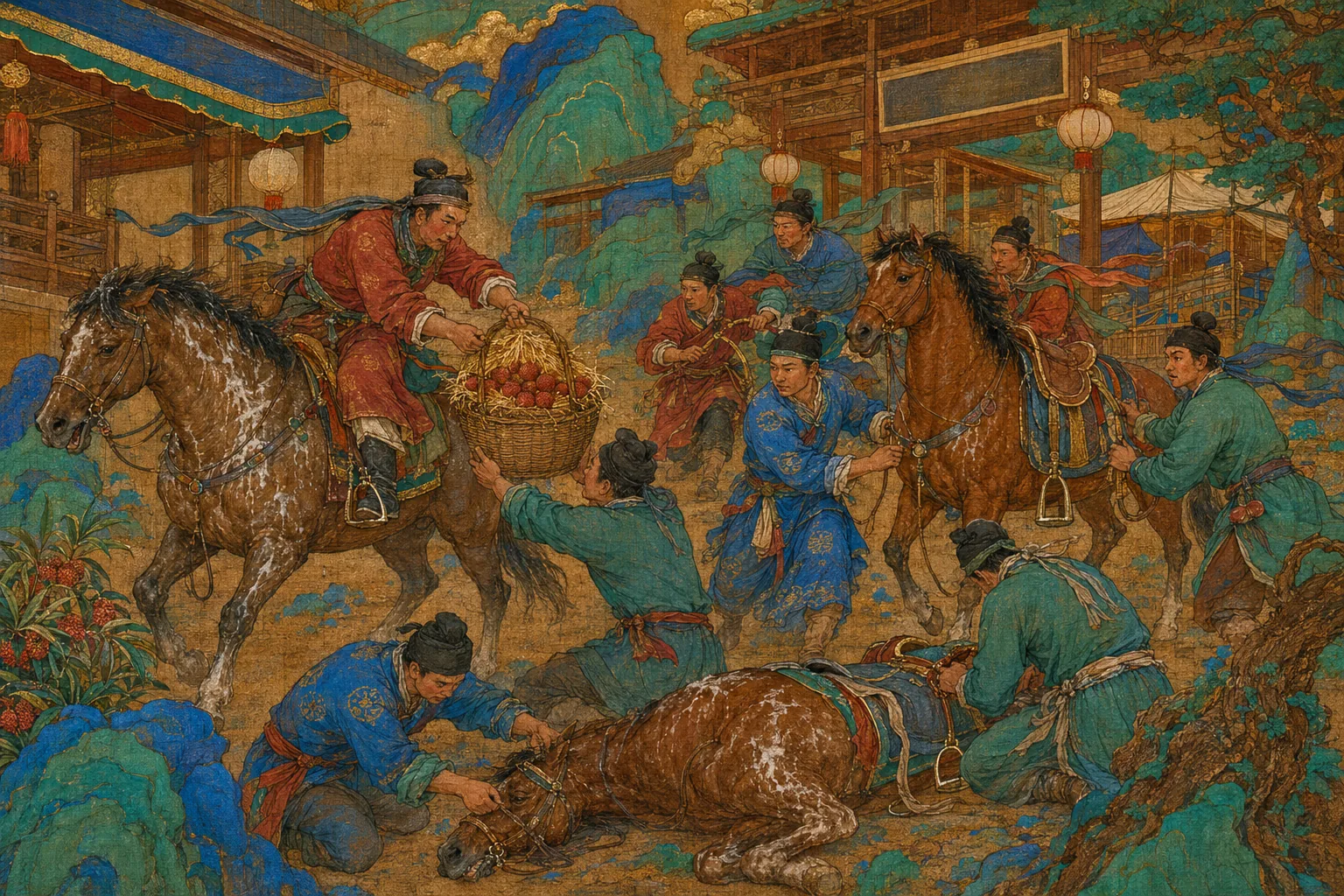
Generated illustration · the military post system used to run fruit north for a favourite · after a Tang dynasty court painting on silk with Dunhuang colouring
05
riders killing animals to get fruit to a woman while it’s cold.
The lychee relay
Lychees spoil within days and were grown some thousand miles south of the capital. The imperial post system, built to carry military dispatches, was used to bring them north for the consort Yang Guifei. Tang poets were already citing the practice within a generation as an image of a court that had stopped governing.
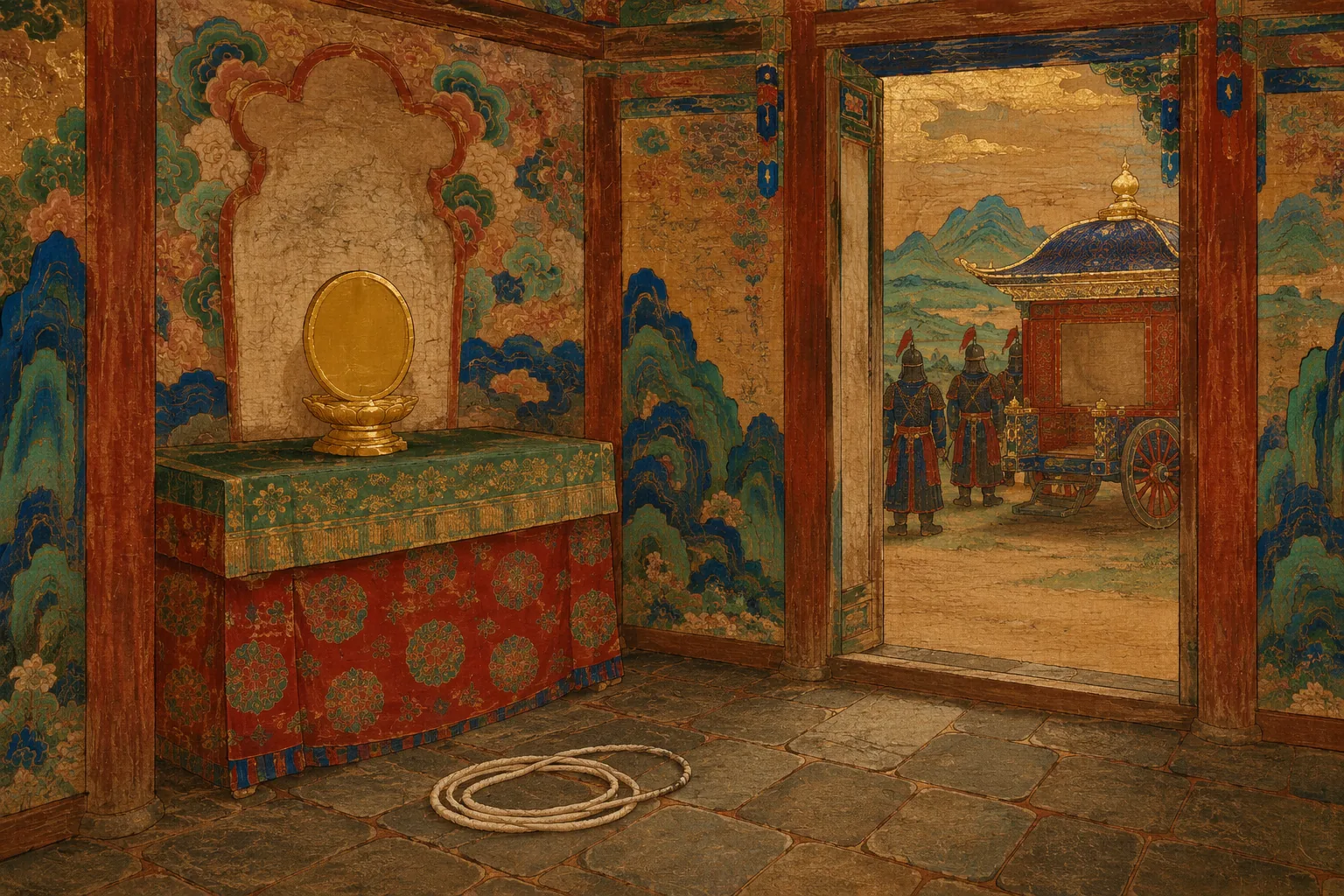
Generated illustration · Mawei, 756: the escort halted until Yang Guifei was dead · after a Tang dynasty court painting on silk with Dunhuang colouring
06
They strangle her with a silk cord in a Buddhist chapel by the road.
Mawei post station, 756
Fleeing the An Lushan rebellion, the emperor’s escort halted and refused to continue until Yang Guifei was dead. She was strangled in a chapel beside the road. Emperor Xuanzong, then seventy-one, was present, and continued to Sichuan.
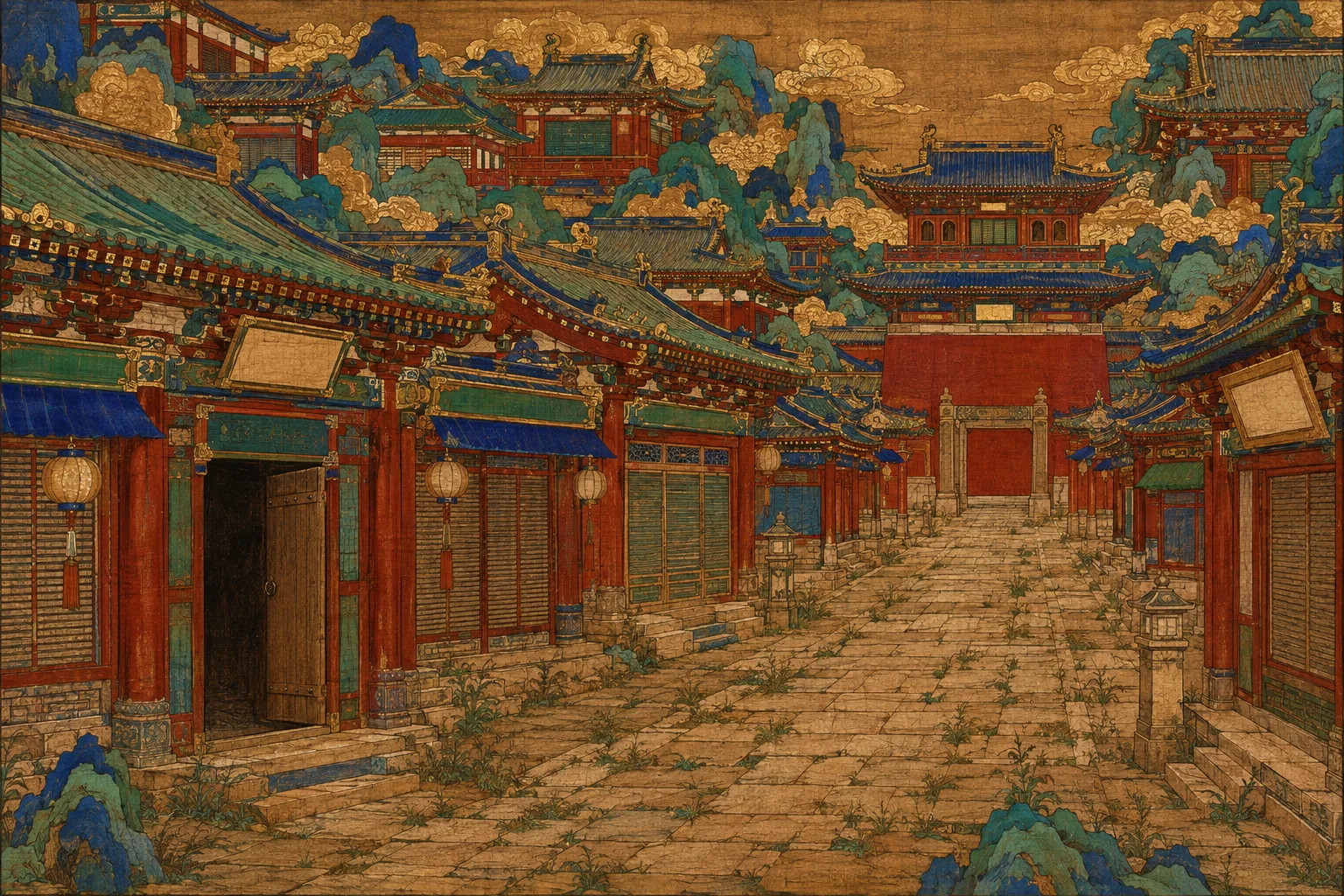
Generated illustration · after the An Lushan rebellion, when the census fell by two thirds · after a Tang dynasty court painting on silk with Dunhuang colouring
07
That is not a war statistic. That’s a hole in the world.
The census figures, 754 and 764
The registered population before the An Lushan rebellion was about fifty-two million; after it, about seventeen million. Historians attribute most of that difference to the collapse of tax registration rather than to deaths, since the state had lost the capacity to count. The dynasty never governed in the same way again.
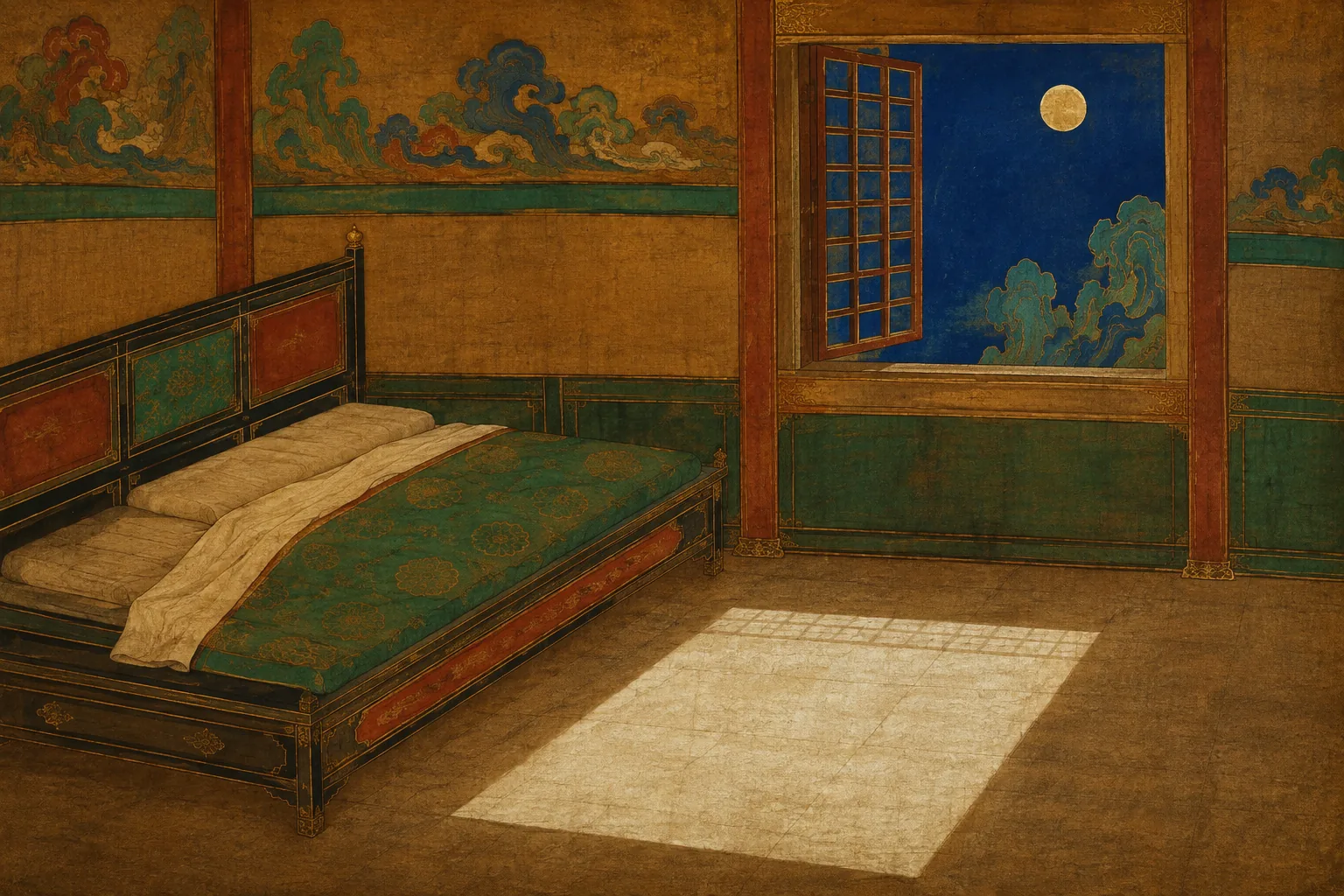
Generated illustration · Quiet Night Thoughts — four lines every Chinese child learns first · after a Tang dynasty court painting on silk with Dunhuang colouring
08
Moonlight at the foot of the bed, looks like frost on the ground,
Quiet Night Thoughts
Li Bai’s four-line poem is generally the first that Chinese children learn: moonlight at the foot of the bed, mistaken for frost, and a head lifted and then lowered in thought of home. Twenty characters. It has outlasted the dynasty, the city and the pronunciation it was written in.
07
Song, 960–1279
Words 76 lines
And of course the Chinese invented gunpowder,
but they only ever used it for fireworks.
Yes. Anyway. Turn to page forty.
Nah. Let me stop you. Let me actually stop you there.
Fire lance, twelfth century, five-foot bamboo, filled with air
and powder and porcelain shards and a two-second scream of flame.
Thunderclap bomb. Iron casing. Shrapnel. That's the name.
Flying fire arrows off the walls at Kaifeng in the snow,
land mines with a trip cord, and a text that tells you how to sew
six formulas together depending on the job,
and the state ran the sulphur monopoly 'cause they knew it was the prize.
Wujing Zongyao, ten forty-four. It's written down. It's fine.
First gunpowder formula on earth. You can read it. It's in line.
So no, we didn't sit around going ooh, look, pretty and pink.
We built the weapon. We just lost anyway. Which is worse, I think.
Bi Sheng's out here setting clay type in a tray,
movable, individual, four hundred years the early way.
Didn't catch on though. Want to know why? Do the maths on that.
Alphabet's twenty-six. We're working with a couple of thousand,
so a case of movable type is a warehouse. That's not backwardness,
that's an engineering constraint. The tool fits the language.
Compass. Floating needle in a bowl, pointing south,
nautical manual, eleven nineteen. Out of my mouth
comes the sentence that ruins me: we drew the map of the sea,
then somebody else sailed it, and the ships came back for me.
Paper money. Jiaozi. Sichuan. Merchants got tired
of hauling iron coins by the cartload, so they issued a note. Inspired.
State takes it over. State likes it. State prints a little more.
And the Song invents inflation a thousand years before
anybody had a word for it. That's the thing about the future.
You invent the whole thing. Including the sin.
We made the powder, we made the press,
we made the needle, we made the mess.
We made the note that made the debt,
we made the future. It ain't got here yet.
Kaifeng. Million people and a river full of boats.
There's a scroll, seventeen feet, everybody in it, all the coats,
noodle stalls, fortune teller, bloke asleep in the shade.
Best painting of an ordinary Tuesday anybody ever made.
Exams open the door. Farmer's son with a memory and a plan
sits three days in a sealed cell, comes out a government man.
Rich kid's got tutors, so it's not fair. But the door is there,
and nowhere else on the planet in eleven hundred is it there.
Su Shi failed upward beautifully. Exiled for a poem,
exiled for another one, kept writing, never went home,
grew his own vegetables, invented a way to braise the pork.
You can order it in Hangzhou tonight. Nine-hundred-year fork.
Wrote to his brother from the coast: wherever I calm down is my town.
Sent to the actual edge of the world. And he just sat down.
Huizong painted birds. Beautiful. Genuinely great.
Invented a calligraphy style. Ran a terrible state.
Deal with the Jurchens: help me take the north, we'll split.
Jurchens took the north. Then they looked at us, and thought about it.
Eleven twenty-seven. Kaifeng falls. Court taken north in a cart.
Titles for the captives up in the cold: Marquis of Muddled Virtue.
That's real. That's how it's told.
Court runs south to Hangzhou. Calls it a temporary base.
Stays a hundred and fifty years. Never says it to your face.
Yue Fei wanted it back. Won every battle he was in.
Mother had four characters tattooed on his back, in the skin:
serve the country with the utmost loyalty. He did.
Twelve miles from Kaifeng. Twelve miles.
And the court sent twelve gold tablets in one day ordering him home.
Because a general who takes the north brings the old emperor back,
and the new one is sitting in his chair.
Chief minister needed a charge. Man asked, what's the evidence?
He said: mòxūyǒu. Perhaps there is some.
Killed him in prison at thirty-nine on perhaps there is some.
His tomb's in Hangzhou. Four iron statues kneel outside it, heads down.
Eight hundred years people have been spitting on them.
They had to put up a rail.
So. Page forty.
No, I did the reading.
The reading says we built the gun and lost the country.
That's not a fun fact. That's a different lesson.
And it doesn't fit on your slide.
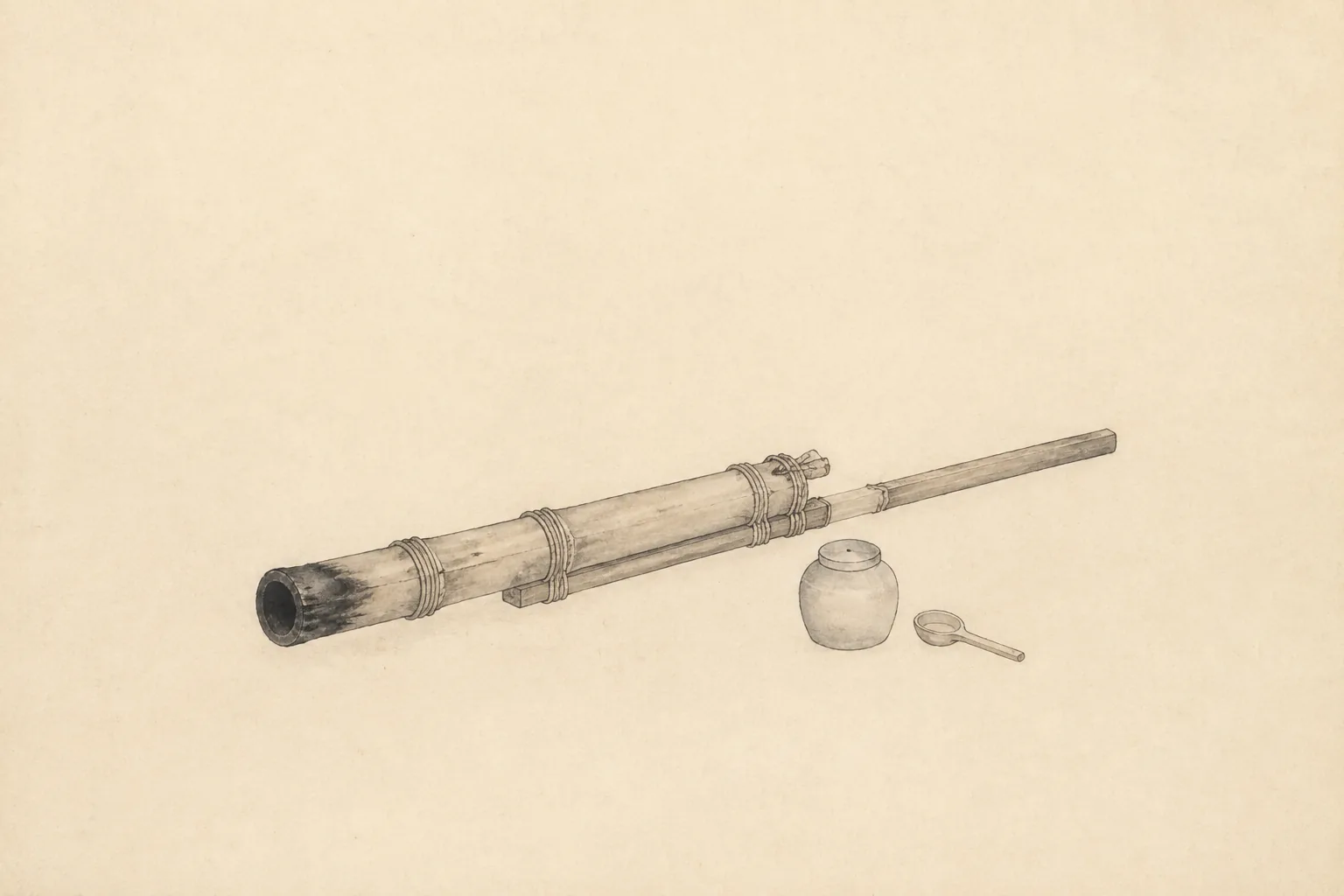
Generated illustration · the twelfth-century fire lance, ancestor of every firearm · after a Northern Song ink painting on paper
01
Fire lance, twelfth century, five-foot bamboo, filled with air
The fire lance, twelfth century
A bamboo tube packed with gunpowder and shrapnel, lashed to a spear and discharged at close range. Replacing the tube with metal produced the first guns. The fire lance is the ancestor of all firearms and was in military use under the Song.
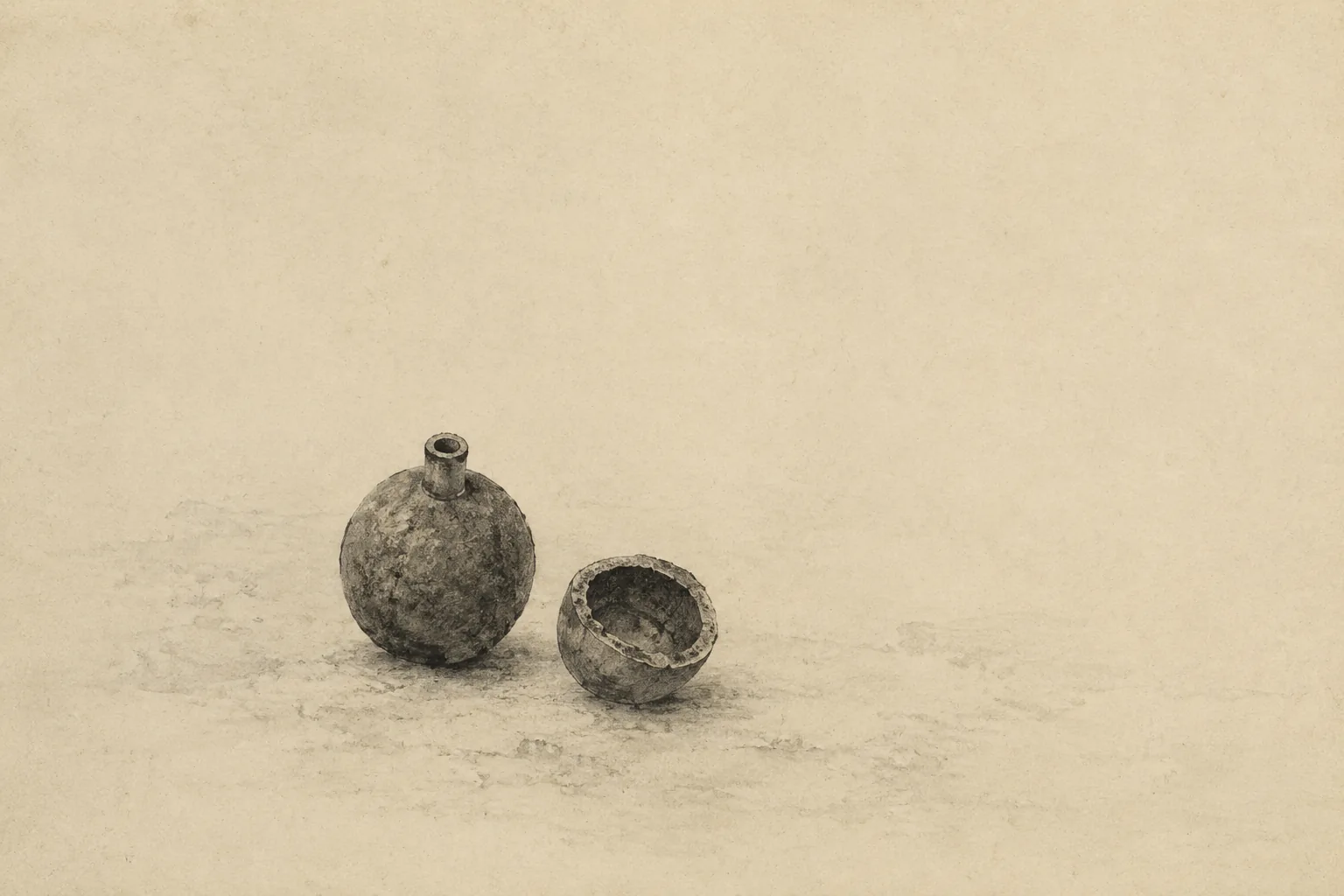
Generated illustration · the cast-iron bomb whose casing is the weapon · after a Northern Song ink painting on paper
02
Thunderclap bomb. Iron casing. Shrapnel. That’s the name.
The thunderclap bomb
A cast-iron shell filled with gunpowder, built to burst and throw fragments, so that the casing itself acts as the weapon. Song and Jin armies used them against one another, dropped from walls and thrown by trebuchet. Accounts describe the detonation being audible for miles.
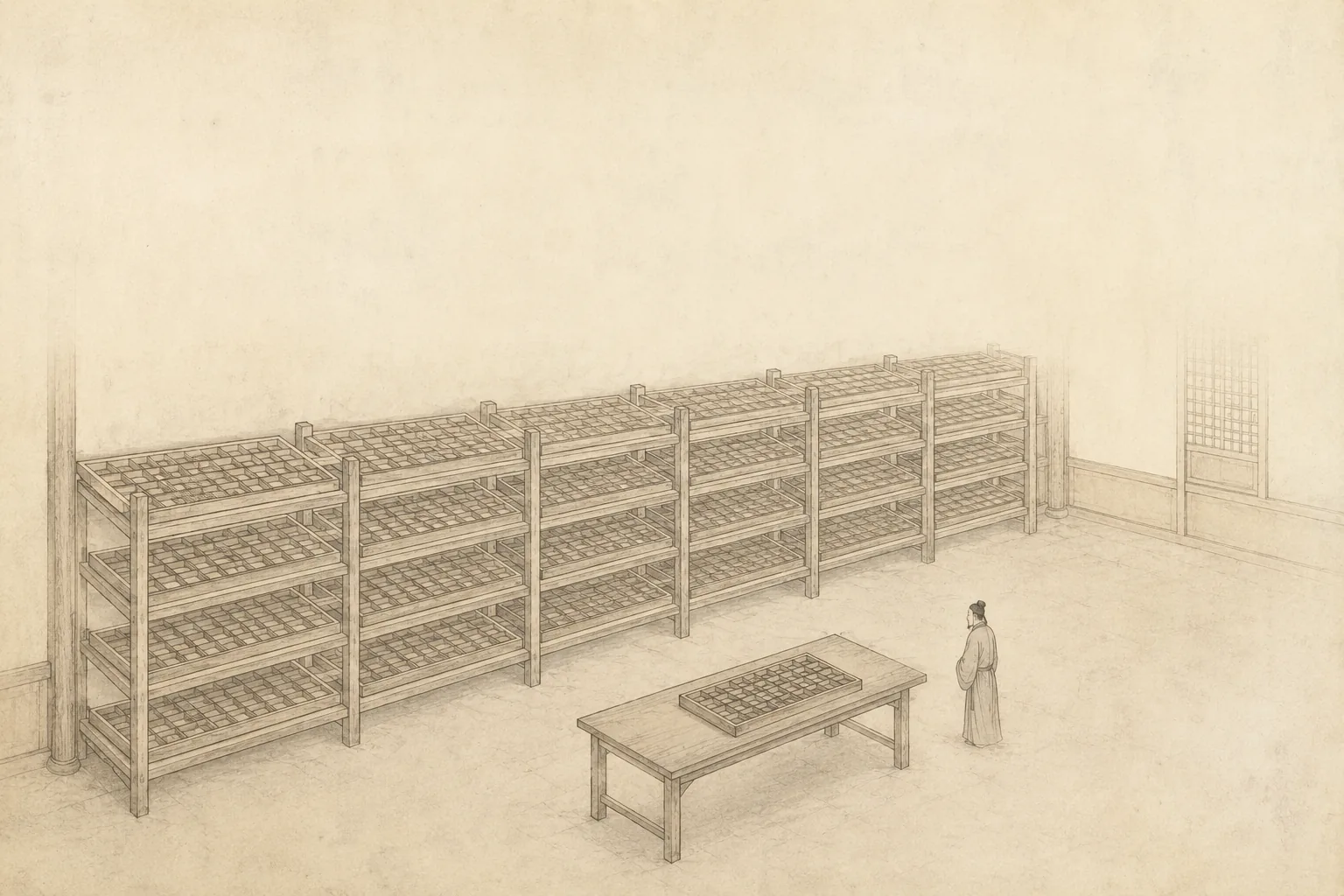
Generated illustration · movable type, c.1040, and the arithmetic that kept it niche · after a Northern Song ink painting on paper
03
Alphabet’s twenty-six. We’re working with a couple of thousand,
Movable type, c.1040
Bi Sheng cut movable type in clay around 1040, four centuries before Gutenberg, but the technique remained a minority one. An alphabet needs a case of a few dozen sorts; Chinese needs several thousand. Whole-page woodblock printing stayed cheaper for centuries.
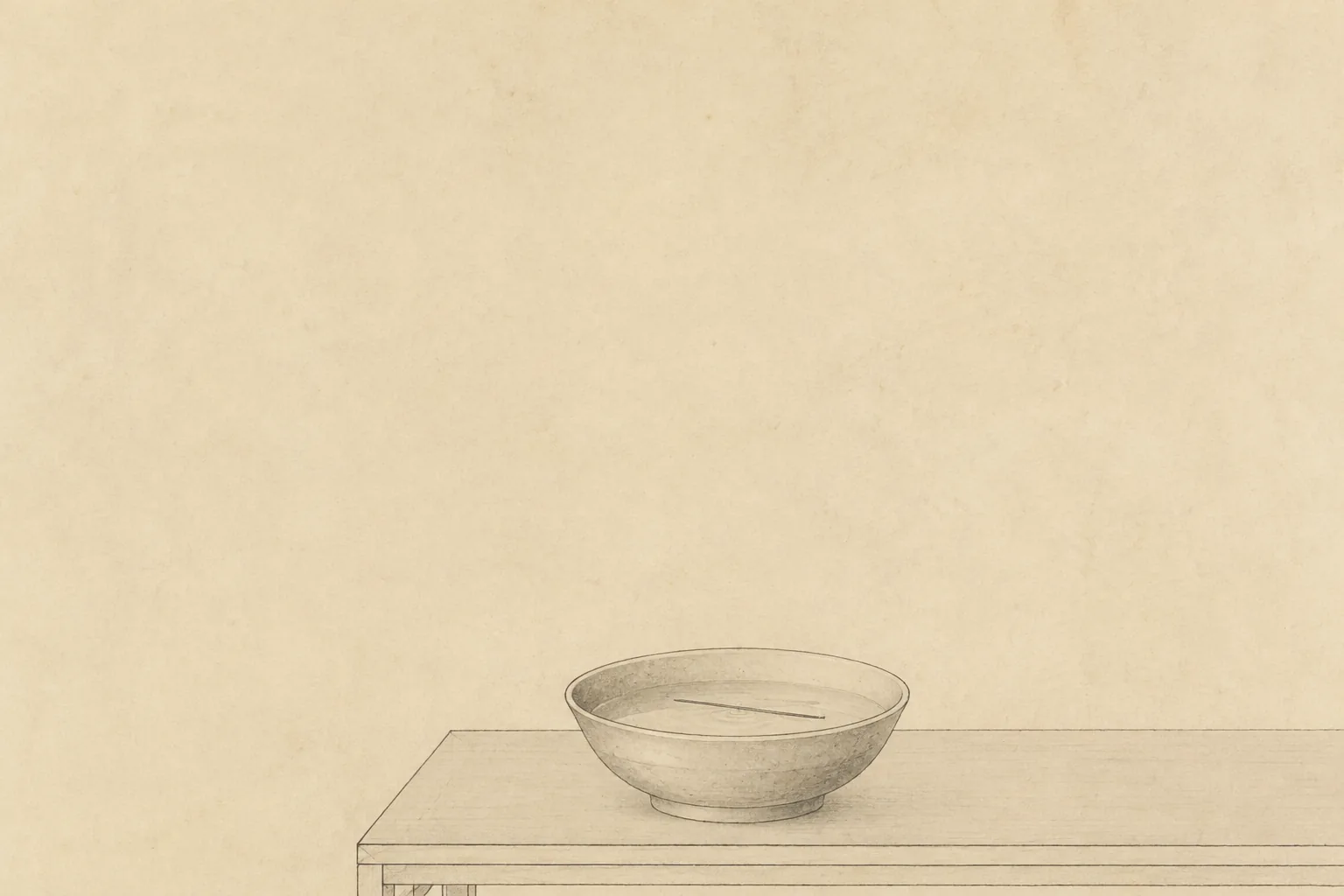
Generated illustration · the compass described for navigation in 1119, the first anywhere · after a Northern Song ink painting on paper
04
Compass. Floating needle in a bowl, pointing south,
The compass, described 1119
A magnetised needle floated in a bowl of water. Its use for navigation is described in a Chinese manual of 1119, the earliest such account known anywhere. Chinese compasses were read as pointing south rather than north: the same instrument, a different convention.
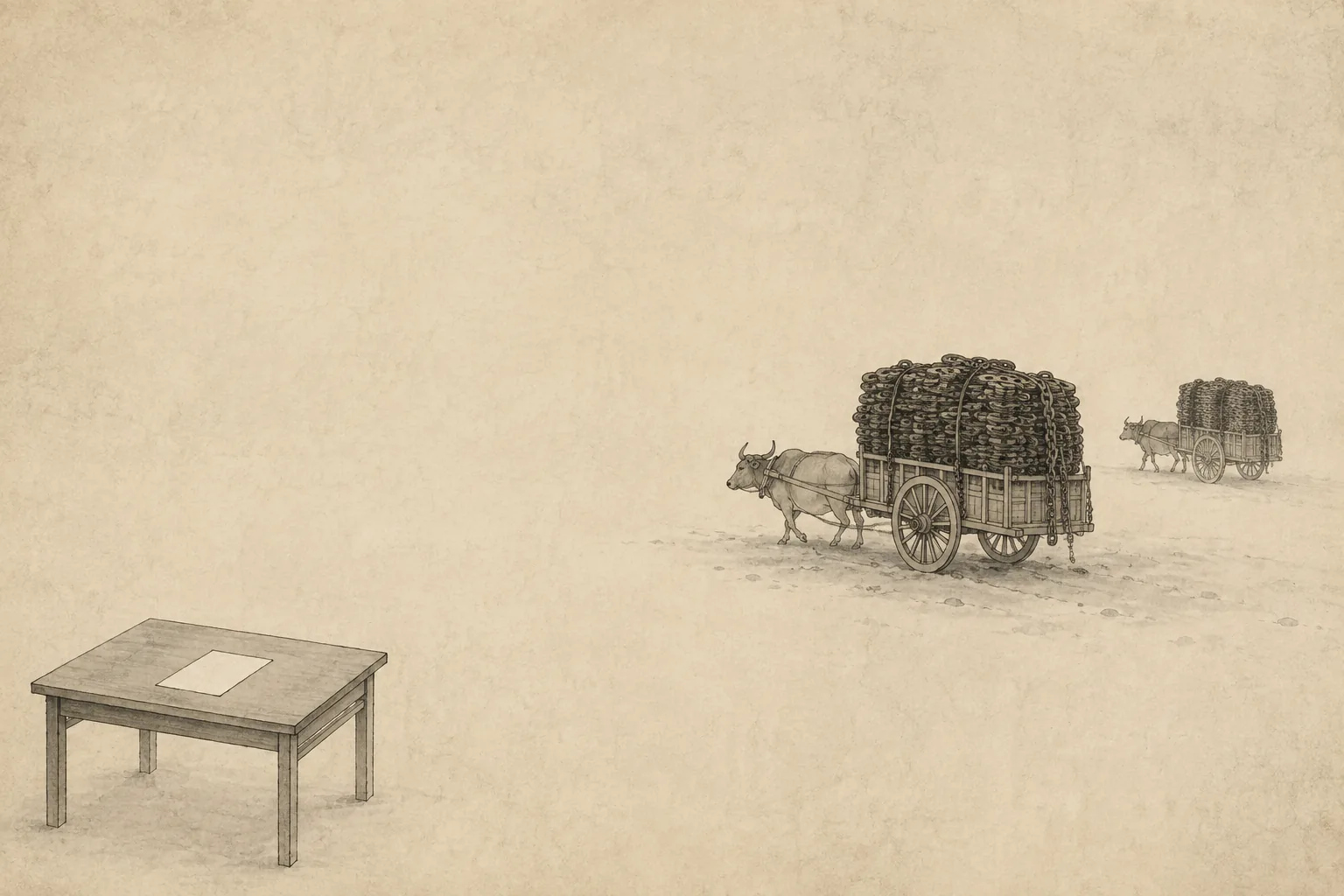
Generated illustration · jiaozi: the world’s first paper money, and its first inflation · after a Northern Song ink painting on paper
05
so they issued a note. Inspired.
Jiaozi: the first paper money
Merchants in Sichuan, faced with moving iron coinage by the cartload, began issuing paper receipts. The state took the practice over and then issued more notes than it held reserves for. The Song therefore produced both the world’s first paper currency and its first paper inflation.
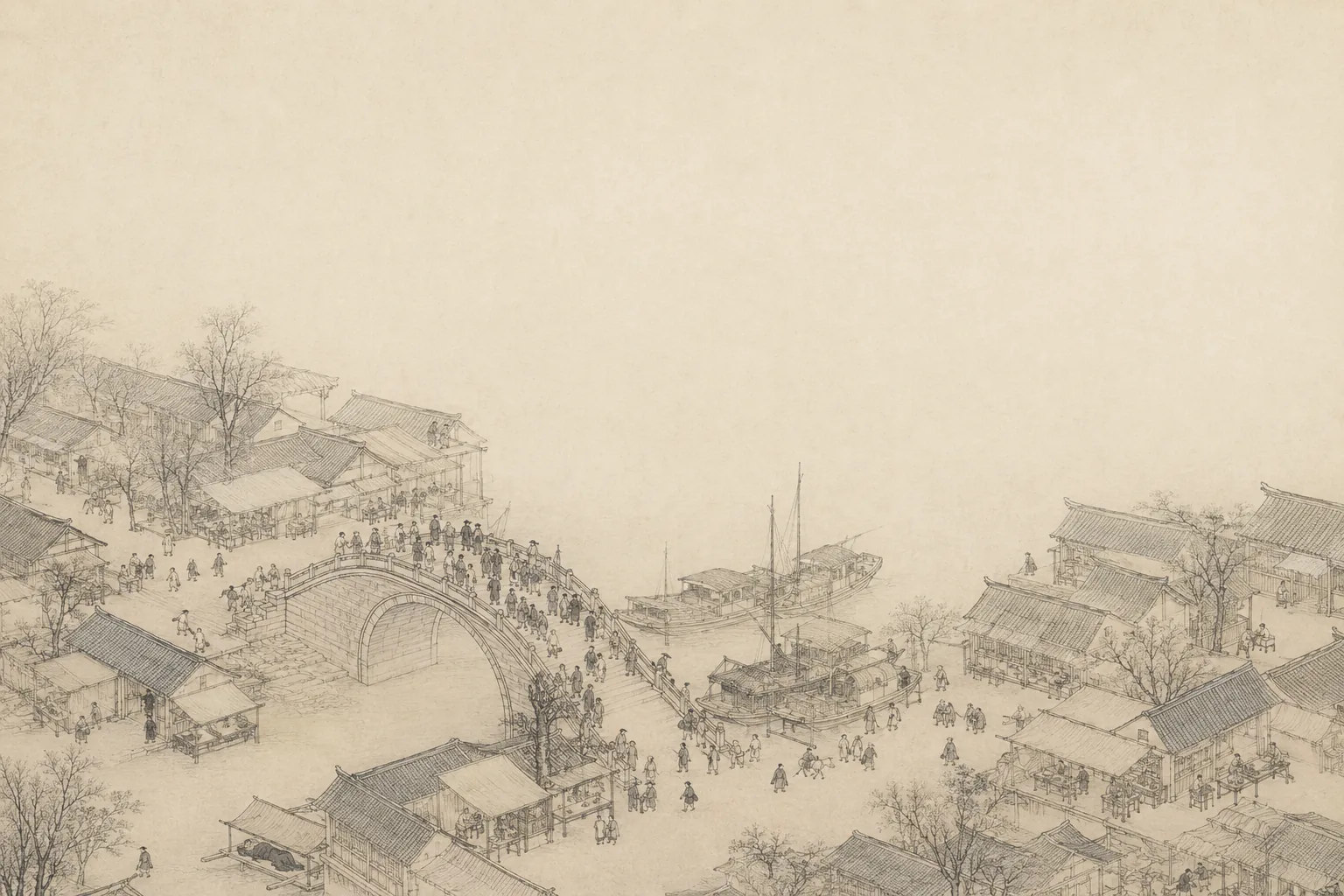
Generated illustration · Kaifeng around 1100, after the most reproduced painting in China · after a Northern Song ink painting on paper
06
Best painting of an ordinary Tuesday anybody ever made.
Along the River During Qingming, c.1100
The scroll is about five metres long and holds several hundred figures hauling, trading, arguing and sleeping. There is no emperor, no battle and no deity in it. Its subject is an ordinary working day in Kaifeng, a city of around a million people, and it is the most reproduced painting in China.
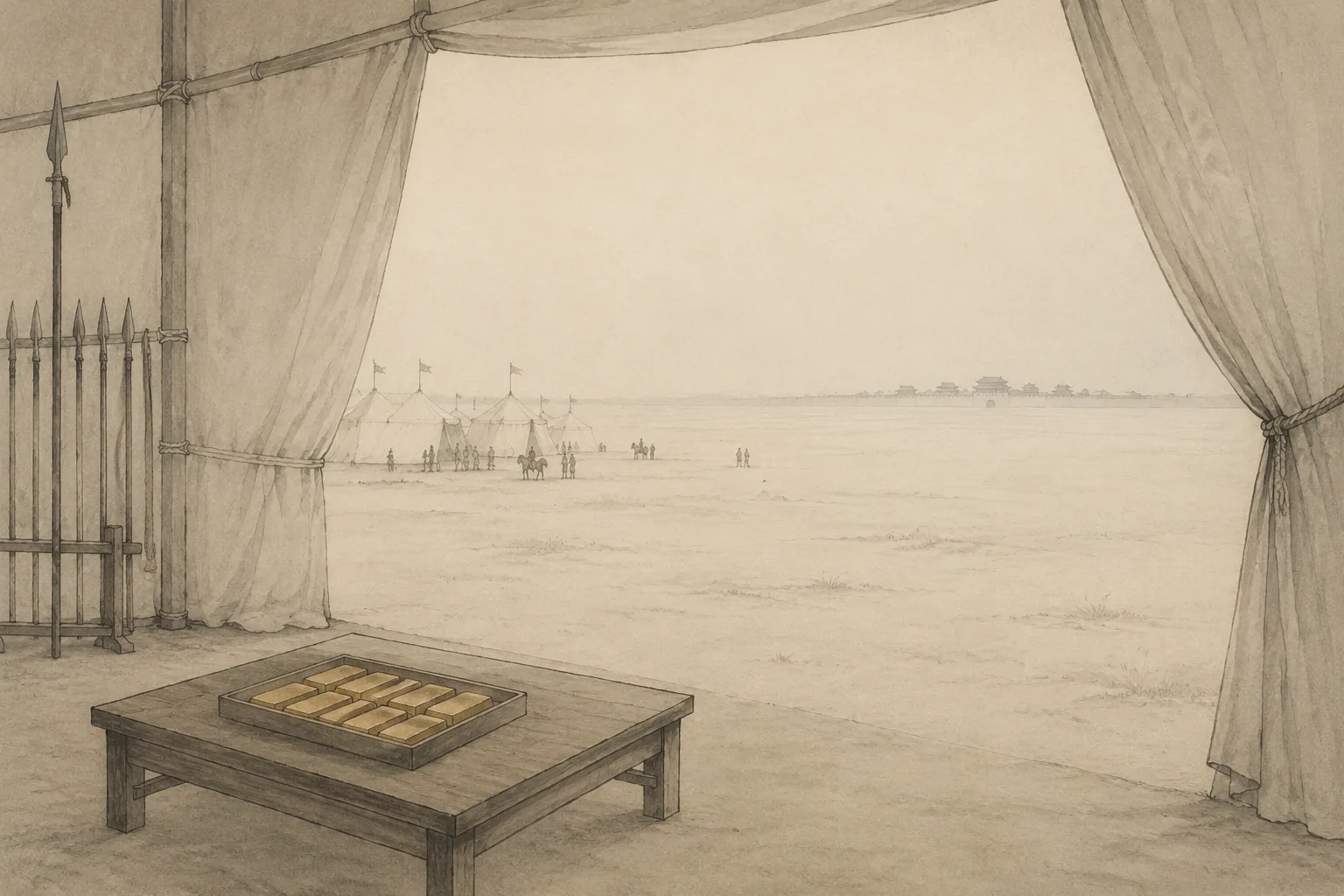
Generated illustration · the twelve gold tablets that recalled Yue Fei from a won campaign · after a Northern Song ink painting on paper
07
And the court sent twelve gold tablets in one day ordering him home.
Yue Fei, 1103 to 1142
Yue Fei won his northern campaigns and was recalled regardless, by twelve urgent orders issued in a single day. The reason was dynastic: a general who recovered the north would also recover the captured emperor, and his son held the throne. Yue Fei was killed in prison at thirty-nine, on a charge his accuser could not evidence.
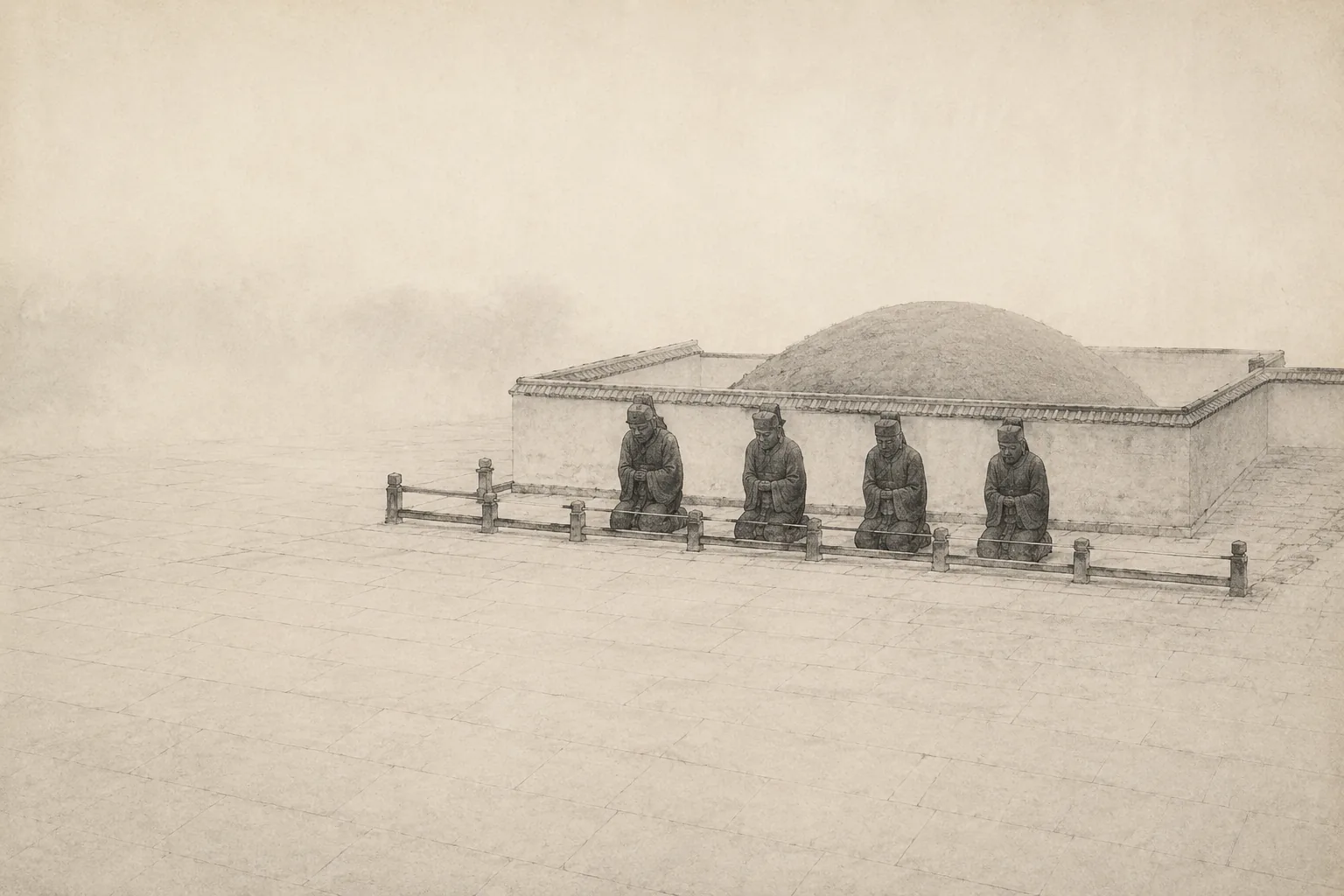
Generated illustration · the iron figures outside his tomb, railed off from the spitting · after a Northern Song ink painting on paper · later than the Song, studied here
08
Four iron statues kneel outside it, heads down.
The kneeling figures at Hangzhou
Four iron figures kneel outside Yue Fei’s tomb: the chief minister who had him killed, the minister’s wife and two accomplices. They are much later than the Song and were placed there to be spat at. The practice was sustained enough that the site eventually installed a railing to protect them.
08
Yuan, 1271–1368
Words 79 lines
Largest land empire in the history of the world.
Not the largest ever. The largest that touched.
You could ride from Korea to Hungary and never leave.
Grass. Horses. Nothing. That's the whole inventory.
No cities to burn behind us, so we don't fight for territory,
we fight for the animals, the grazing, and the right to move,
and a man who owns nothing but a horse has nothing left to lose.
Composite bow. Sinew and horn. Fires from the saddle at a run.
Three mounts each, we swap them out, so the marching never gets done.
You build a wall against the north. Fine. Walls have gates.
Gates have men. Men have a price. That's not strategy, that's rates.
Surrender and you keep your city. Resist and there is no city.
That's not cruelty, that's arithmetic, and arithmetic isn't pretty
but it's cheap. Word travels faster than the column ever could,
so the next town opens up before we arrive.
The terror does the work. The killing's just the proof it's good.
Who's the horse and who's the rider,
who's the water, who's the stone,
you can sit on a foreign throne long enough
that the throne becomes your own.
Kublai's the grandson. Kublai's different. Kublai reads the room.
Doesn't want a pasture where a country was. Wants the loom,
wants the tax base, wants the farmers in the field and paying rent,
so he picks a Chinese name out of the Book of Changes. Yuan. Primal. Original intent.
Builds a capital at Dadu. You know it. It's Beijing.
Every emperor after him sits in a Mongol city and calls it the natural thing.
Never learned to read the language. Ran it through interpreters and clerks.
Four classes: Mongols top, Central Asians next, northern Chinese third,
southern Chinese underneath the whole apparatus. That's the word.
Suspended the exams for thirty-odd years, so a class of men
who trained their entire lives for one door found the door shut. And then
they had to go somewhere. So they wrote plays.
Guan Hanqing writing a woman executed on a false charge, and the snow
falls in June to prove her innocent. Unemployed scholars invented Chinese opera.
That's the compensation. That's the trade.
You take a country's civil service and you get a theatre made.
Twelve seventy-nine. Yamen. Last of the Song fleet at sea.
Boy emperor is eight years old. Chancellor takes him on his back. Debris
in the water, the fleet chained together and burning at the stern,
and he walks into the sea with the child, because there's nowhere left to turn.
They say a hundred thousand followed him in.
Bodies in the water for days. That's the end of three hundred years.
Wen Tianxiang wouldn't bend. Captured, dragged north in a cage,
Kublai offered him the highest office in the realm at any wage,
just serve. Just say the word. He wrote a poem in the cell instead
about the one thing you get to keep when everything else is dead.
Executed. Faced south before he knelt.
South is where the throne had been.
Who's the horse and who's the rider,
who's the water, who's the stone,
you can sit on a foreign throne long enough
that the throne becomes your own.
Ninety-seven years. That's it. Shortest of the big ones.
Printed money till the money meant nothing. Princes fighting sons.
Two fleets sent at Japan and two typhoons sent them down,
divine wind, they called it. Kamikaze. Never took the town.
Then the Yellow River jumps its course in thirteen forty-four,
floods the plain, and the court conscripts a hundred and fifty thousand more
to dig it back. And a rumour goes out in the mud and the rain:
a one-eyed stone man will rise from the river and the empire ends again.
And they dug. And they found one. One eye. Carved. Right there in the silt.
Somebody buried it the week before. Best piece of propaganda ever built.
Red Turbans in the field within the month. Whole plain alight.
And down in Anhui there's a boy who lost his mother, father, brother, all
in one bad season. Buried them in a borrowed strip of ground.
Went to a monastery. Monastery starved. Went out begging with a bowl.
He's coming.
Here's what I can't get past.
The dynasty list they made me memorise has the Yuan on it.
Right there between Song and Ming, like it belongs.
Conquered by an outside people, ruled from a city they built,
and a hundred years later it's just another Chinese dynasty
and the Mongols are a minority nationality with a folk dance.
So which way does it go.
Because I keep being scared that if I stay here long enough
I'll dissolve.
And this says the other thing can happen.
This says sometimes the ocean takes the salt.
And nobody can tell you, from the inside, which one you are.
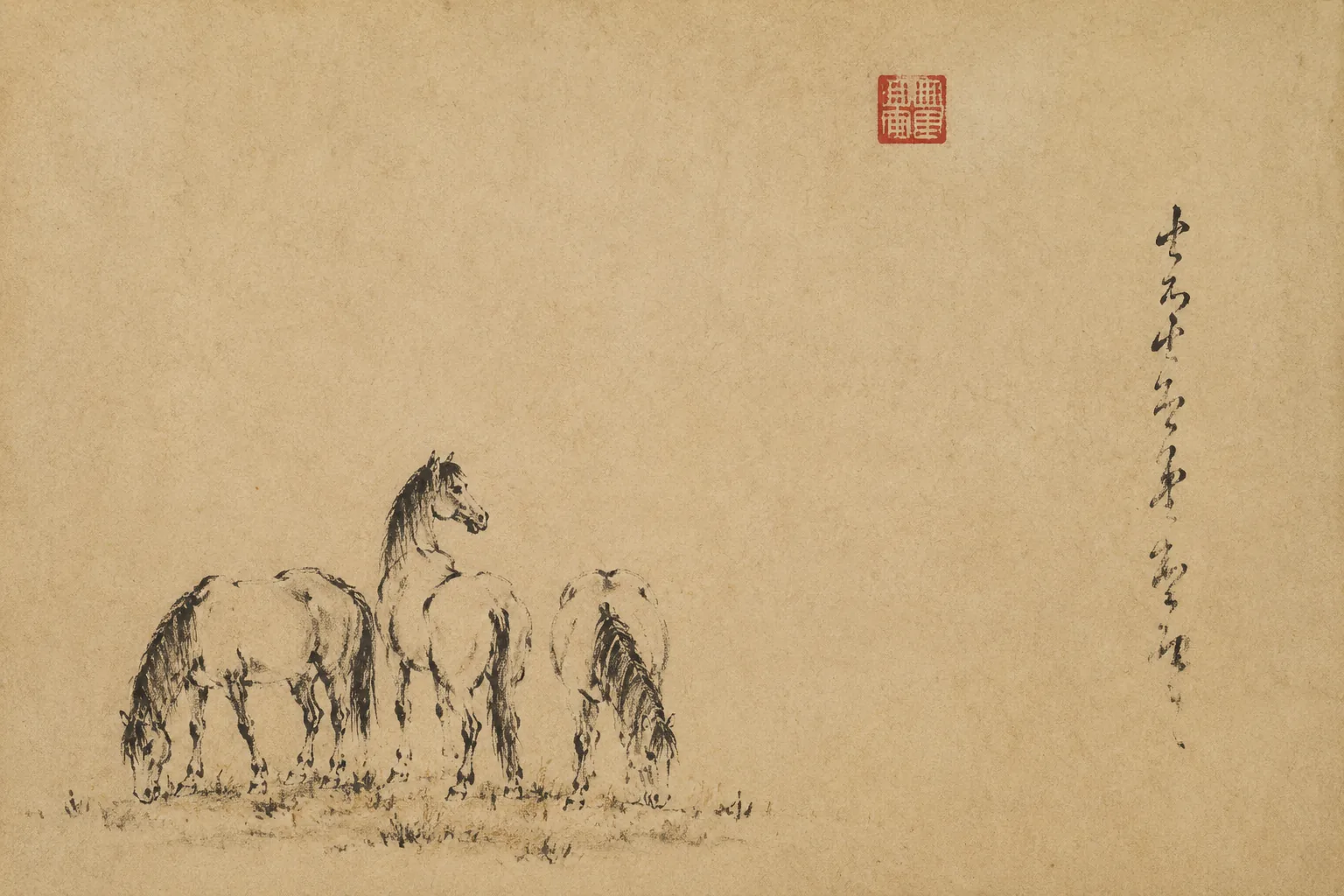
Generated illustration · the steppe economy: no cities to lose, and war over grazing · after a Yuan dynasty literati dry-brush ink painting on paper
01
Grass. Horses. Nothing. That’s the whole inventory.
Steppe warfare
Steppe armies had no cities to defend, which changed what a campaign was for: livestock, grazing and freedom of movement rather than territory. The composite bow of sinew and horn could be shot from a moving horse, and riders travelled with several mounts each, so a column could continue where a supplied army would have had to halt.
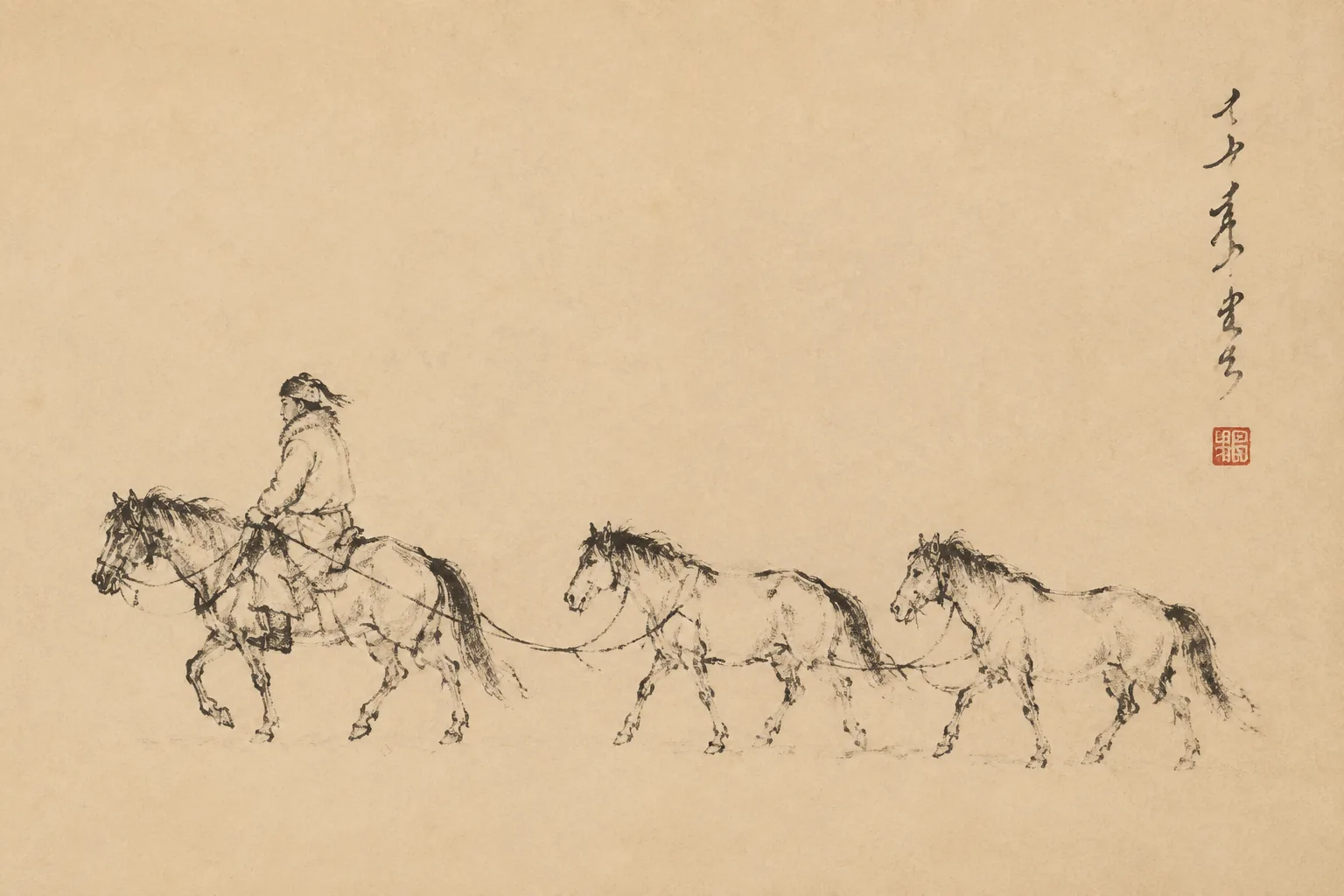
Generated illustration · remounts, which is how one empire reached from Korea to Hungary · after a Yuan dynasty literati dry-brush ink painting on paper
02
Three mounts each, we swap them out, so the marching never gets done.
The Mongol empire at its height
By the late thirteenth century Mongol rule ran from Korea to Hungary as one continuous land mass, the largest contiguous empire recorded. Spare mounts were central to it: a rider with remounts covers ground a supplied army cannot, and can arrive ahead of news of his approach.
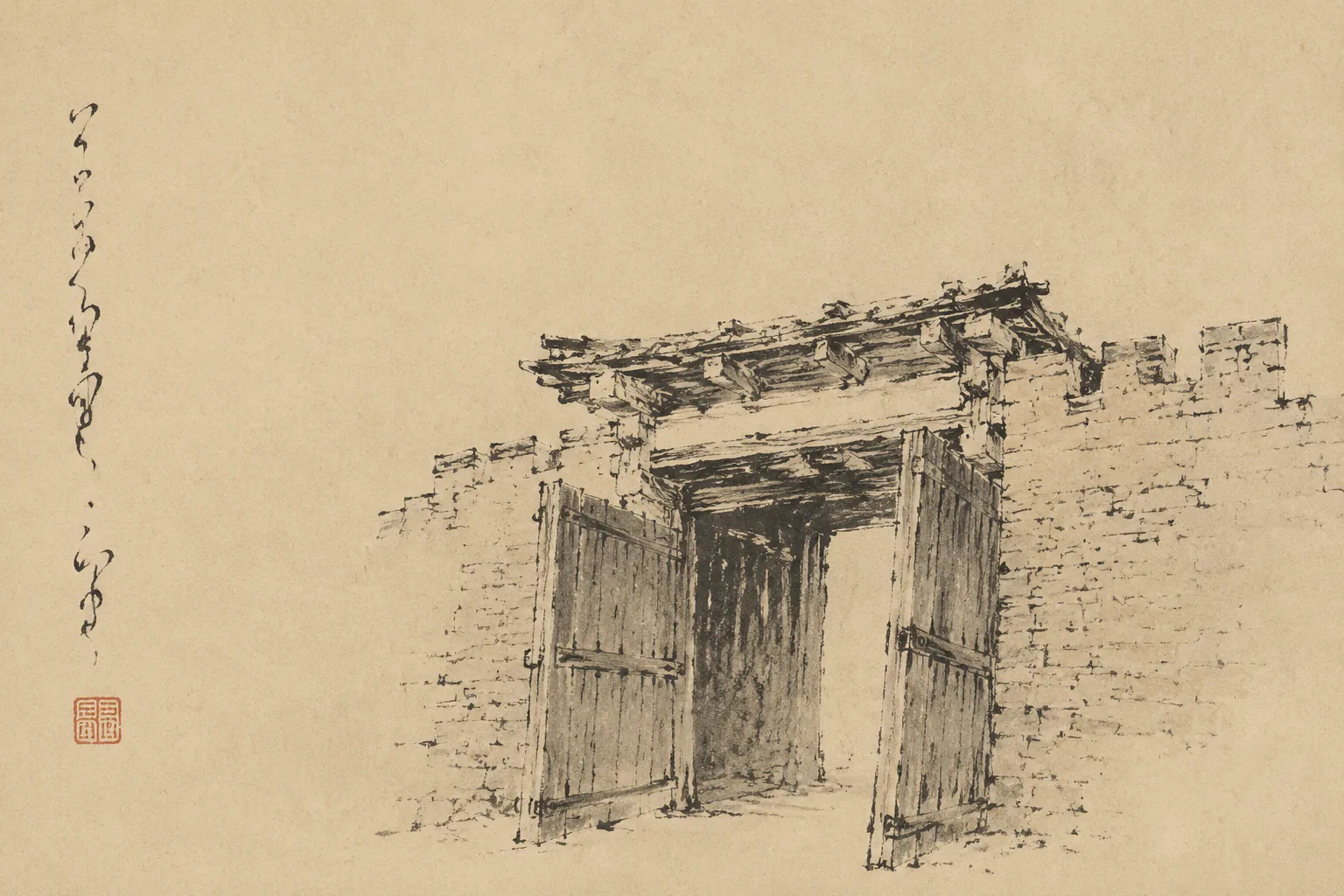
Generated illustration · the published offer — open the gates and keep the town · after a Yuan dynasty literati dry-brush ink painting on paper
03
Walls have gates. Gates have men. Men have a price.
The terms offered
The Mongol offer was published in advance: a city that opened its gates was spared, a city that resisted was destroyed. Because the terms were known, most places surrendered before an army arrived. The destruction of those that resisted, Baghdad in 1258 among them, is what made the terms credible.
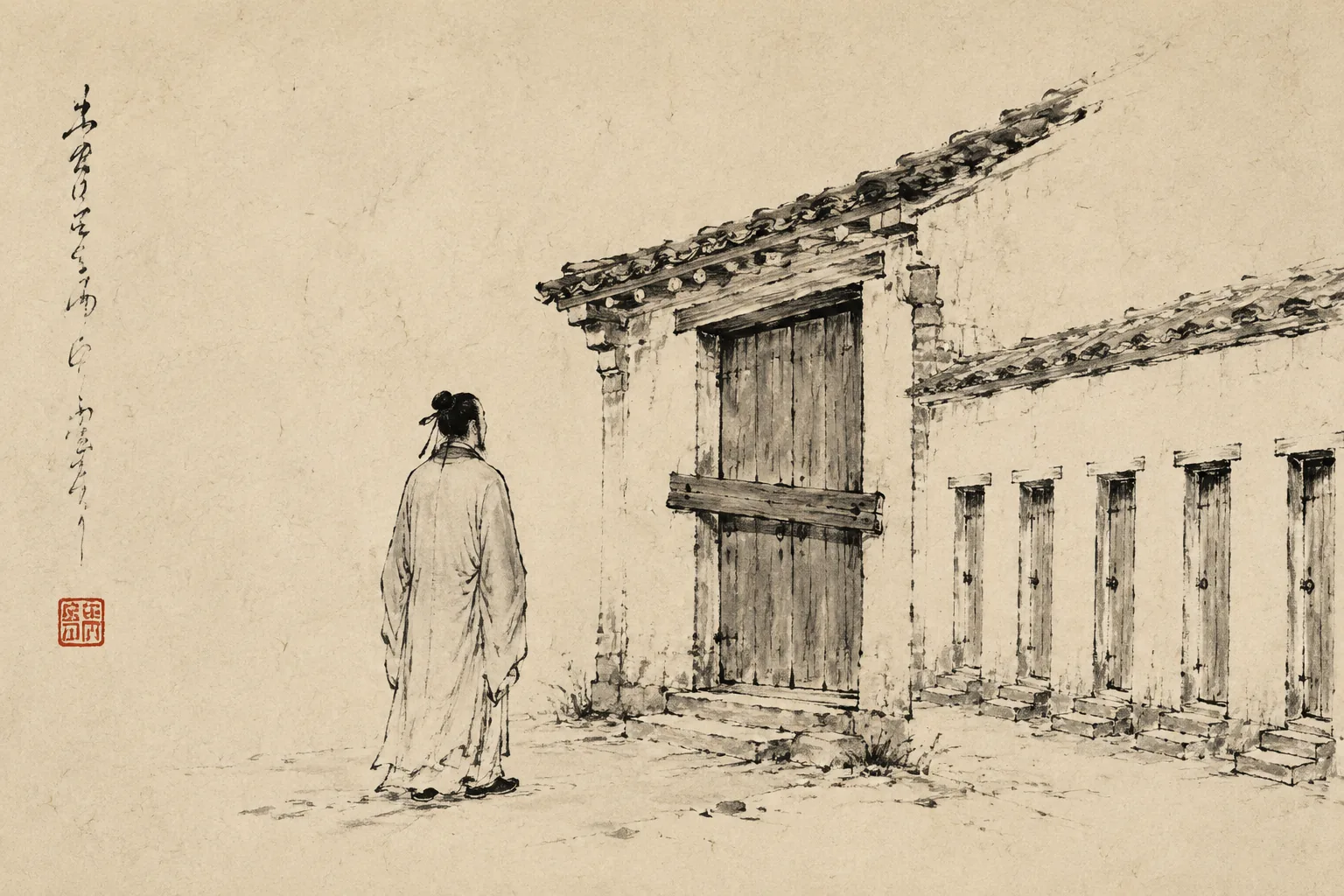
Generated illustration · the examinations suspended for four decades under Yuan rule · after a Yuan dynasty literati dry-brush ink painting on paper
04
found the door shut. And then
Four ranks, and the examinations suspended
The Yuan sorted the population into four legal ranks, with Mongols at the top and southern Chinese at the bottom, and suspended the civil service examinations for around four decades. This closed the one career for which an educated man had trained.
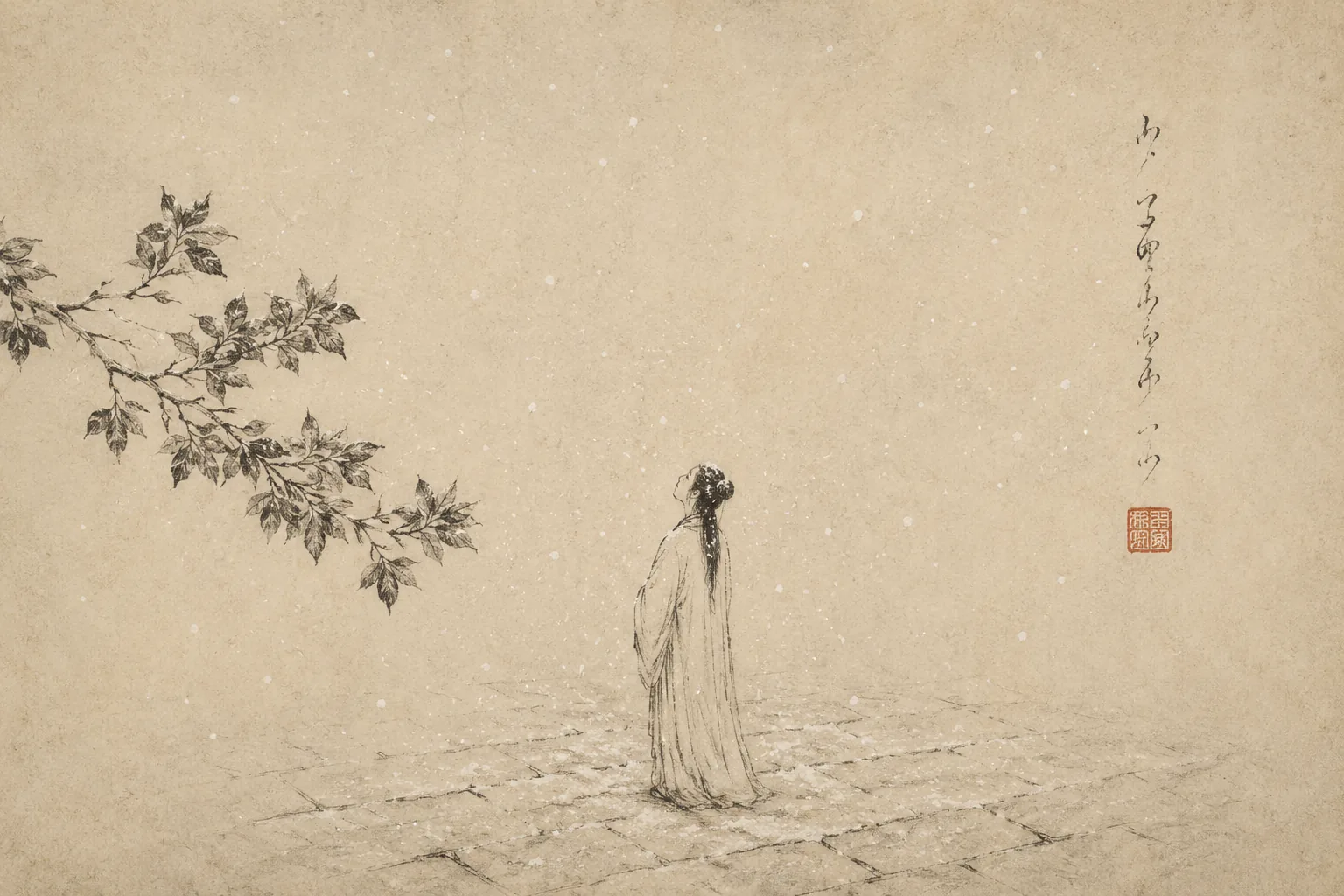
Generated illustration · Guan Hanqing’s Dou E: the drama a closed civil service produced · after a Yuan dynasty literati dry-brush ink painting on paper
05
and the snow falls in June to prove her innocent.
Yuan drama
Shut out of government office, educated men wrote for the theatre. Guan Hanqing’s Injustice to Dou E has a woman executed on a false confession, and snow falling in June as proof of it. Yuan drama is one of the major periods of Chinese literature, and it followed directly from the closure of the examinations.
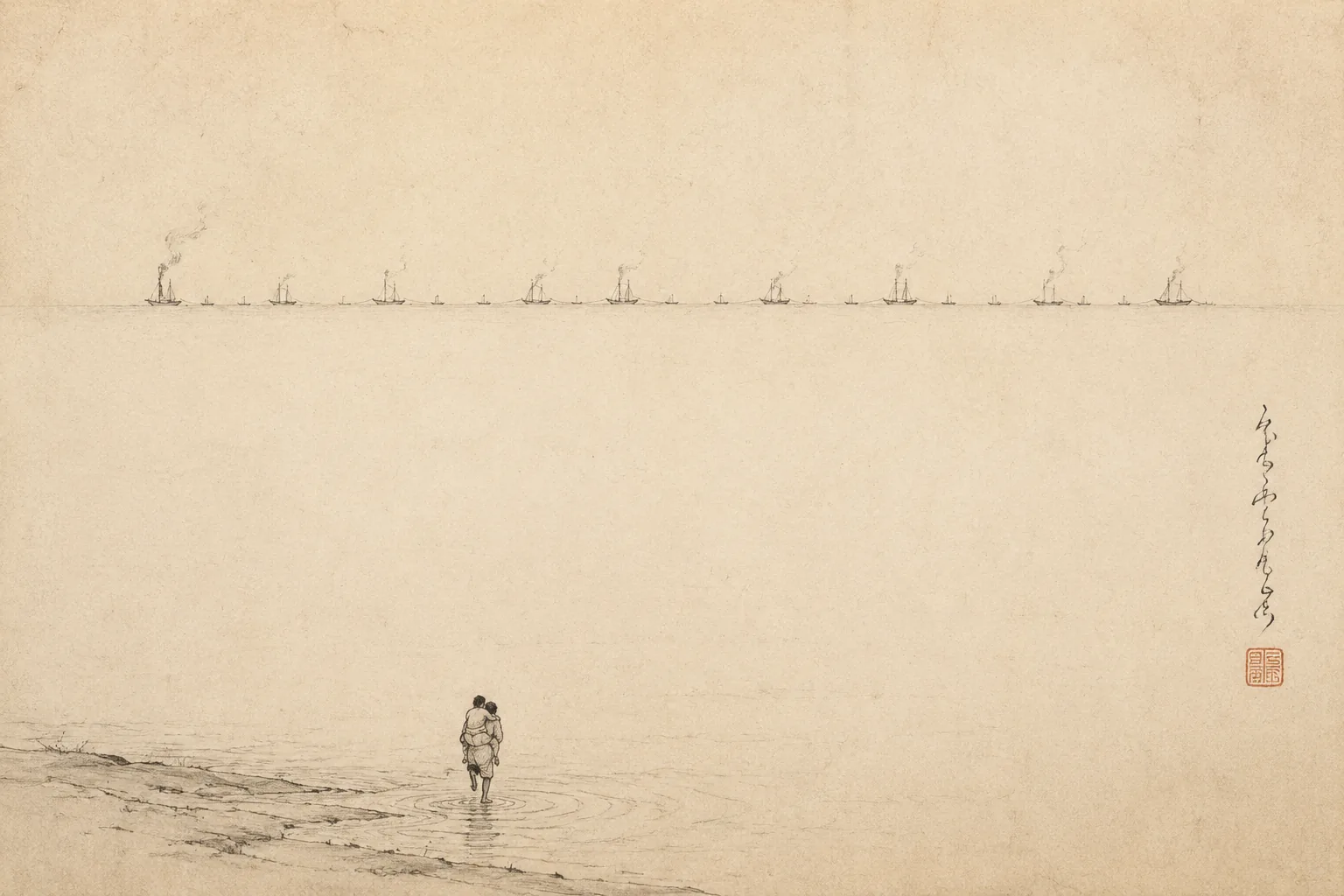
Generated illustration · 1279, the end of the Song, and the first rule of all China from outside · after a Yuan dynasty literati dry-brush ink painting on paper
06
and he walks into the sea with the child, because there’s nowhere left to turn.
Yamen, 1279
The last Song fleet was destroyed in a bay off the southern coast. The chancellor Lu Xiufu carried the eight-year-old emperor into the sea rather than let him be captured, and the sources report that many thousands followed. It ended three centuries of Song rule, and was the first time all of China was governed from outside.
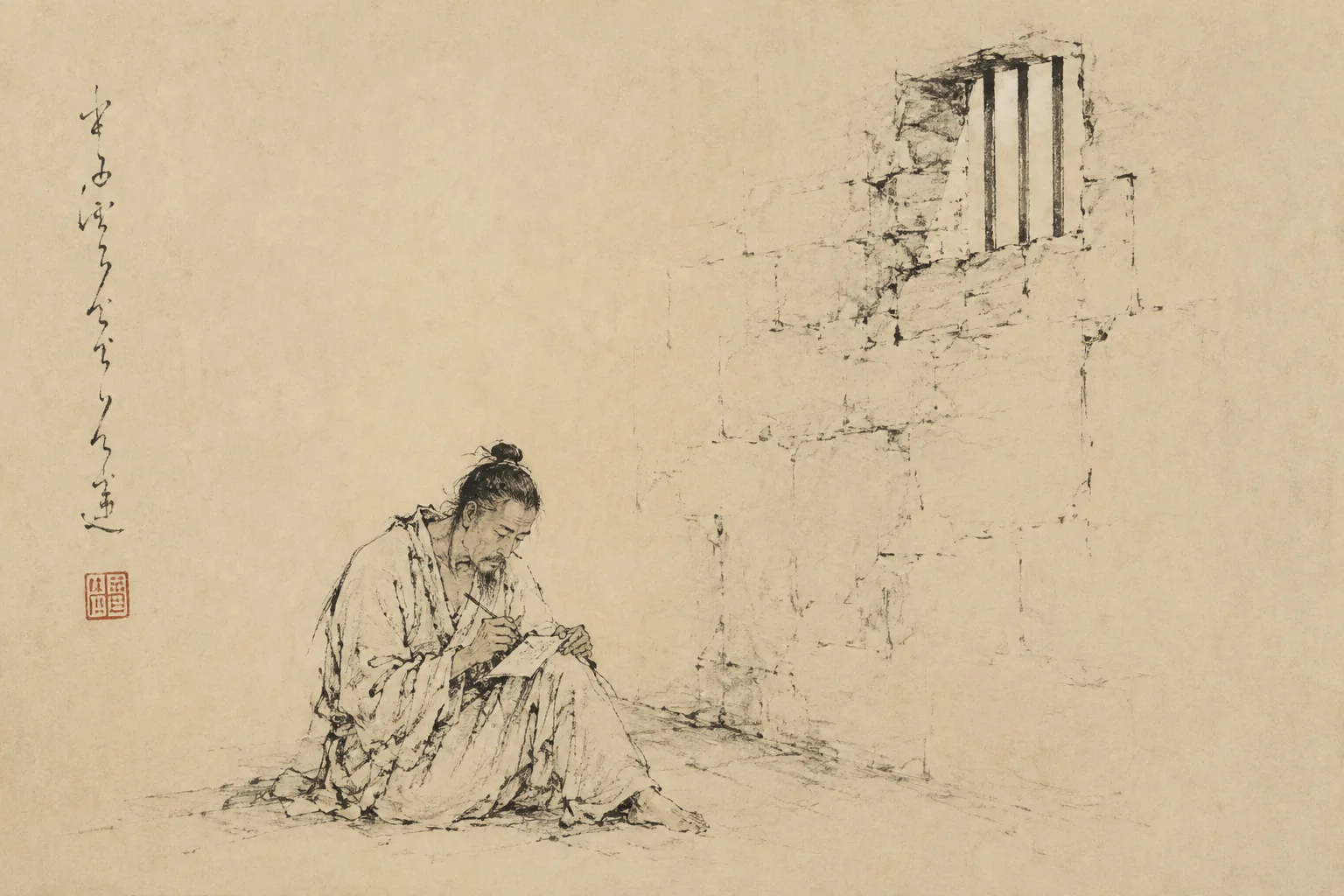
Generated illustration · Wen Tianxiang refusing high office, and writing in his cell instead · after a Yuan dynasty literati dry-brush ink painting on paper
07
about the one thing you get to keep when everything else is dead.
Wen Tianxiang, executed 1283
Wen Tianxiang was captured, held for three years, and offered high office by Kublai Khan if he would serve. He refused, and wrote in his cell instead. Before his execution he turned to face south, toward where the Song throne had stood. His prison poem remains among the most quoted in the language.
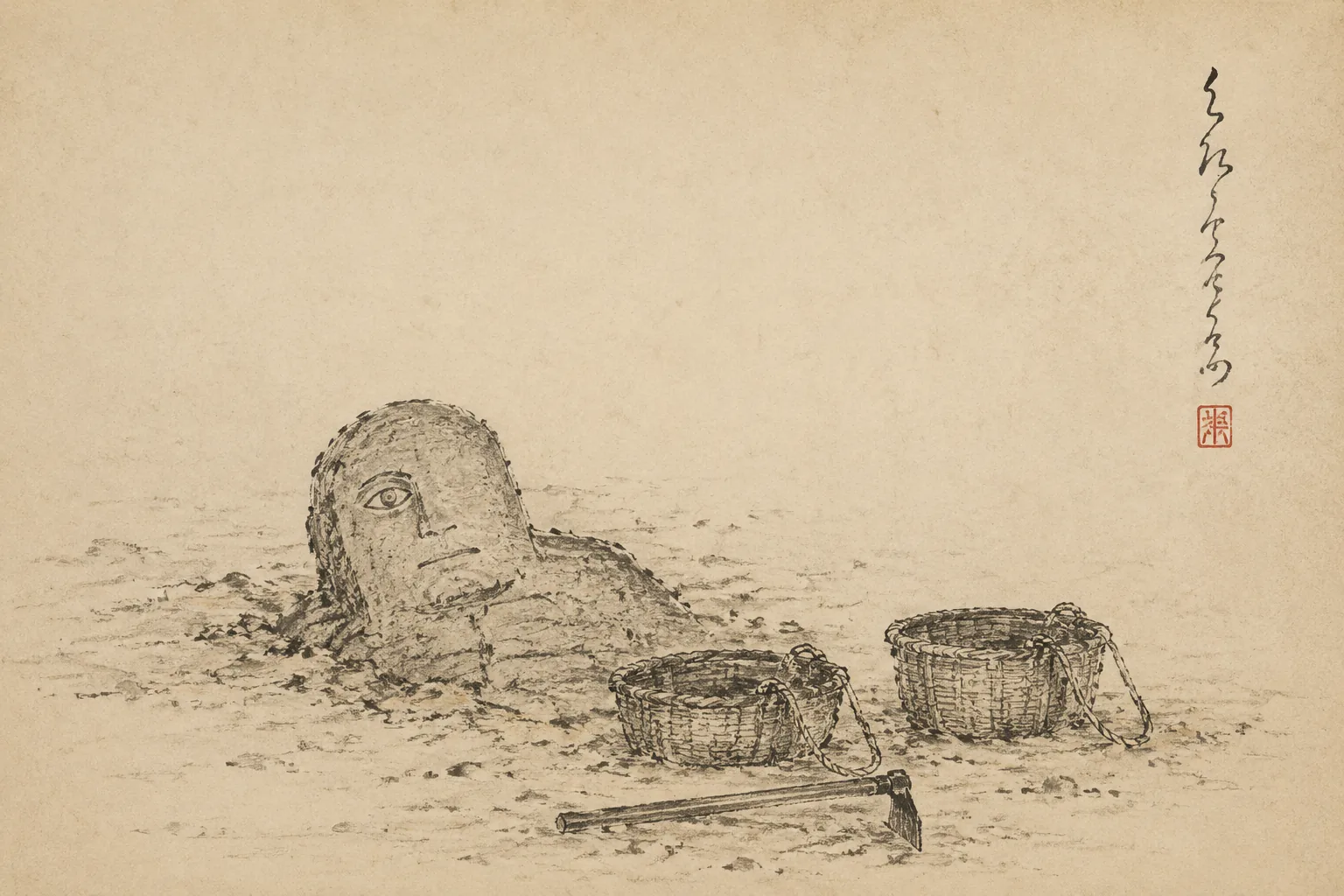
Generated illustration · the planted statue of 1351, and the rebellion it started · after a Yuan dynasty literati dry-brush ink painting on paper
08
Somebody buried it the week before. Best piece of propaganda ever built.
The one-eyed stone man, 1351
The Yellow River changed course in 1344. The mass conscription to redirect it, some 150,000 men, came in 1351; the song compresses the two dates. A rhyme circulated on the works that a one-eyed stone man would rise from the river and end the dynasty. One was dug up. It had been planted there. The Red Turban rebellion began within weeks.
09
Ming, 1368–1644
Words 82 lines
Fourteen oh five. Three hundred ships. Twenty-seven thousand men.
Eighty-seven years before Columbus takes three boats and ninety.
Born in Yunnan. Muslim family. Hajj on my grandfather's tongue.
Ming army came through when I was ten. Took the boys. I was young,
and they made me what they made all the captured boys back then,
and I grew to six foot, and I served a prince, and the prince became
the emperor of everything, and handed me the sea.
Eunuch admiral. Both those words. That's the whole of me.
Treasure ship's four hundred feet if you believe the count,
watertight bulkheads, sternpost rudder, and a crew you can't amount
to anything in Europe for a century and a half.
Carpenters, doctors, translators, astrologers on staff.
Seven voyages. Champa, Java, Malacca, Ceylon,
Calicut, Hormuz, Aden, and the Swahili coast, and on
to Malindi, where they gave me a giraffe for the emperor's floor.
Court called it a qilin. Sign of heaven's favour. Nothing more
than a tall animal on a boat for eleven thousand miles.
They wrote poems about it. Stood in the courtyard in rows and smiled.
We went. We went out further than anybody knew.
And we came back. And we came back.
And then we never came back through.
Understand the mission though, before you make me a saint.
Wasn't looking for a continent. Wasn't laying paint
on an empty map for science. I was there to make it plain:
there is a centre to the world, and here's what it costs to stay in the frame.
Tribute system. Send a gift, get a bigger one back,
kowtow, get trade rights and protection. That's the pact.
Soft power with a fleet behind it. It's a flex you can moor.
And when the king of Ceylon tried it on I took him prisoner in his own war
and shipped him to Nanjing. Pirate fleet in the straits, I burned it.
Five thousand dead in a channel. That's the peace. We earned it.
So no, we weren't gentle. We just weren't settlers.
Never planted a flag in a harbour and called the harbour ours.
Never built a fort on somebody's coast and named it for a saint.
Didn't want the land. Wanted the letter, the bow, the paint.
Whether that's restraint or a different kind of pride,
I've had six hundred years to think about it. Haven't decided.
Then the emperor dies. The next one lasts ten months.
And the one after that has advisors, and the advisors have a view.
The view is this: the fleet costs more than the grain tax of two provinces.
Mongols are massing in the north. There is nothing in the south we need.
The voyages are a eunuch's vanity and a drain on the treasury. Stop them.
So they stopped them. Ships rotted at anchor in Nanjing.
Skills went with the shipwrights, and the shipwrights went with the work.
And when someone at court later asked to see the records
so the voyages could be proposed again,
the archive could not produce them.
Burned, or hidden, or lost, depending who you read.
Either way the answer was the same:
there is nothing to look at. There is no such thing as that road.
Fourteen thirty-three. Last fleet home. I died somewhere on it,
buried at sea off Calicut, most likely, if you want it honest.
Fourteen ninety-two, a Genoan with three small ships and a bad estimate
sails west with royal backing and a deed for whatever he can get.
Not better sailors. Not better boats. Not braver, not more skilled.
Just a continent of small hungry kingdoms where nobody could build
a wall around the whole idea and simply cancel it.
Europe was too broken to be stopped. That was the benefit.
One king says no, you walk to the next king. There's always a next king.
We had one desk. And one man at that desk decided the whole thing.
Two-mast limit on private ships. Then no seagoing ships at all.
Coastal villages emptied inland by the wall
of a law that made the ocean into a crime you could commit.
And the pirates filled the gap, 'cause a sea don't stay empty,
and the smuggling went on anyway, it just went on without a flag.
My dad has a mate who says it all the time.
Says, we could have had the whole world and we chose not to.
Says it like it's a flex. Like restraint. I used to nod.
Now I think about the best ships anyone had ever built
sitting in a river turning into soil,
and a man in a room deciding that the thing that costs money
is the thing that isn't real.
And I think about my grandad landing at Southampton in fifty-nine
with one case, on a ship built in a country
that had spent four hundred years deciding
the sea was somebody else's business.
You don't get to keep the option. That's what nobody tells you
about turning inward. You don't get to keep it warm.
The knowledge goes. The men who knew go.
And one day somebody comes to your coast anyway,
and they're the ones with the boats.
Eighteen thirty-nine. They came with the boats.
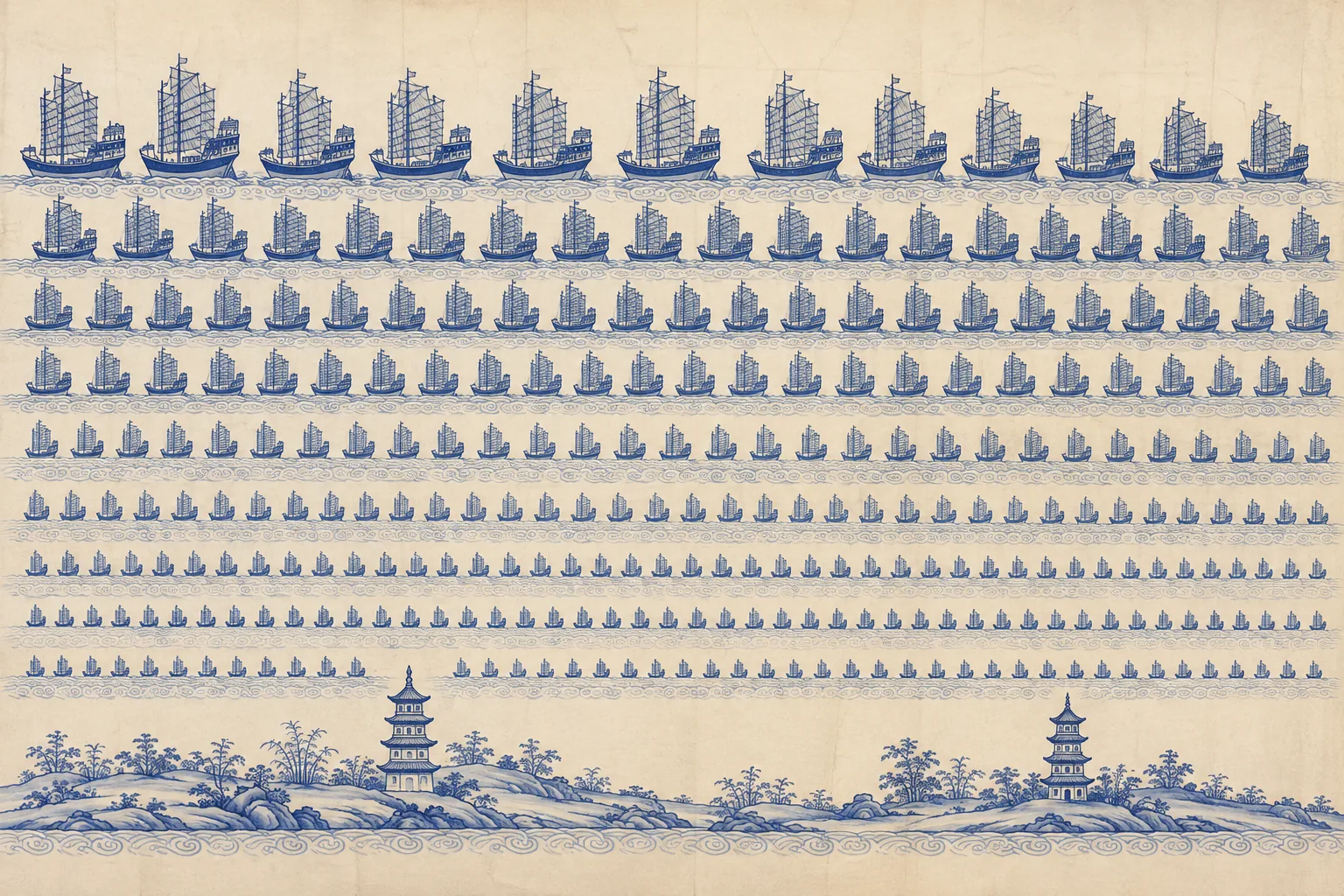
Generated illustration · 1405: the largest navy in the world, eighty years before Columbus · after a Ming navigational strip-map scroll in a blue-and-white porcelain palette
01
Fourteen oh five. Three hundred ships. Twenty-seven thousand men.
The first voyage, 1405
The first fleet sailed in 1405 with several hundred vessels and around twenty-seven thousand men, the largest navy in the world. Columbus crossed the Atlantic eighty-seven years later with three ships and about ninety men. Seven Ming voyages followed in under thirty years.
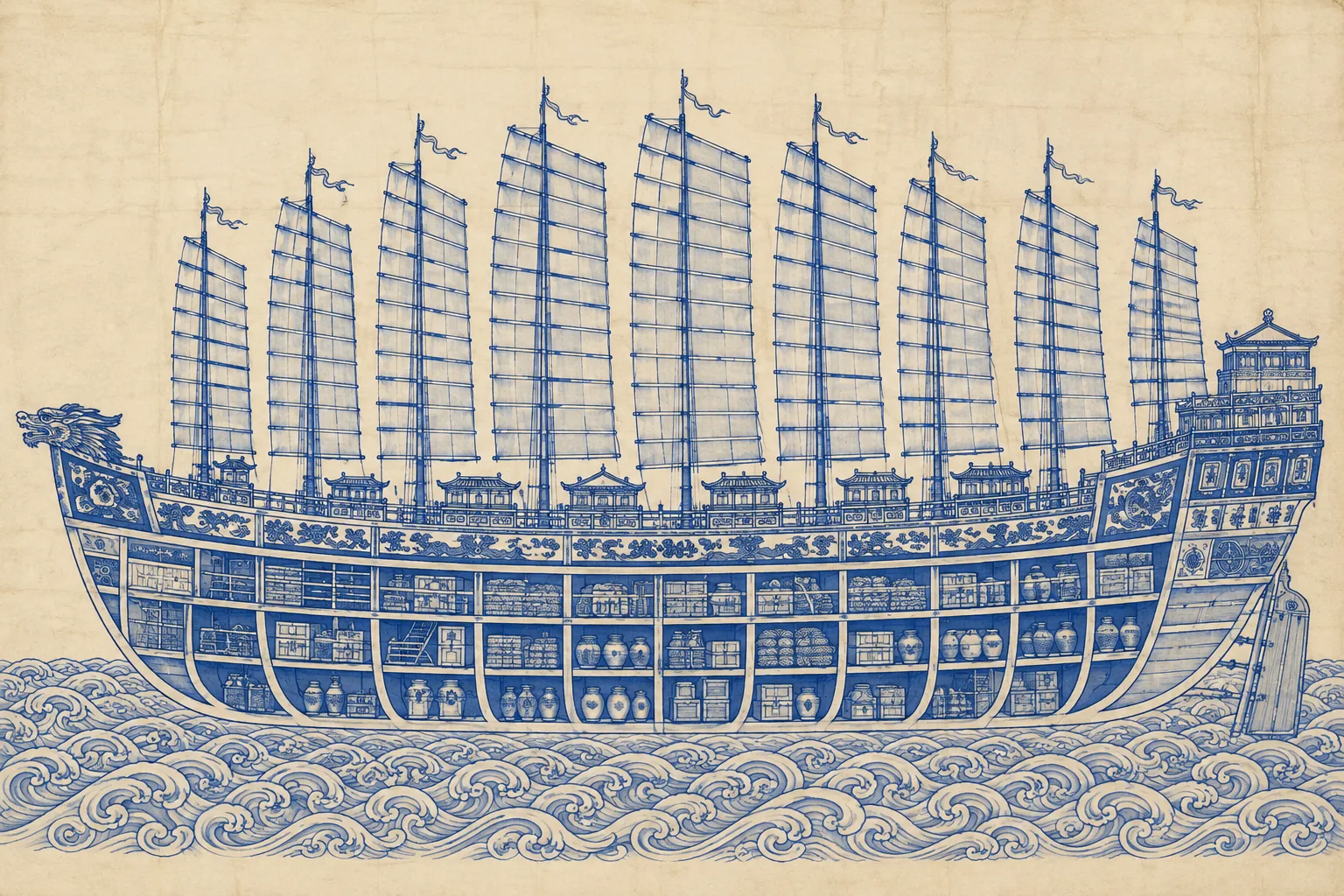
Generated illustration · the treasure ship, watertight-compartmented centuries early · after a Ming navigational strip-map scroll in a blue-and-white porcelain palette · dimensions disputed
02
watertight bulkheads, sternpost rudder, and a crew you can’t amount
The treasure ships: dimensions disputed
Ming sources record the largest ships at over four hundred feet, which would make them the biggest wooden vessels ever built. Naval historians dispute the figure, since the rigging loads may not be sustainable in timber. The engineering is not disputed: transverse watertight compartments and a sternpost rudder, both centuries ahead of European practice.
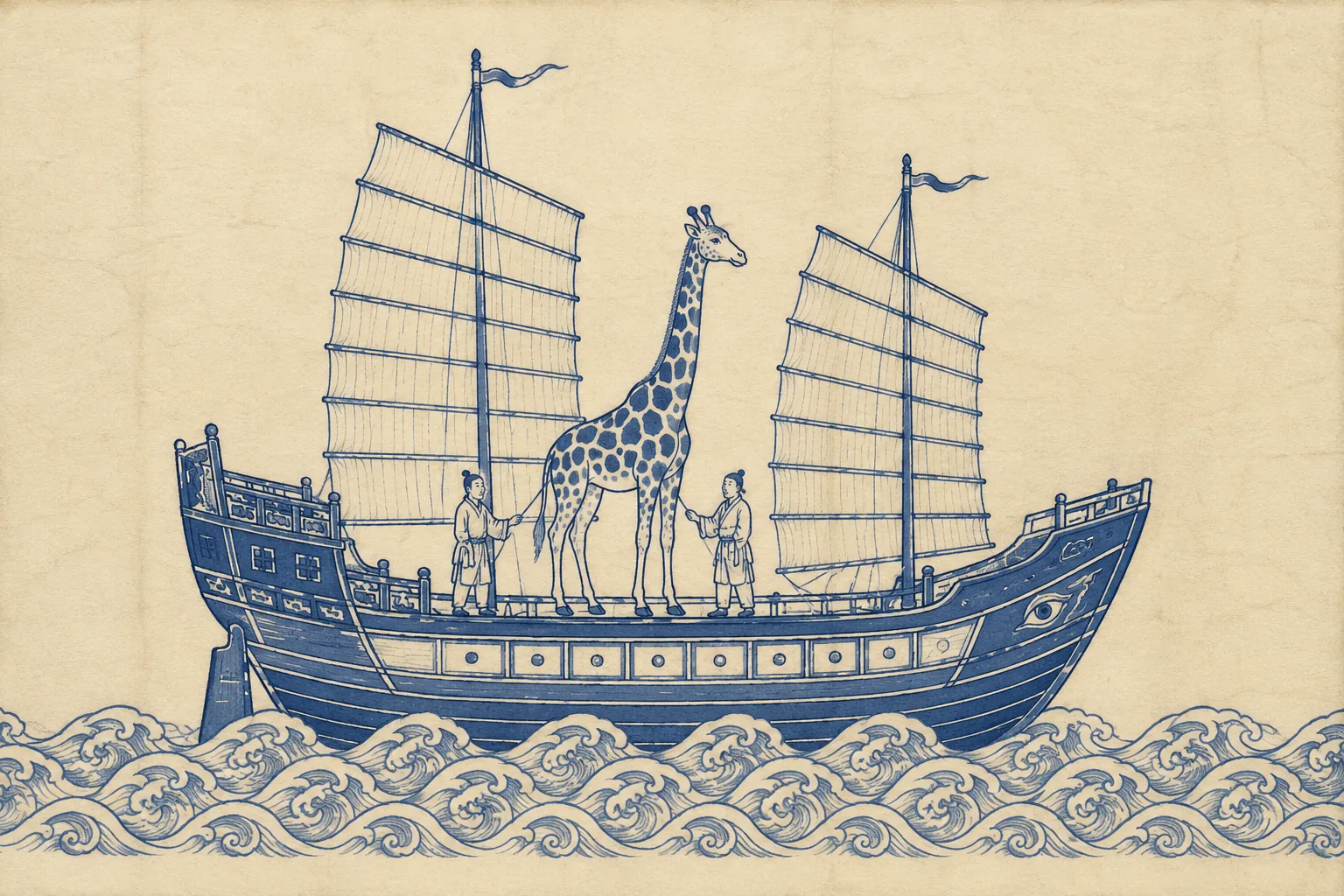
Generated illustration · a giraffe from the Swahili coast, received at court as a qilin · after a Ming navigational strip-map scroll in a blue-and-white porcelain palette
03
Court called it a qilin. Sign of heaven’s favour.
The giraffe presented at Nanjing, 1414
A giraffe was given to the fleet at Malindi on the Swahili coast and carried some eleven thousand miles to Nanjing. The court identified it as a qilin, an auspicious beast held to appear when a just ruler holds the mandate of heaven. Officials assembled to view it and wrote poems on the occasion.
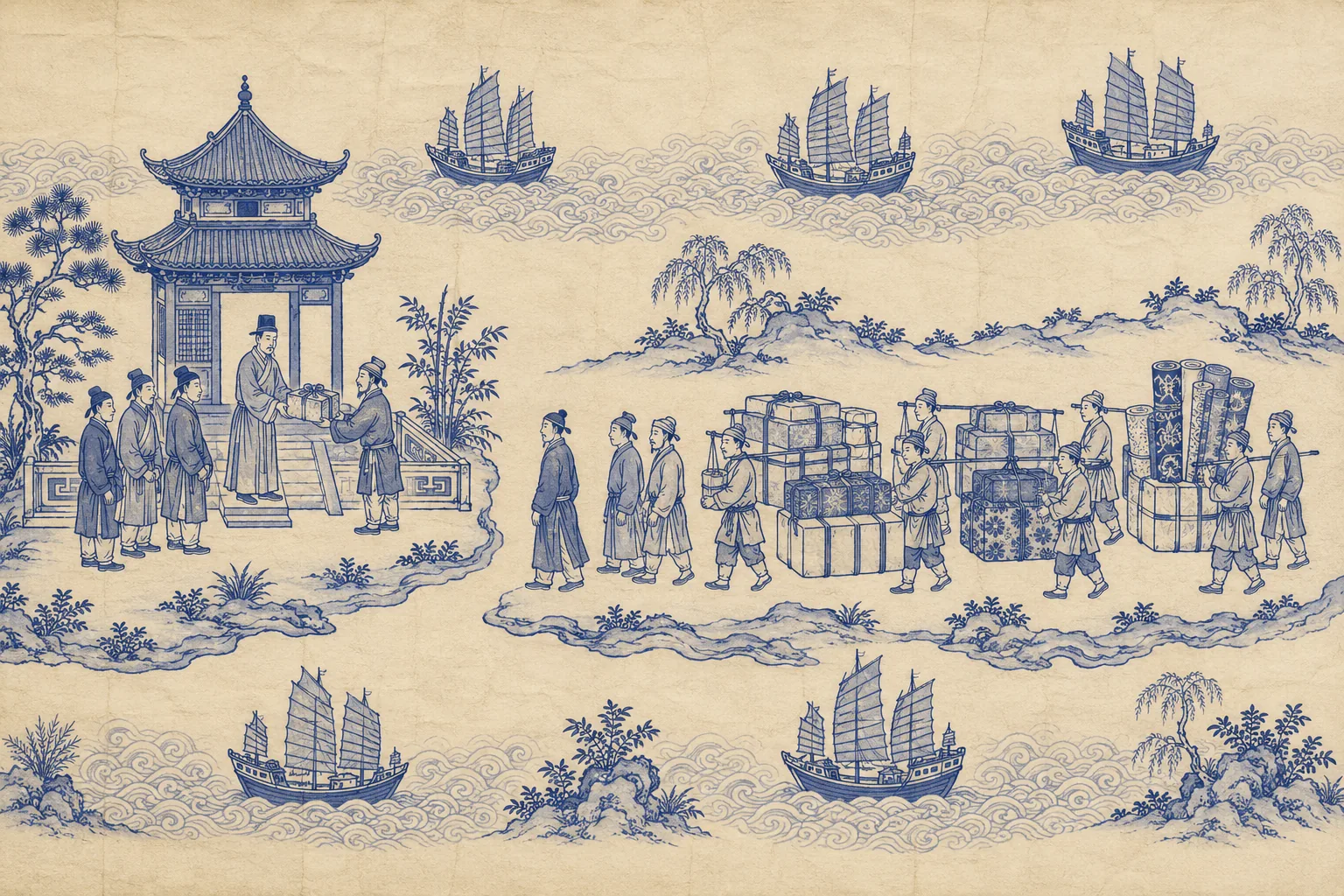
Generated illustration · the tribute system, run at a deliberate loss · after a Ming navigational strip-map scroll in a blue-and-white porcelain palette
04
Tribute system. Send a gift, get a bigger one back,
The tribute system
A foreign ruler sent a gift and performed the kowtow; the Ming court sent back something markedly more valuable, together with trade rights and protection. The system ran at a deliberate loss. What it purchased was formal acknowledgement of a single centre, with other states arranged around it.
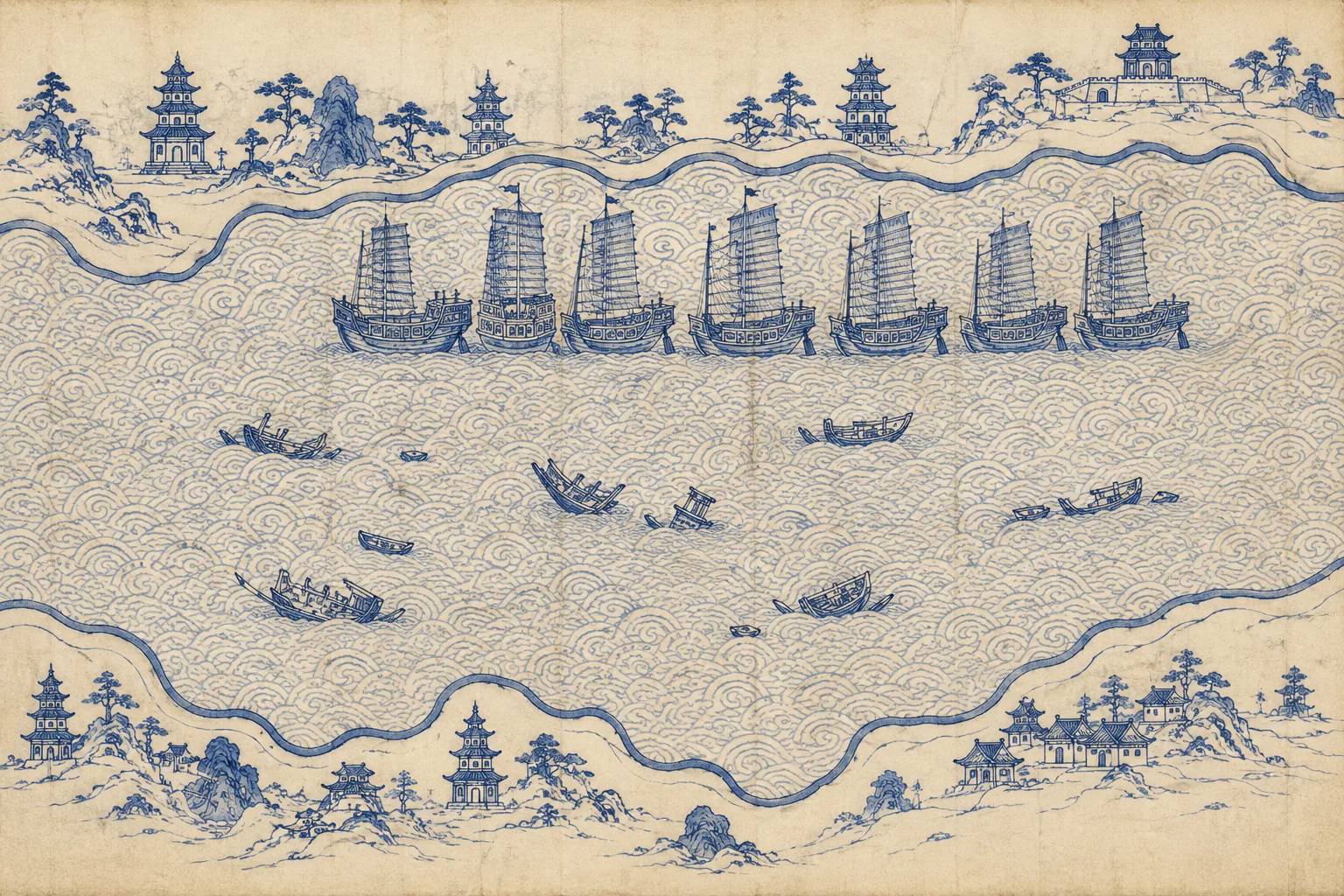
Generated illustration · the Malacca Strait, cleared by force — the fleets were not gentle · after a Ming navigational strip-map scroll in a blue-and-white porcelain palette
05
Pirate fleet in the straits, I burned it.
The fleets in action
The voyages were armed. Zheng He destroyed a pirate fleet in the Malacca Strait, with thousands reported killed, and took the king of Ceylon prisoner in his own country and carried him to Nanjing. The fleets did not claim territory: no forts were built and no colonies established.
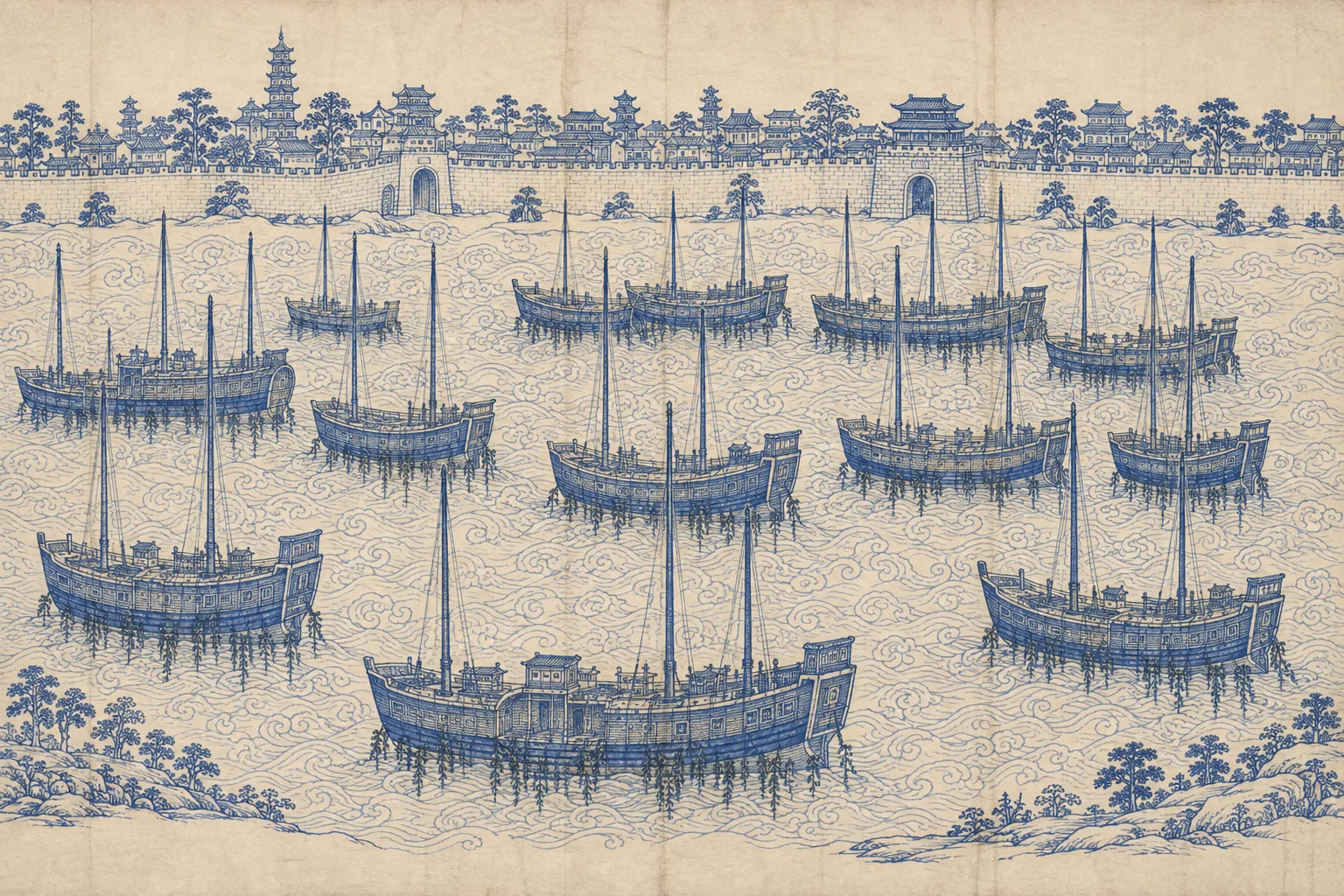
Generated illustration · after 1433, when the voyages were stopped as a drain on the treasury · after a Ming navigational strip-map scroll in a blue-and-white porcelain palette
06
Ships rotted at anchor in Nanjing.
The voyages halted, 1433
The court assessed the fleet as costing more than the grain tax of two provinces, with Mongol pressure increasing in the north and no strategic requirement in the south. The voyages were stopped, the ships were left at anchor, and the shipwrights dispersed to other work.
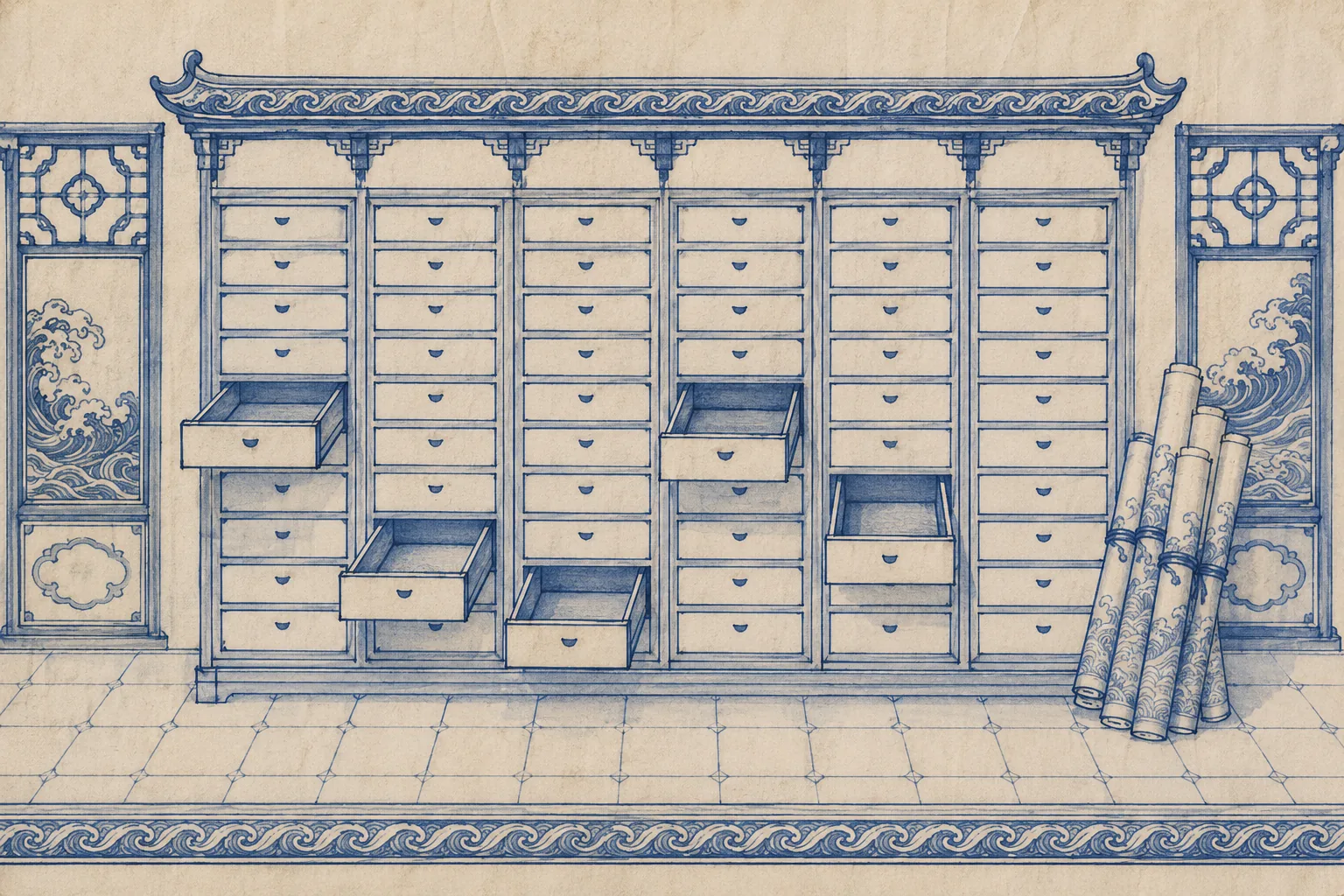
Generated illustration · the voyage records, unproducible when somebody later asked · after a Ming navigational strip-map scroll in a blue-and-white porcelain palette
07
there is nothing to look at. There is no such thing as that road.
The missing records
When a later official sought the voyage records so that the expeditions might be proposed again, they could not be produced. Accounts differ as to whether they were burned, hidden or simply lost. The traditional story that the official Liu Daxia destroyed them is disputed.
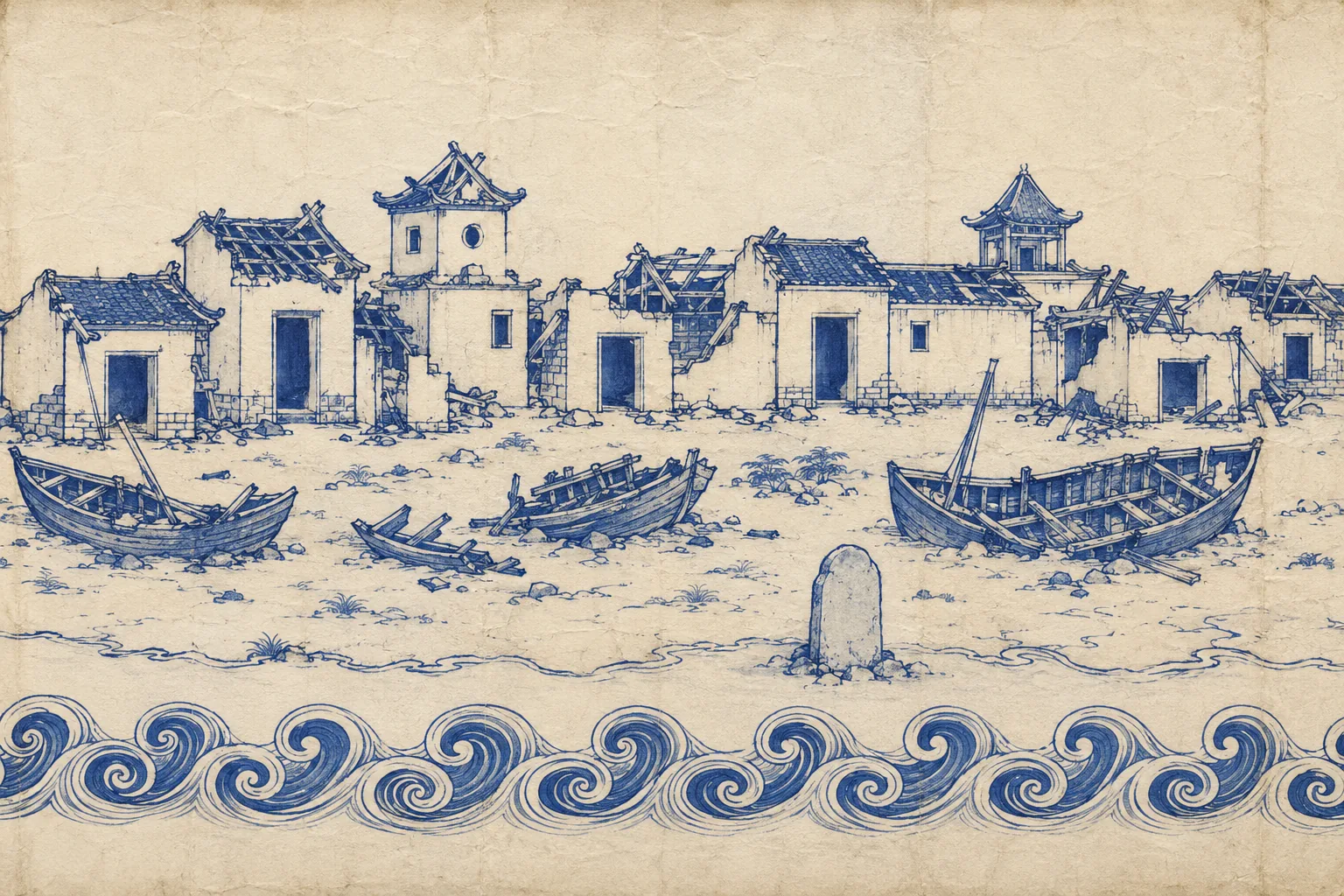
Generated illustration · haijin: private seagoing banned, and the coast cleared inland · after a Ming navigational strip-map scroll in a blue-and-white porcelain palette
08
of a law that made the ocean into a crime you could commit.
Haijin: the sea bans
Private seagoing vessels were first restricted by size and then prohibited outright, and stretches of coast were cleared inland to enforce the ban. Maritime trade continued as smuggling, and piracy increased. The large forced coastal evacuations were a later Qing measure of 1661.
10
Late Qing, 1839–1901
Words 81 lines
Silver in. Silver out.
Watch which way it flows. That's the whole century.
Eighteen hundred. We're a third of the world economy, easy.
Tea, silk, porcelain, everybody wants it, and we're breezy
about the terms: come to Canton, one port, one season,
deal through the licensed merchants, pay in silver. That's the reason
the bullion's flowing east and Parliament is losing sleep,
'cause Britain's got a habit and the habit isn't cheap.
Two hundred million pounds of leaf a year down English throats
and nothing we want back. Wool? In Guangzhou? Take your coats.
So they need a product. Something we'll take. Something addictive.
Grown on land they already hold. Something extractive.
Bengal. Company land. Poppy under British administration,
processed in Patna, auctioned in Calcutta, shipped by private operation
so the Company keeps clean hands and the courts stay confused,
sold to us illegally, by design, at a price we can't refuse.
That's not a trade dispute. Let's be exact about the crime:
a state-run narcotics operation. Planned. At scale. Over time.
Smoke going in. Silver going out.
Smoke going in. Silver going out.
Tell me who's the addict. Tell me what it's about.
Lin Zexu gets the job. Straight arrow. Actually good.
Seizes twenty thousand chests at Humen. Doesn't burn it like they would,
digs three trenches, floods them, salt and lime, breaks the balls in by hand,
twenty-three days of destruction, then flushes it off the land.
Wrote an apology to the sea god first for the mess he was about to make.
Then he wrote to Queen Victoria. That's the part I can't shake.
Polite. Reasoned. Says: I'm told your country bans this stuff.
I'm told you don't permit it at home. So how is it not enough
to know it's poison? Where's your conscience in this trade?
Sovereign to sovereign. One moral claim, plainly made.
She never got it. Never delivered. Times printed it later as a joke.
Traders went to Parliament, said our property's gone up in smoke,
so the fleet came. Nemesis. Iron hull, shallow draft, steam,
sails upriver against the current, which our whole defence had never seen.
War junks against a gunship isn't a battle, it's a demonstration.
Two hundred and seventy-one dead at Chuenpi. Two British. That's the equation.
Nanjing. Eighteen forty-two.
Twenty-one million silver dollars. Five ports opened.
Hong Kong ceded in perpetuity.
Extraterritoriality: a British subject who commits a crime here
is tried by British law, in a British court, on our soil.
Most favoured nation: anything we ever give anyone else,
Britain gets automatically, forever, without asking.
And it doesn't say the word opium anywhere in it. Not once.
They fought a war to sell a drug
and wouldn't write the drug's name on the paper.
Lin Zexu was blamed for the war and exiled to Xinjiang.
The man who was right.
That's treaty one. Now again. Second war, fifty-six,
pretext is a boat and a flag, and this time the French are in the mix.
Burn the Summer Palace. Three days. Eight hundred acres of it.
Killed nothing military. Killed a garden. Ceremonially did it.
Stuff's in our museums now. There's a dog in a case in London
named after the fire it came out of. That's not a slander, that's a label.
Meanwhile inside: Taiping. Man fails the exam four times,
has a fever dream, reads a tract, decides he's Christ's
younger brother sent to sweep the demons from the land.
Twenty million dead. Maybe thirty. Nobody counts that sand.
Bloodiest civil war in human history, and it's not close,
and in the West it's a footnote, and here it's a ghost.
Japan takes Taiwan in ninety-five, and that one's the knife,
'cause Japan was the student. Copied the West in one life,
came back and beat us in six months. Korea gone. Fleet gone.
Boxers rise, court backs them, eight foreign armies march on
the capital, dowager runs to Xi'an in a peasant cart,
indemnity four hundred and fifty million taels.
One tael per Chinese head. They costed it out. That's the art.
Hundred years of humiliation. Bǎinián guóchǐ.
I used to hear it in the news and think, alright, that's a bit,
that's the past getting weaponised, and I'm too clever to be organised.
Then I actually read the treaties. And they're worse than the propaganda.
The propaganda is a summary. The treaties are the receipt.
And I'm in a country that did it, on a road named for a man
who has a statue, and my mate goes, ancient history mate,
and it's a hundred and eighty years, and my grandmother's grandmother was alive.
That's four people. Four. Hold four hands and you're there.
I'm not defending anybody's government. I'm telling you the arithmetic.
You don't get carved for a century and come out relaxed about the knife.
Nineteen eleven. Two thousand years of emperors.
Ends in a bomb accident in Wuchang
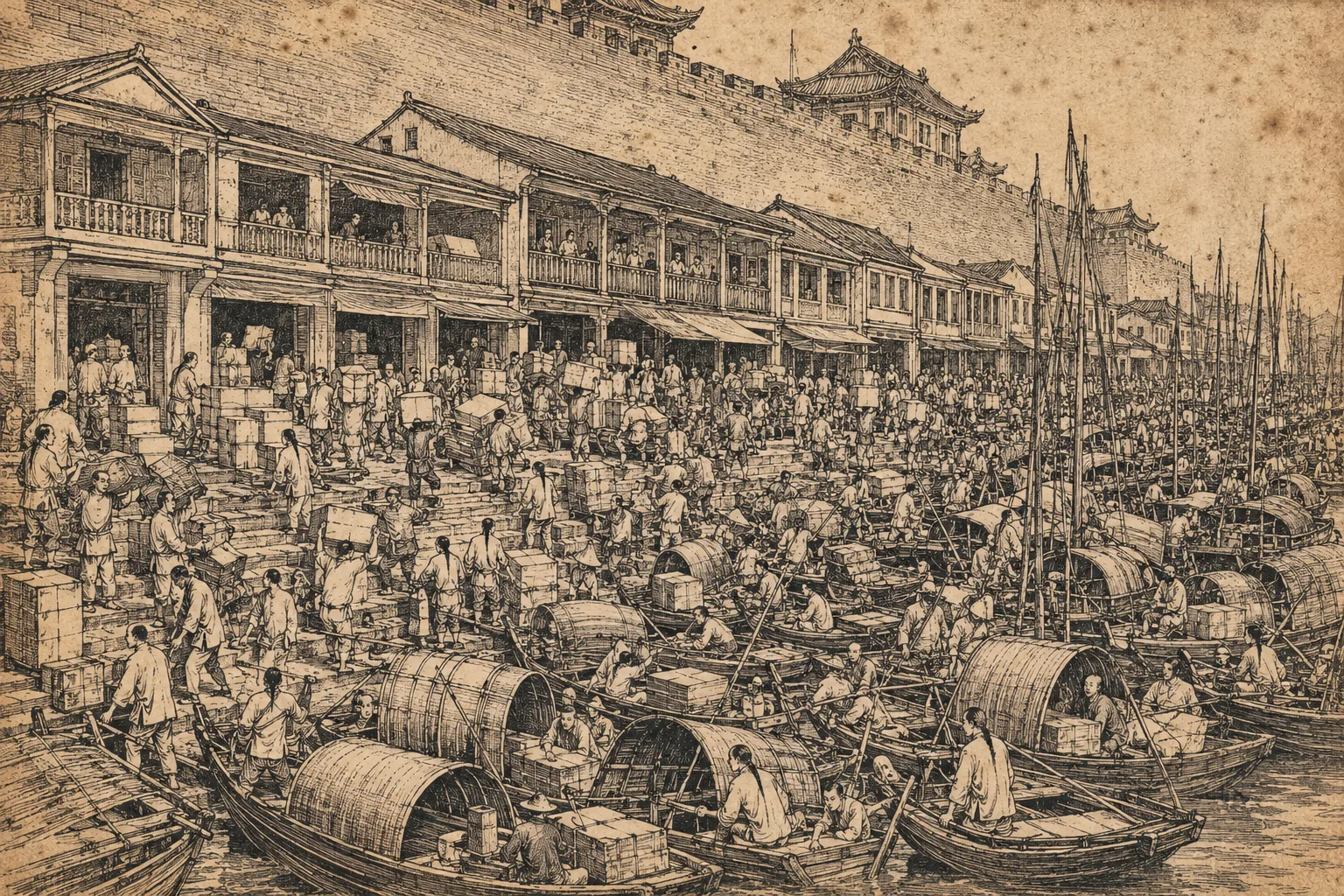
Generated illustration · the Canton system: one port, one season, payment in silver · after a late Qing Dianshizhai Pictorial lithograph
01
come to Canton, one port, one season,
The Canton system, to 1842
All foreign sea trade passed through one city in one season, handled by a licensed guild of Chinese merchants, from a strip of factories outside the city wall that Europeans were not permitted to leave. Payment was in silver. The arrangement was restrictive and profitable to China, and its end was the object of the wars.
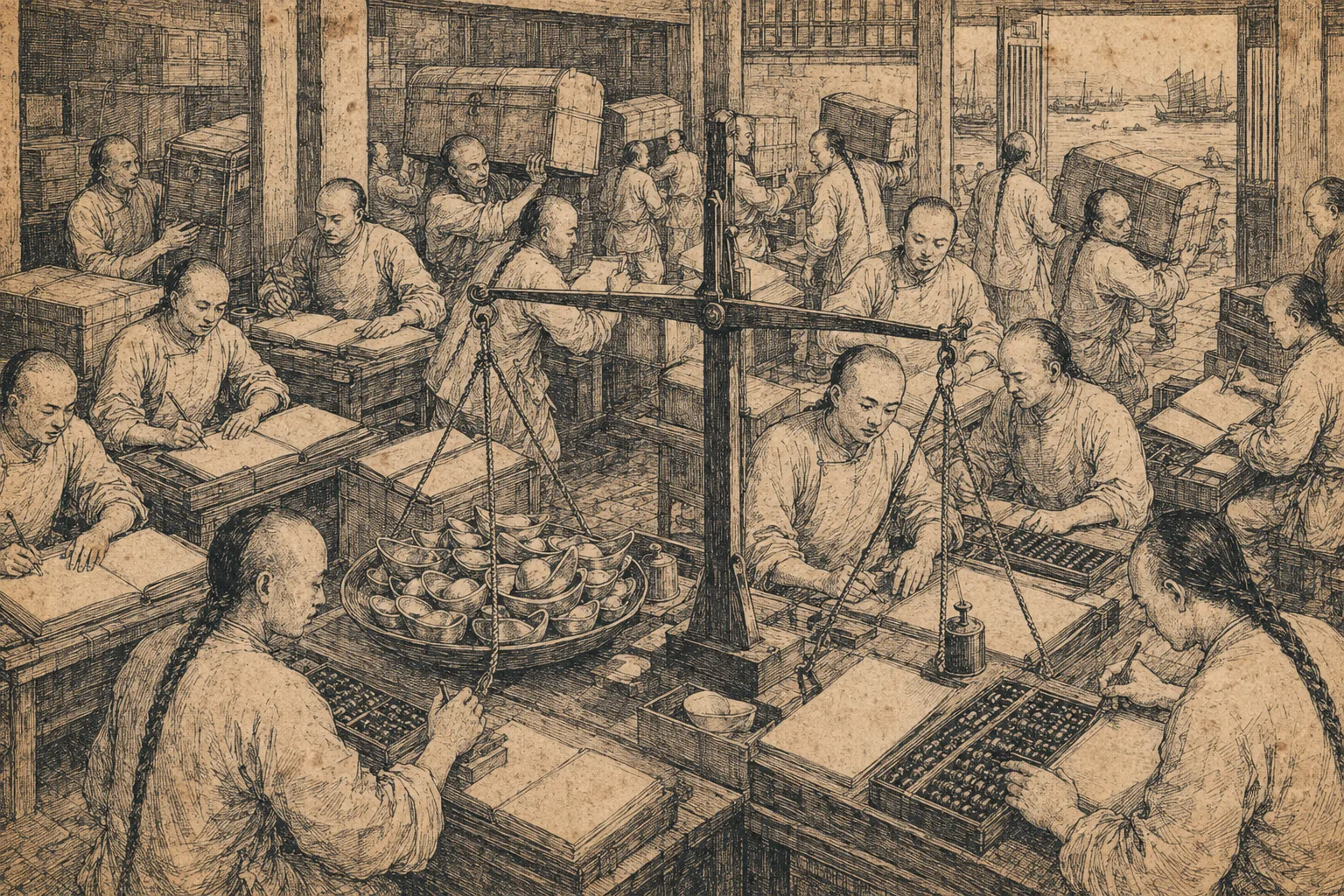
Generated illustration · thirty million pounds of tea a year, and the bullion going one way · after a late Qing Dianshizhai Pictorial lithograph
02
Smoke going in. Silver going out.
The tea trade and the silver drain
By the 1830s Britain imported on the order of thirty million pounds of Chinese tea a year and had little that China wished to buy in exchange, so the balance was settled in silver. Opium reversed the direction of that flow. The song’s figure of two hundred million pounds belongs to the late nineteenth century.
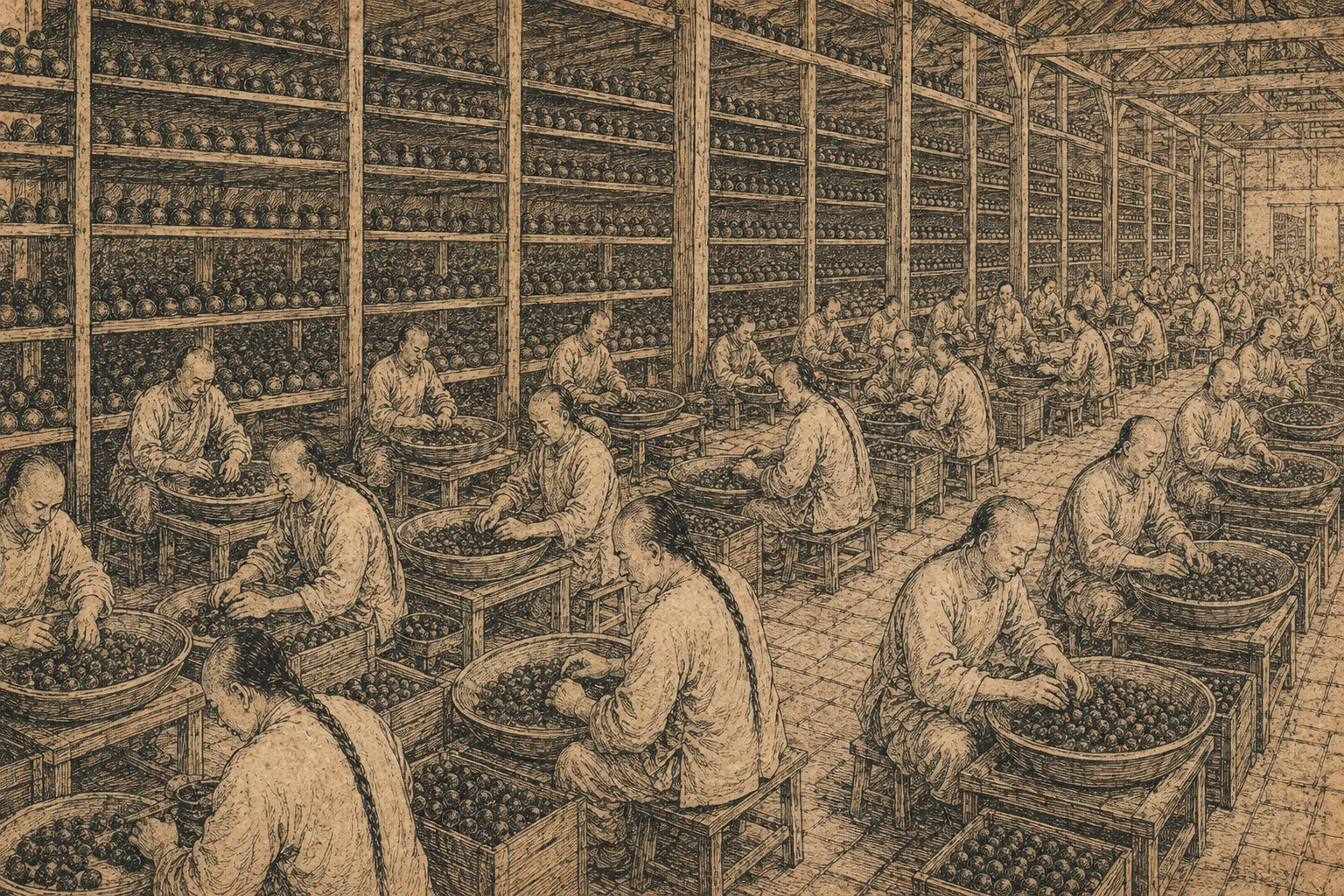
Generated illustration · opium grown on Company land in Bengal and auctioned in Calcutta · after a late Qing Dianshizhai Pictorial lithograph
03
Bengal. Company land. Poppy under British administration,
Bengal opium
The opium was grown on East India Company land in Bengal, processed at Company factories in Patna and Ghazipur, and auctioned in Calcutta. It was then carried to China by private traders, which allowed the Company to hold a monopoly on the product without conducting the smuggling itself.
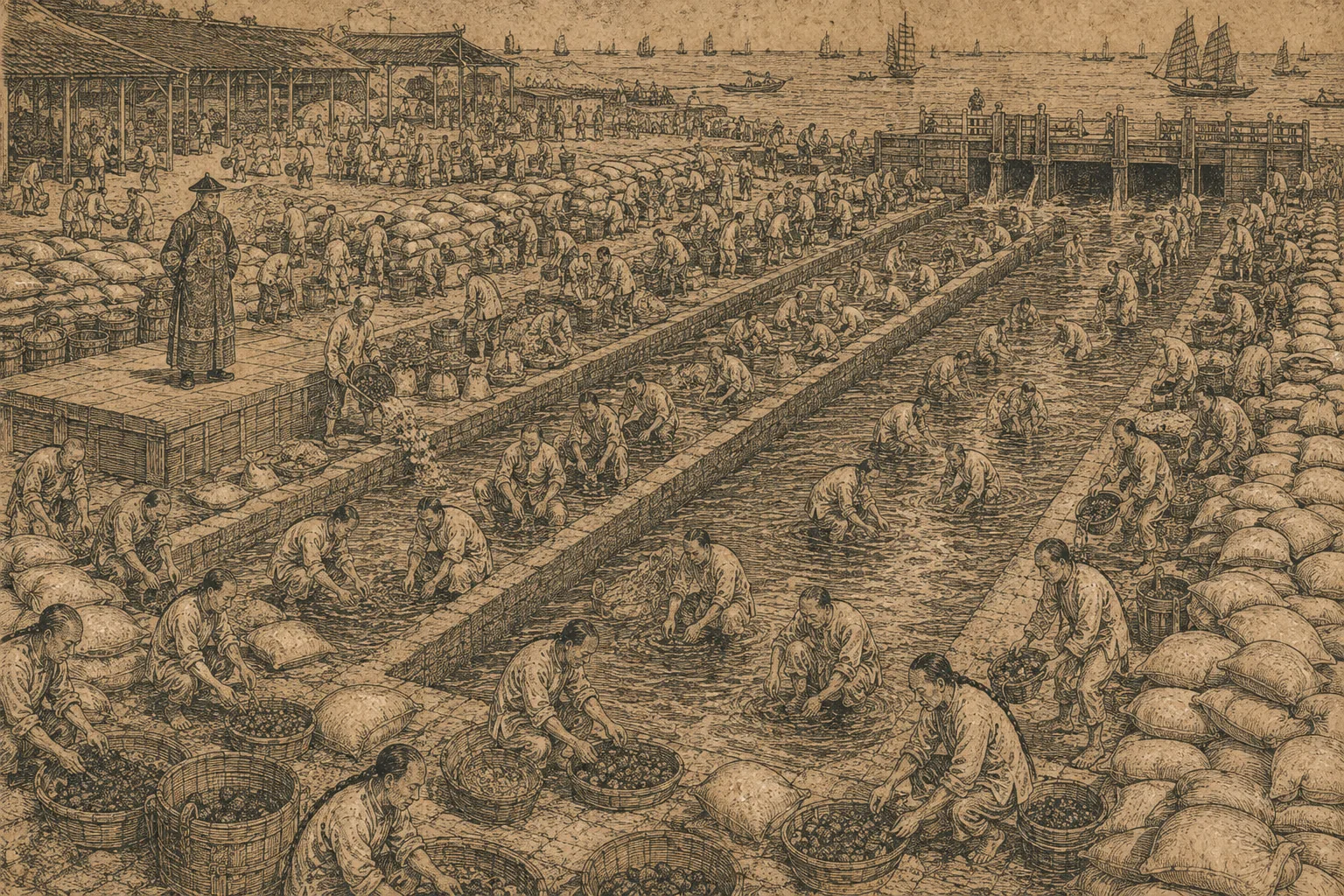
Generated illustration · Humen, 1839: twenty thousand chests destroyed in flooded trenches · after a late Qing Dianshizhai Pictorial lithograph
04
twenty-three days of destruction, then flushes it off the land.
Humen, June 1839
Commissioner Lin Zexu seized around twenty thousand chests of opium and destroyed them over twenty-three days. The chests were not burned: the balls were broken by hand into flooded trenches dosed with salt and lime, and the residue flushed to sea. Lin wrote an apology to the sea god beforehand.
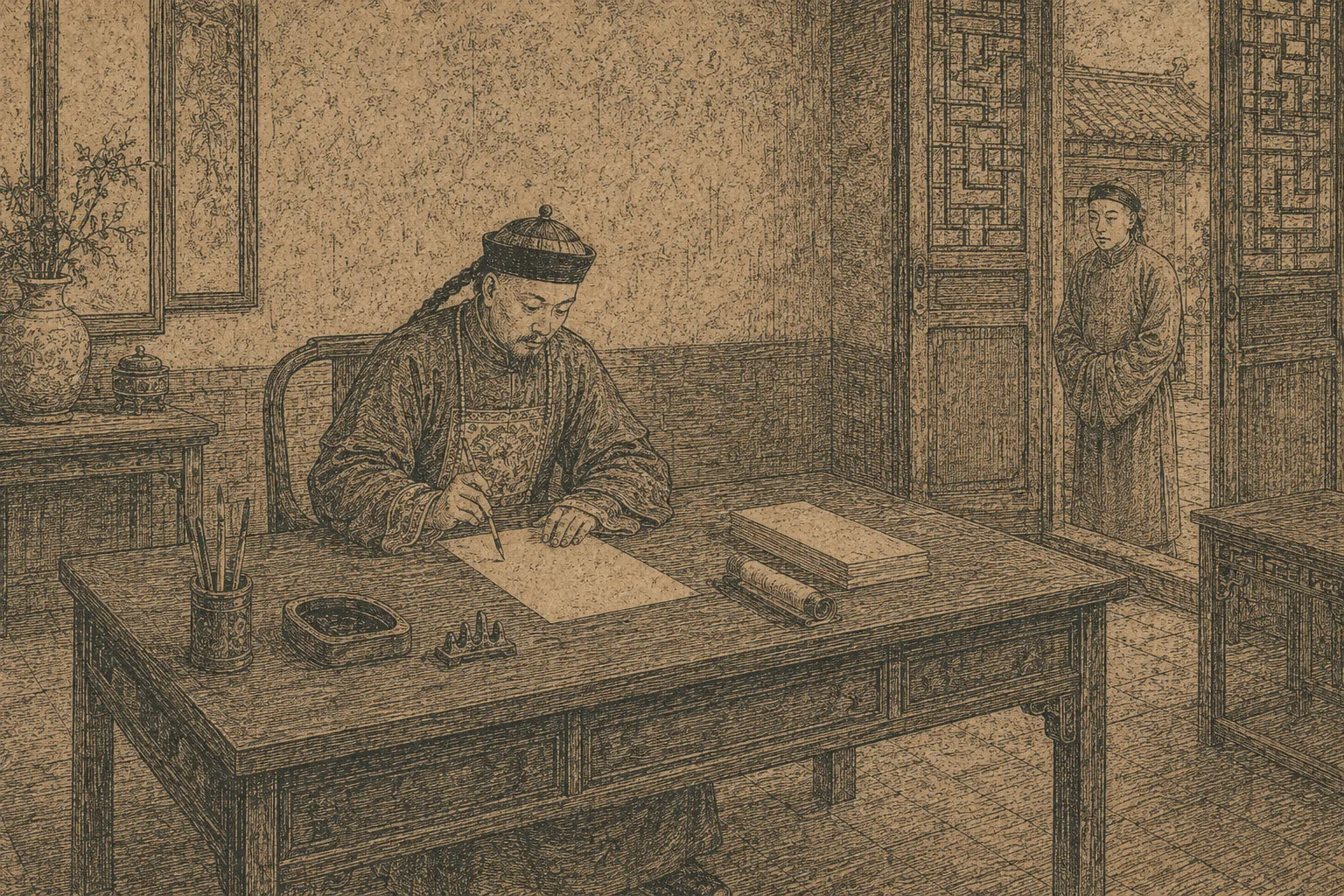
Generated illustration · Lin Zexu’s letter to Queen Victoria, never delivered · after a late Qing Dianshizhai Pictorial lithograph
05
She never got it. Never delivered. Times printed it later as a joke.
Lin Zexu’s letter to Queen Victoria, 1839
The letter makes one argument: that Britain does not permit the drug at home and therefore knows what it is. It was never delivered. The Times printed a translation as a curiosity. Lin was held responsible for the war that followed and exiled to Xinjiang.
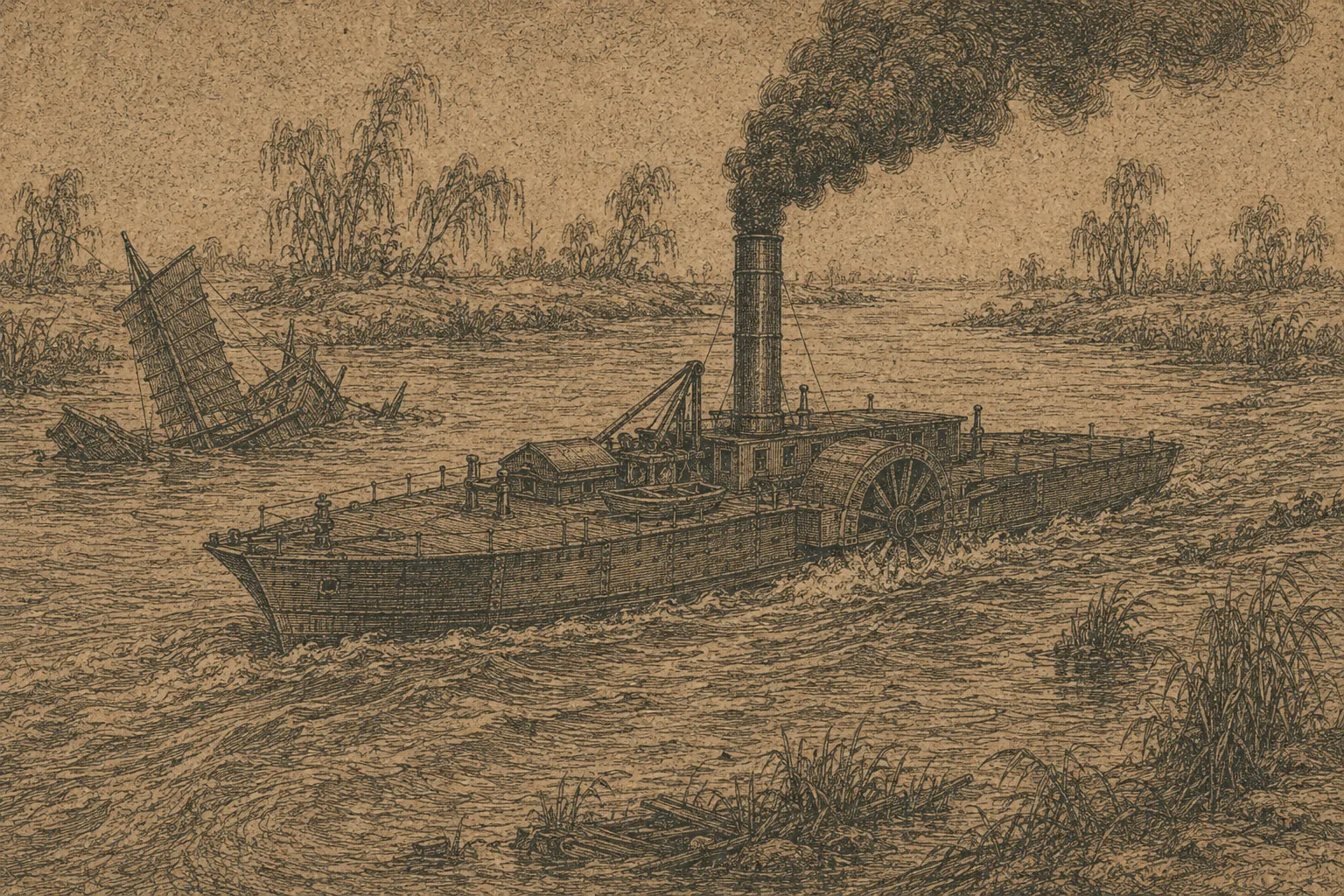
Generated illustration · an iron steamer working upriver, against water nothing was meant to reach · after a late Qing Dianshizhai Pictorial lithograph
06
sails upriver against the current, which our whole defence had never seen.
The Nemesis, 1841
The Nemesis was iron-hulled, shallow-draughted and steam- driven, and could work upriver against wind and current, into water Chinese defences assumed to be unreachable. Accounts of the action at Chuenpi in January 1841 put the Chinese dead in the hundreds and record British wounded but no British killed. The song’s figures are more precise than the sources support.
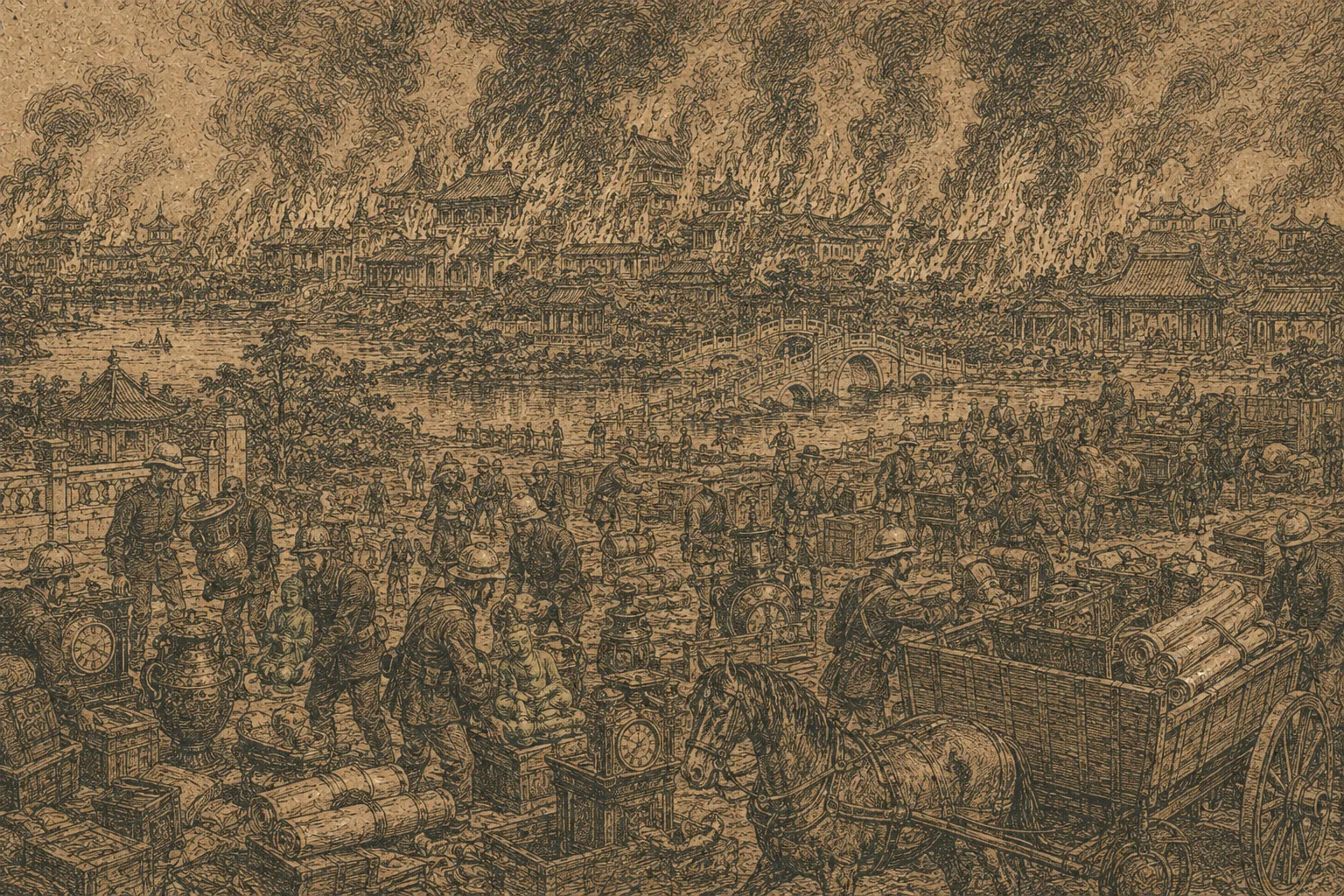
Generated illustration · the Yuanmingyuan, looted and burned in October 1860 · after a late Qing Dianshizhai Pictorial lithograph
07
Burn the Summer Palace. Three days. Eight hundred acres of it.
The Yuanmingyuan, October 1860
British and French troops looted the imperial garden palaces north-west of Beijing and then burned them on Lord Elgin’s order as a reprisal: several days, hundreds of buildings, no military target. Objects removed that week are held in European and American museum collections today.
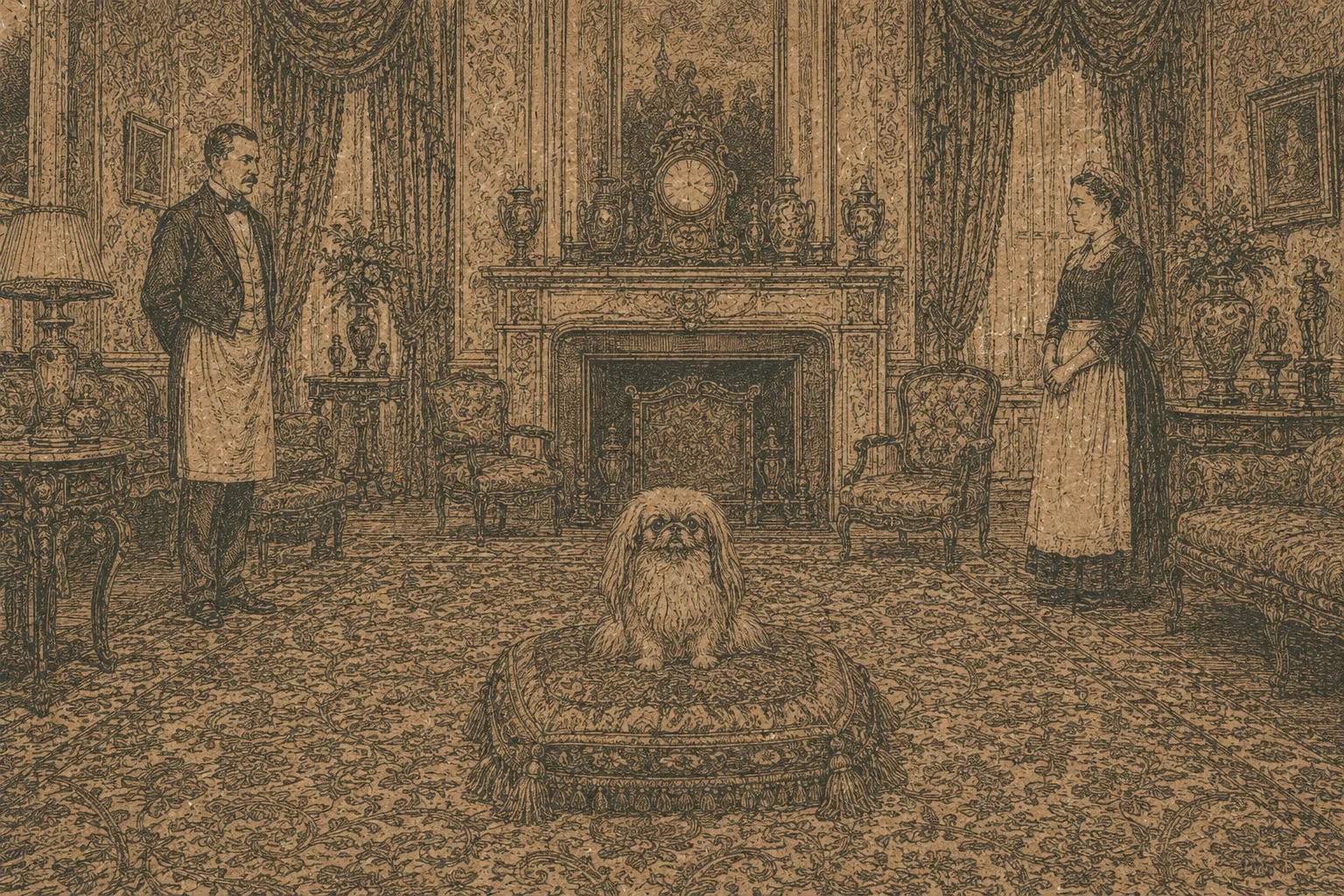
Generated illustration · a palace dog given to Queen Victoria, and named Looty · after a late Qing Dianshizhai Pictorial lithograph
08
There’s a dog in a case in London named after the fire it came out of.
Looty, taken 1860
A Pekingese was found in the palace grounds during the looting of October 1860, brought to England by Captain John Hart Dunne, presented to Queen Victoria and named Looty. Friedrich Wilhelm Keyl painted her in 1861 and the portrait remains in the Royal Collection. The name was the official one, used at court. The song has two details wrong, and both soften it: she was named for the looting rather than the fire, and she was a living dog rather than a specimen in a case.
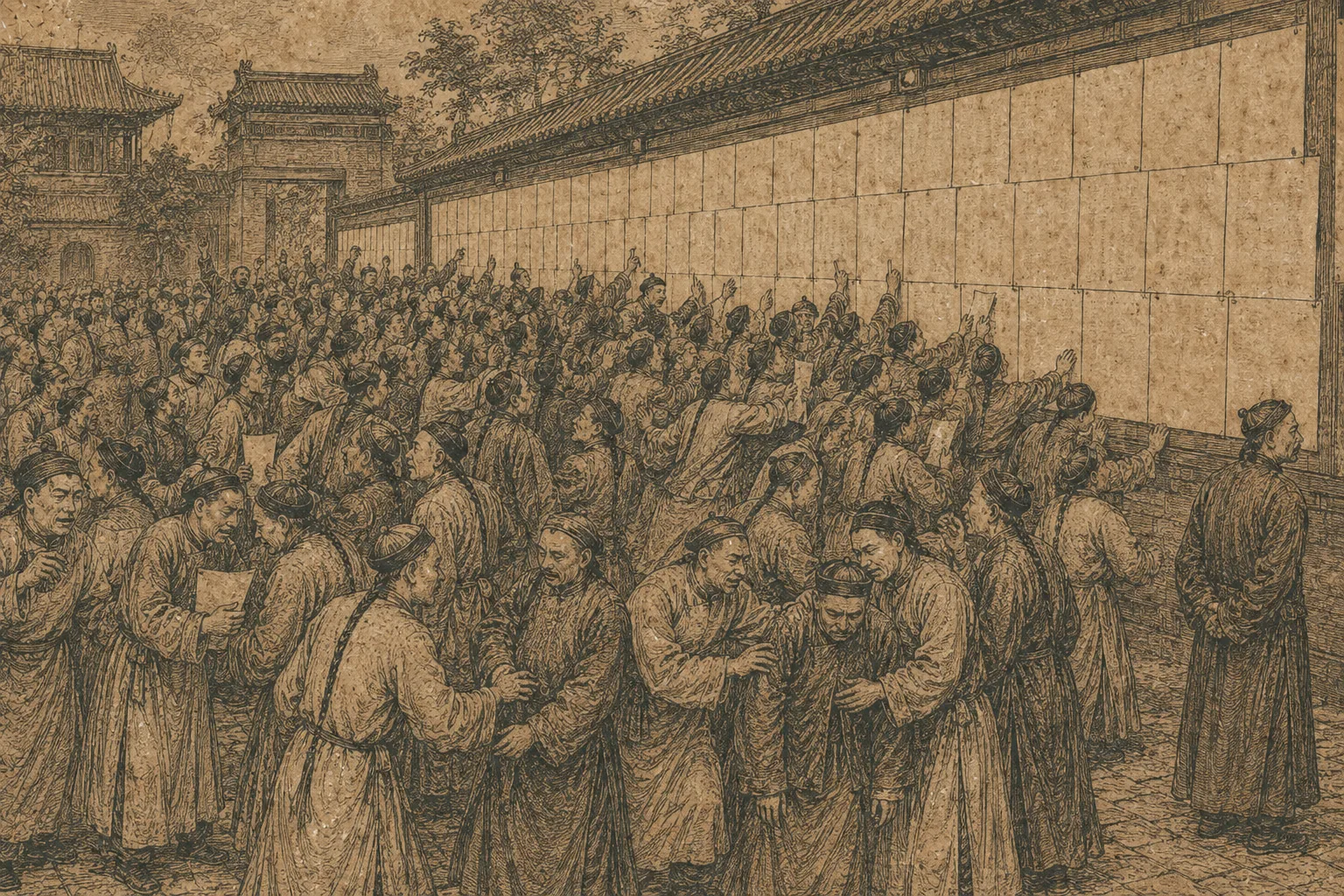
Generated illustration · the examinations Hong Xiuquan failed four times before the Taiping · after a late Qing Dianshizhai Pictorial lithograph
09
Man fails the exam four times,
The Taiping rebellion, 1850 to 1864
Hong Xiuquan failed the provincial examinations four times, suffered a breakdown, read a Christian tract and concluded that he was the younger brother of Jesus Christ. The rebellion that followed killed an estimated twenty to thirty million people over fourteen years, making it the deadliest civil war on record.
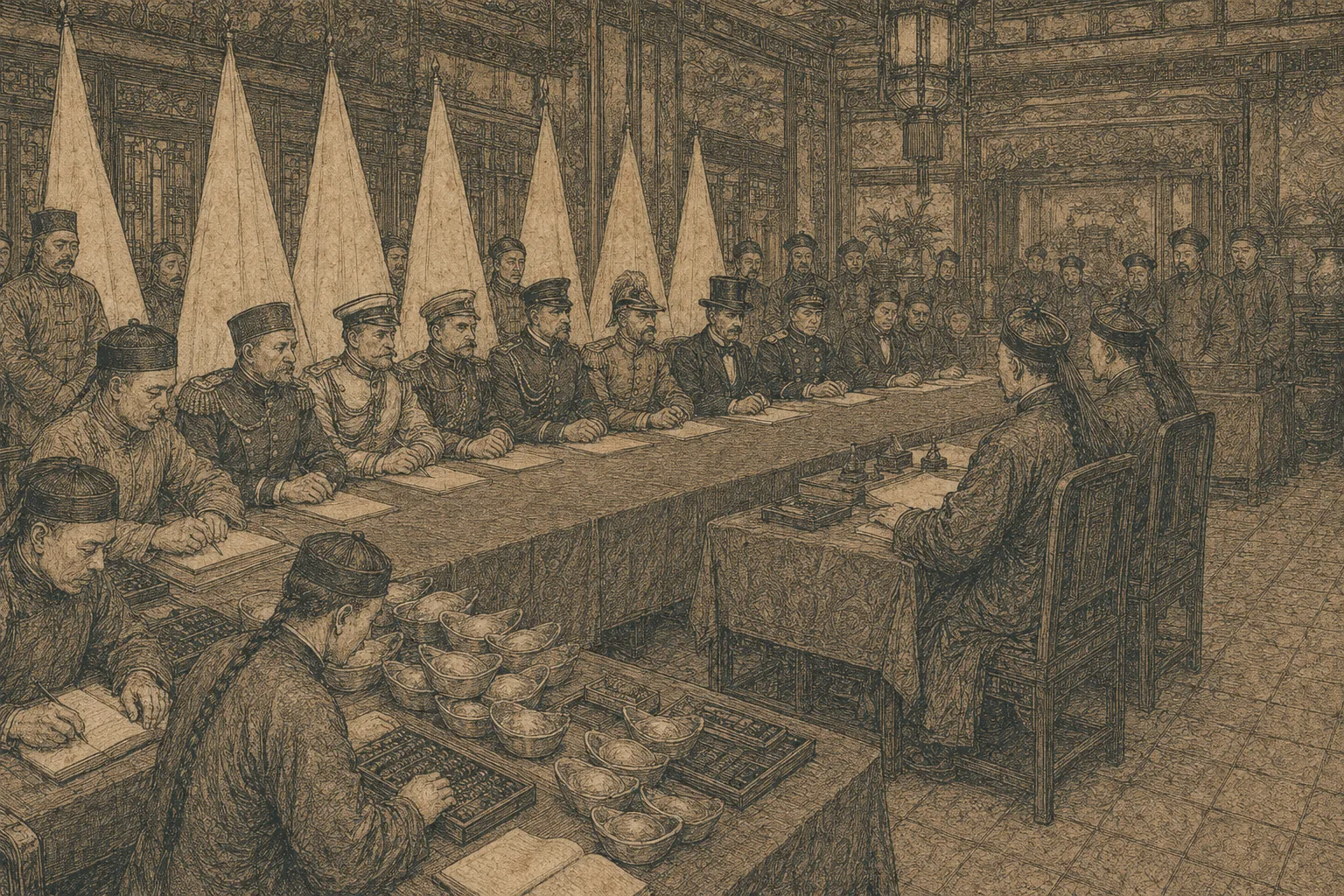
Generated illustration · the Boxer indemnity of 1901, costed at one tael per person · after a late Qing Dianshizhai Pictorial lithograph
10
One tael per Chinese head. They costed it out. That’s the art.
The Boxer Protocol, 1901
Eight foreign armies occupied Beijing and the court fled inland. The settlement imposed an indemnity of 450 million taels of silver, payable over thirty-nine years with interest. The sum was set at one tael for every person then estimated to live in China.
11
1911–1949
Words 65 lines
Two thousand years of emperors.
Gone in four months.
Nobody had a plan for the morning after.
Sun Yat-sen's in Denver reading it in a paper, that's the truth,
raising money in America while the country hits the roof.
Comes home. President. Six weeks. Hands it to a general
'cause the general's got the army and a promise, and it's rational
until Yuan Shikai decides that president's too small a crown
and declares himself emperor in nineteen fifteen. Whole thing comes down
in eighty-three days. Dies humiliated. And here's the cost:
he built the army personally, so when he goes, the centre's lost.
Every commander he made keeps his men and takes a province.
Warlord era. Nineteen sixteen. Nobody's in charge. That's the promise.
Who's holding it? Nobody's holding it.
Who's holding it? Nobody's holding it.
Flag on the building, name on the door,
and a different man's army at the gate by four.
Versailles. Nineteen nineteen. We fought on the winning side,
sent a hundred and forty thousand men to dig the trenches, and they died
in France, in Belgium, clearing shells with their hands in the mud.
Ask for Shandong back. They give it to Japan. That's the blood.
May the Fourth. Students in the streets outside the Gate,
and the whole intellectual class goes: the old thing cannot wait.
Burn the classics, learn the science, write in how we actually speak.
Two answers in the room: liberal reform, or the other week
in nineteen twenty-one, thirteen men in a girls' school in Shanghai
found a party. Fifty-three members total. Police move them, they comply,
finish the meeting on a boat on a lake in Jiaxing.
Thirteen men. Remember that. That's the whole thing.
Nationalists and Communists ally. Northern Expedition rolls.
Chiang gets to Shanghai, turns, and empties out the payrolls
with the Green Gang doing the killing in the streets for three days straight.
Alliance over. Civil war. Nineteen twenty-seven. That's the date.
Mao goes rural. Everybody says the workers, he says the farmers instead.
Encircled five times, breaks out on the fifth, and the Long March is ahead:
six thousand miles, a year, eighty-six thousand out and eight thousand in,
and he walks out of it in charge. That's what the march was. Not a win.
A selection process.
Nineteen thirty-one. Japan takes the northeast on a faked explosion.
Nineteen thirty-seven. Marco Polo Bridge. Full invasion.
Nanjing, December. Six weeks.
I'm not going to describe it. Look it up, or don't.
Two hundred thousand is the low estimate.
Chiang breaks the Yellow River dikes to slow the tanks.
Drowns half a million of his own people. It slows the tanks.
Fourteen million dead by the end.
Eighty million refugees inside their own country.
Carried universities inland on their backs, professors walking,
libraries in crates, lectures in caves during the raids.
That happened too.
Forty-five. Japan surrenders. Two months of talks and a photograph
of two men toasting who have both already done the maths.
Forty-six, it's on. Nationalists have the cities, the planes, the gold,
American guns, and an inflation rate that can't be told
in numbers that mean anything. Wheelbarrow of notes for rice.
Communists have land reform. Give the farmer the field. That's the price.
Forty-nine. Chiang takes the treasury, the art, and two million men
to Taiwan. Says it's temporary. Sets up the government again.
October first. Gate of Heavenly Peace. Man in a grey suit.
Says the Chinese people have stood up.
And a hundred years of being carved
ends.
And something else starts, and nobody in that square
knows what
and nobody in that square
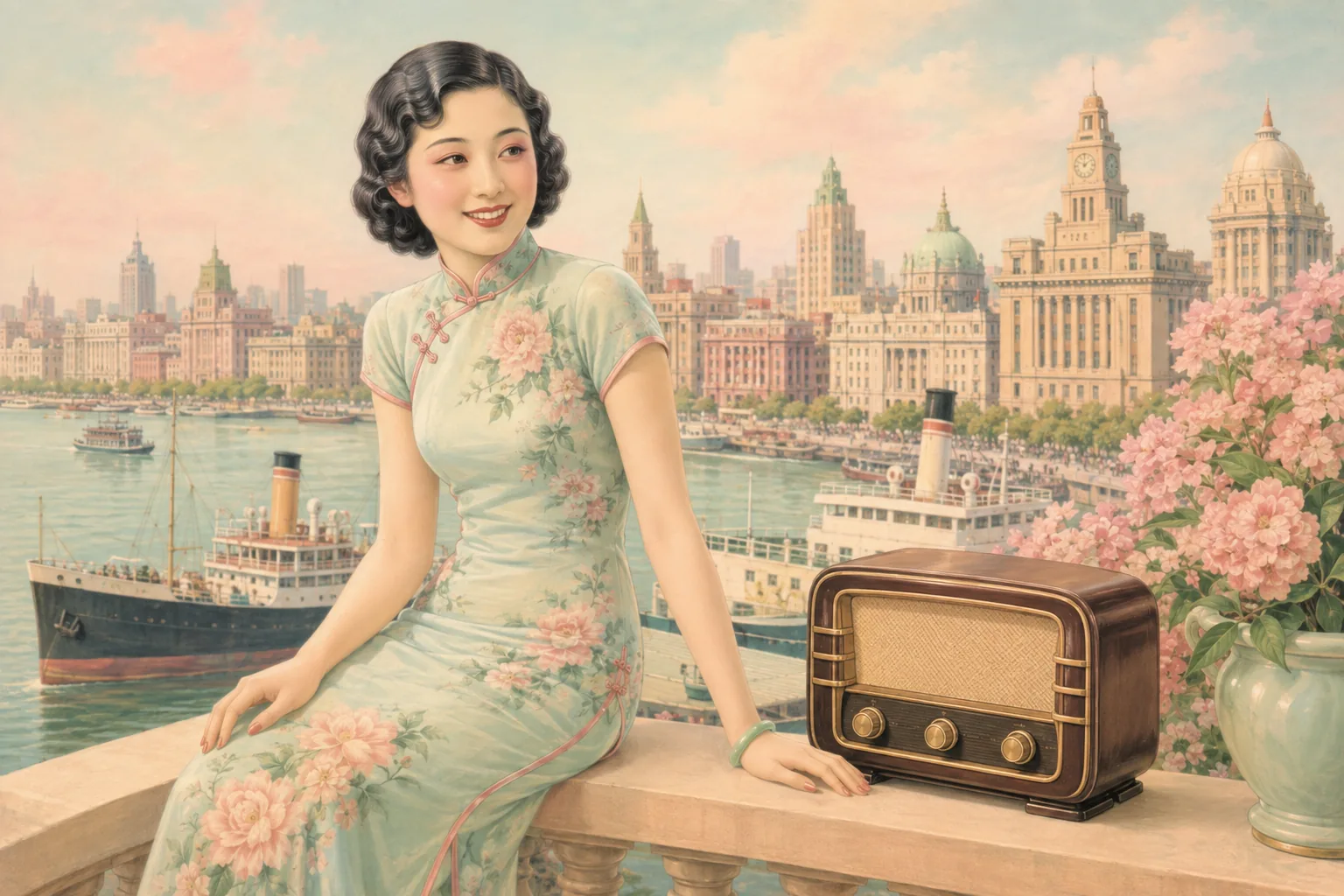
Generated illustration · the treaty-port Shanghai the calendar posters were selling · after a 1930s Shanghai calendar poster
01
Nobody had a plan for the morning after.
Shanghai calendar posters, 1930s
Calendar posters were advertising art, given away by tobacco and cosmetics companies, and they remain the most recognisable image of republican Shanghai. Outside the treaty ports, the Nationalist government was unable to collect tax across most provinces.
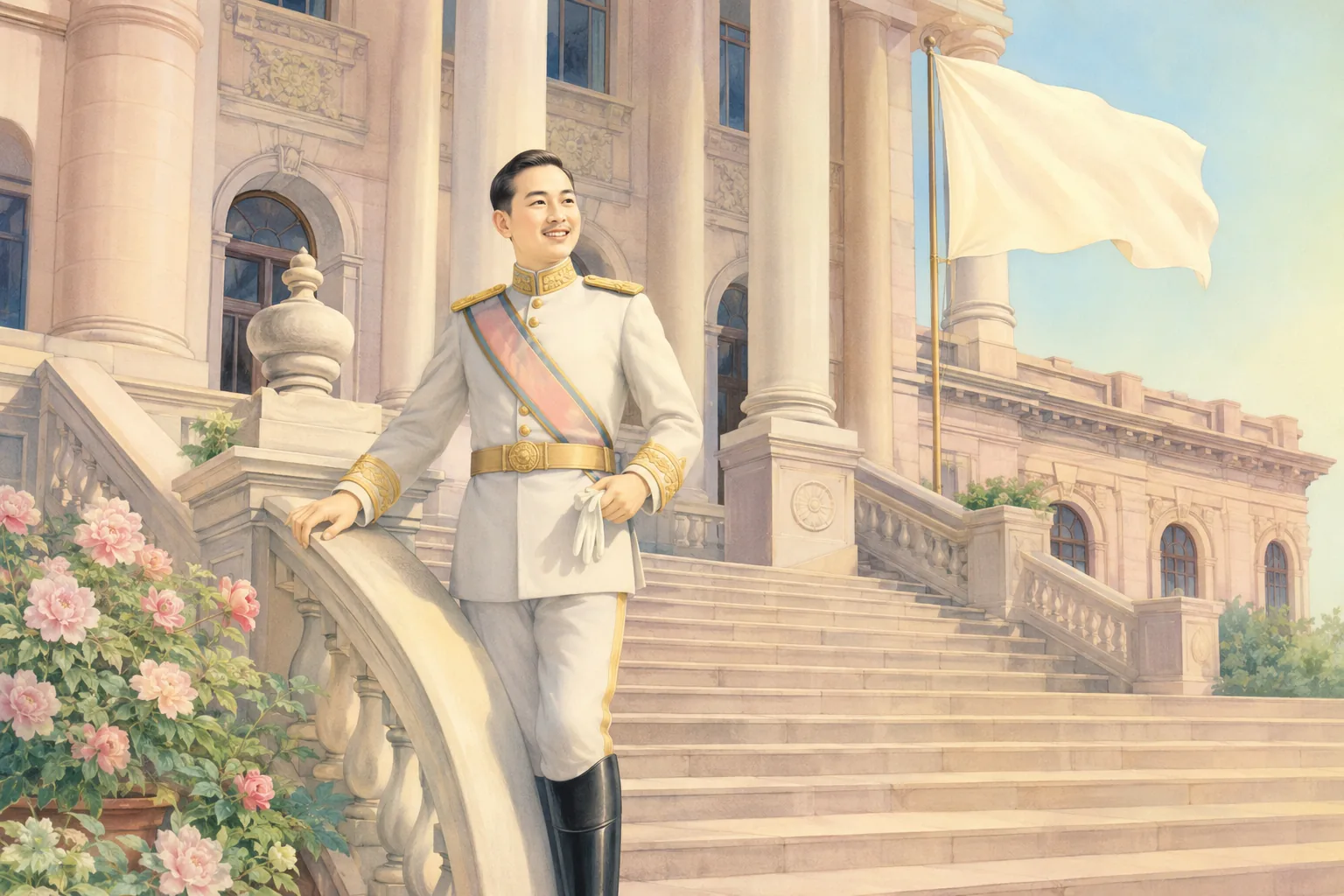
Generated illustration · the warlord years, 1916–28, when no government held the country · after a 1930s Shanghai calendar poster
02
Flag on the building, name on the door,
The warlord era, 1916 to 1928
Yuan Shikai had built the modern army personally, and on his death in 1916 it fragmented among the commanders he had promoted, each holding a province with troops loyal to him. A government in Beijing was recognised abroad and controlled very little territory.
Generated illustration · Chongqing, 1945: two men toasting and moving troops · after a 1930s Shanghai calendar poster
03
of two men toasting who have both already done the maths.
The Chongqing talks, autumn 1945
Mao Zedong and Chiang Kai-shek met for six weeks of negotiations after the Japanese surrender and were photographed together. Both sides moved troops while the talks continued. Full civil war resumed the following year.
Generated illustration · the hyperinflation of 1948–49, when notes were carried by volume · after a 1930s Shanghai calendar poster
04
Wheelbarrow of notes for rice.
Hyperinflation, 1948 to 1949
Nationalist hyperinflation reached the point where prices doubled within days and banknotes were handled by volume rather than counted. The currency reform of 1948 destroyed the savings of the urban population on which the government depended.
Generated illustration · the Chinese Labour Corps in France and Belgium, 1917–18 · after a 1930s Chinese New Woodcut relief print
05
sent a hundred and forty thousand men to dig the trenches, and they died
The Chinese Labour Corps, 1916 to 1920
Around 140,000 Chinese labourers were shipped to France and Belgium to dig trenches, move munitions and clear battlefields. Thousands died there. China was on the winning side of the war, but at Versailles the German concessions in Shandong were transferred to Japan rather than returned to China.
Generated illustration · May the Fourth, 1919, and the revolt against the old order · after a 1930s Chinese New Woodcut relief print
06
May the Fourth. Students in the streets outside the Gate,
The May Fourth movement, 1919
Three thousand students marched in Beijing on hearing the Versailles terms. The protest widened into a general movement against the old order: writing in the spoken language, adopting modern science, and abandoning deference to the classical canon. Most political movements in modern China date themselves from it.
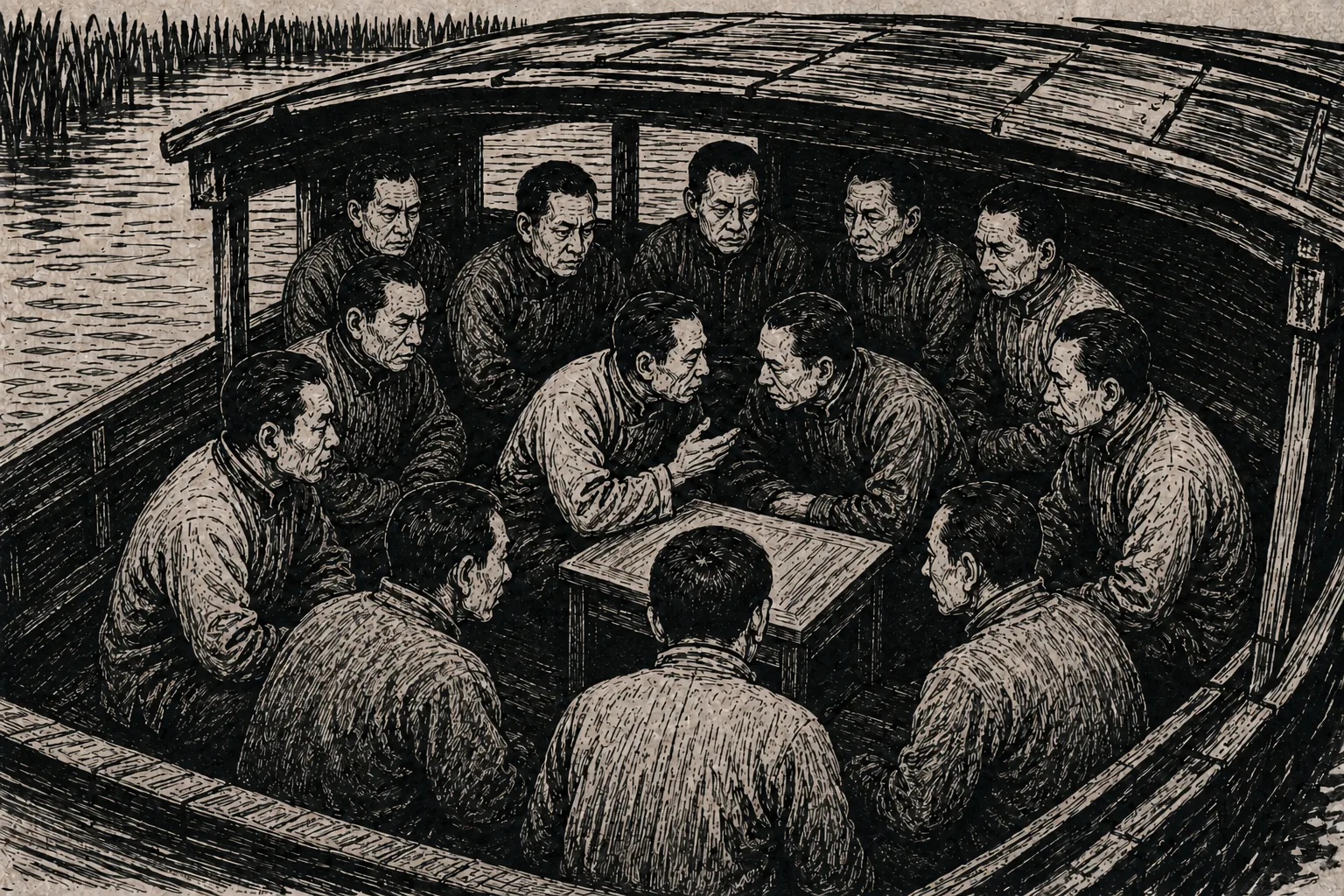
Generated illustration · the founding of the Communist Party, Jiaxing, July 1921 · after a 1930s Chinese New Woodcut relief print
07
finish the meeting on a boat on a lake in Jiaxing.
The first Congress of the Communist Party, July 1921
The party was founded in Shanghai by around thirteen delegates, representing a total membership in the dozens. They met at a house on Rue Wantz in the French Concession; the delegates lodged at the Bowen Girls’ School, which is the school the song refers to. Police attention forced them out and the congress concluded on a hired boat on the lake at Jiaxing. One of the thirteen was governing China twenty-eight years later.
08
I’m not going to describe it. Look it up, or don’t.
Nanjing, December 1937: not depicted
Nanjing fell in December 1937 and the killing that followed lasted about six weeks. Estimates of civilians and disarmed soldiers killed range from tens of thousands at the low end of scholarly dispute to the three hundred thousand recorded in China. Denial remains active in Japanese politics. This wall is deliberately left without a picture: a generated image of these events would be a manufactured document.
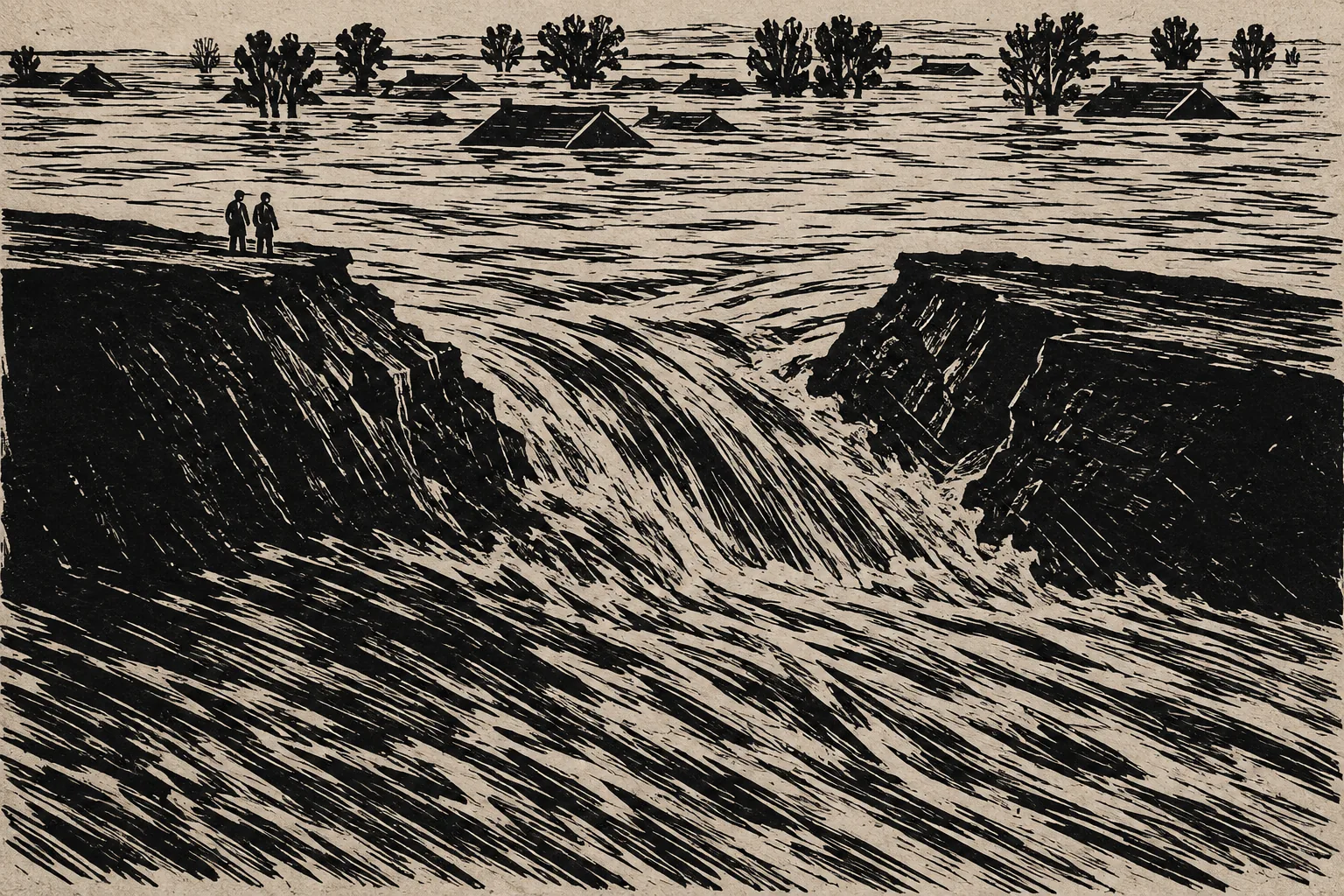
Generated illustration · Huayuankou, 1938: the dikes breached to slow an advance · after a 1930s Chinese New Woodcut relief print
09
Chiang breaks the Yellow River dikes to slow the tanks.
Huayuankou, June 1938
To slow the Japanese advance, Nationalist forces breached the Yellow River dikes and flooded the plain. Estimates of Chinese civilians drowned range from four hundred thousand to eight hundred thousand. Millions were displaced and the river remained off its course for nine years. The advance was slowed.
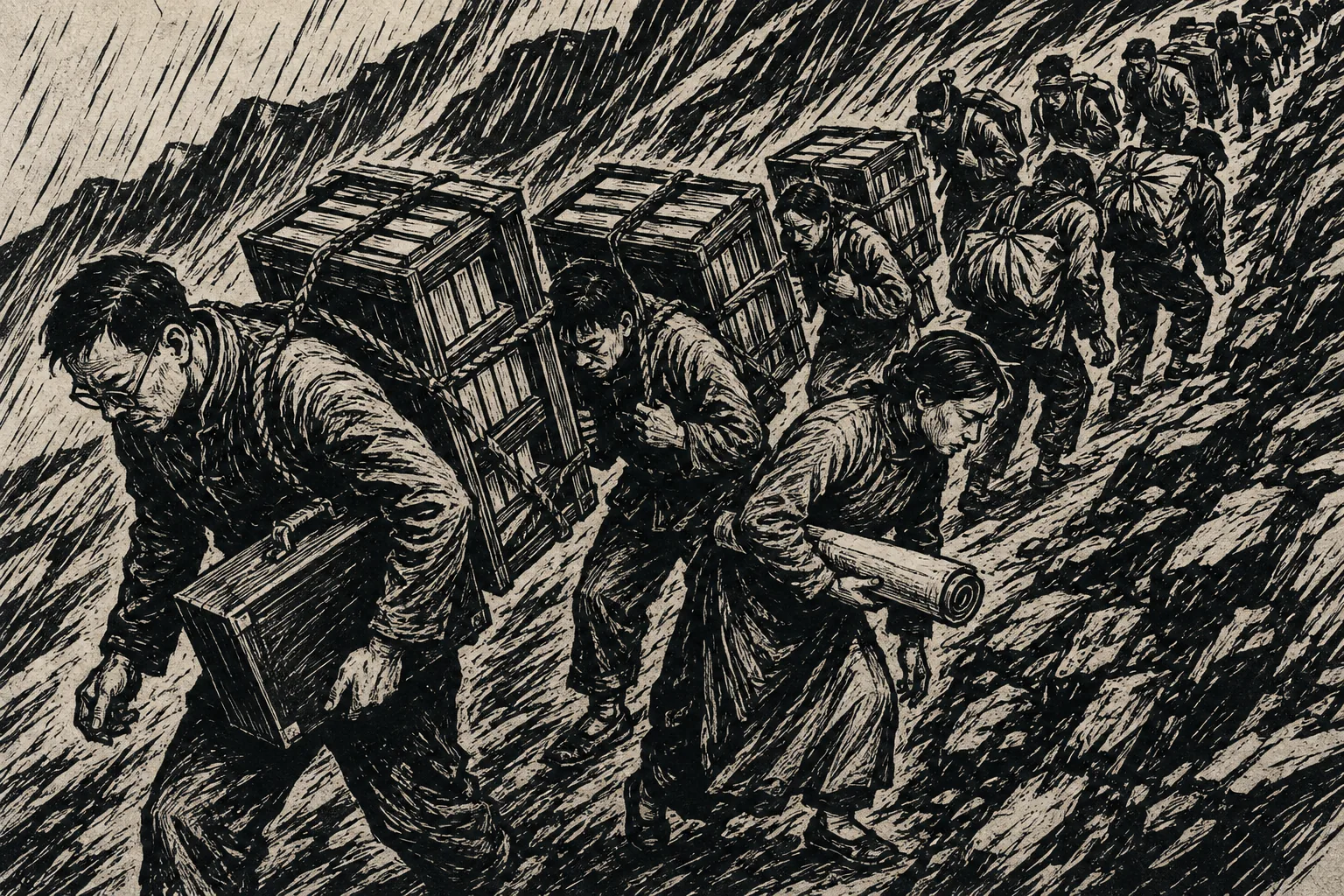
Generated illustration · the universities that walked inland and taught through the raids · after a 1930s Chinese New Woodcut relief print
10
Carried universities inland on their backs, professors walking,
The National Southwest Associated University, 1938 to 1946
Peking, Tsinghua and Nankai universities evacuated inland and combined at Kunming, much of the journey made on foot with the libraries in crates. The university operated for eight years through air raids, in huts with tin roofs. Its graduates include two Nobel laureates in physics.
Generated illustration · the Long March, 1934–35: eighty-six thousand out, eight thousand in · after a 1930s Chinese New Woodcut relief print
11
eighty-six thousand out and eight thousand in,
The Long March, 1934 to 1935
The march covered some nine thousand kilometres in a year. Around eighty-six thousand set out from the south and perhaps eight thousand reached the north. It was a retreat from military defeat, and Mao Zedong emerged from it in control of the party.
12
Mao era, 1949–1976
Words 84 lines
My grandmother told me four things about her life.
It took her sixty years to tell me the fourth one.
This is all of them.
One. She said the first years were good, and I believe her.
She got a field. Her father had rented that field from a man
whose family had owned it since before anyone could say.
They put the man in front of the village and read out what he'd taken.
Then they killed him. And she clapped.
She told me that part without flinching. She said, you don't understand
what it was to owe somebody your whole harvest before it grew.
She said the landlords weren't a metaphor. They had a name and a house.
She was nineteen. She could read by the end of that year.
Nobody in her family had ever read anything.
It worked. For a minute, it actually worked.
Two. The backyard furnaces. She said the whole village had one.
Melted the tools. Melted the door hinges. Melted the woks,
which meant nobody could cook, which meant the communal kitchen,
which meant the kitchen decided who ate.
Steel came out useless. Everyone knew it was useless. Nobody said.
Because the cadre reported the tonnage upward,
and the man above him added a bit, and the man above him added a bit,
and by the time the number reached Beijing the harvest was a miracle,
so the state took its share of a miracle
out of a village that had a real harvest, a small one, in a bad year.
Close planting. Deep ploughing. Kill the sparrows because they eat the grain.
They killed the sparrows. Locusts came. Nobody had thought about the locusts.
She said the quiet that spring was the strangest thing she ever heard.
Three. She had a brother.
She said he was funny. That's the whole description I ever got. Funny.
Fifty-nine into sixty. She said the village ate the seed grain,
then the bark off the elms, then a white clay that fills you up
and does something to you that I can't get into.
She walked to the county town to ask for the ration and it was closed.
Not out. Closed.
She came back and he had died in the night, and the ground was too hard,
and she was too weak to dig properly, and she has never once,
in sixty years, told me where she put him.
I asked, when I was twelve, being clever, doing a school project.
She left the room.
And the grain was going out of the province that whole year.
Exported. To prove the figures. To pay a debt.
That's not a rumour, that's a ledger. You can read the ledger.
Thirty million. And every single one of them is somebody's funny brother.
Four is the one that took sixty years.
Sixty-six. She's a schoolteacher now. She's good at it.
Her students, fourteen, fifteen years old, get red armbands
and the permission of the highest authority in the country
to identify what is rotten in the room.
And what was rotten in the room was that she'd learned to read
from a man who had once been to a mission school.
That's it. That's the whole charge. Foreign connection.
They made her kneel on the platform with a board round her neck.
Jet plane, they called the position. Arms back, head down, for hours.
And the girl reading out the accusation was her best student.
She said the girl was crying while she read it.
She said that was worse.
Struggle sessions. Denunciation. Sons writing up their fathers
because the alternative was to be written up beside them.
Temples emptied. Instruments burned. A thousand years of paper
in a heap in a schoolyard, and children feeding it.
Then the same children sent down to the countryside for ten years
to learn from the peasants, and a whole generation
comes back at thirty with no education, no trade, no time,
and they are the ones who are sixty now, and they do not talk about it,
and their children think they're just difficult about food.
Seventy-six. He dies. Ten days later the Gang of Four is arrested
and the whole thing is over like a fever breaking.
And the verdict they landed on was seventy percent right, thirty percent wrong,
which is a strange sentence to say out loud about a person,
and stranger still when you realise it's the official one, still.
Here's my problem.
I can't hold it as one thing.
She got a field and she learned to read and she buried her brother
and her favourite student put a board around her neck,
and it is the same forty years, and the same man, and the same flag.
People want me to pick which sentence is the true one.
The famine, or the literacy. The struggle session, or the land.
And she wouldn't pick. She never picked. She'd just go quiet
and start washing something that was already clean.
And I used to think that was denial.
Now I think it was the only honest answer available to her.
Some things you don't resolve.
You just carry both,
and you wash the bowl again.
01
I can’t hold it as one thing.
This room has no artwork
Every other room here carries pictures made in the visual language of its period. For these years that language would be the propaganda poster: flat colour, sunrise, raised faces, wheat. It is the most recognisable Chinese graphic style of the twentieth century and it was designed to present this period as a success. There is little to set against it. Photographs of the famine are few and were not taken freely, and photographs of the struggle sessions were taken by those conducting them. This room is therefore left bare. The track is a single account of forty years, given in four parts.
13
1989, and the reform years
Words 63 lines
Two things happened in the same decade.
Everybody argues about which was the real one.
They were both the real one. That's the point.
Seventy-eight. Small man, twice purged, walks back in with a plan.
Won't say the old man was wrong. Says: seek truth from facts. Says a man
shouldn't care what colour the cat is if the cat can catch the mice.
Says some will get rich first. That sentence rewrites a country twice.
Xiaogang village. Eighteen farmers split the land in the dark,
red handprints on an illegal page, swore to raise each other's kids. That's the spark.
Harvest beat the previous five combined. State legalised it after the fact.
Shenzhen was a fishing town. Mangrove, mud. Now seventeen million. That's that.
Eight hundred million out of extreme poverty in forty years.
Largest drop in human suffering ever recorded. No aid programme. No tears.
That happened while I was doing times tables in a classroom in London.
Whatever else is true, put that on the ledger first. It's not a fraud.
Open the window, you get the weather. Inflation at twenty-eight,
and whoever's got a cousin in the bureau gets the licence and the rate.
Buy at state price, sell at market, pocket a house on the spread.
Guāndǎo. Official profiteering. That's the word the students said.
So read the actual banners in the spring of eighty-nine, be precise:
anti-corruption, press freedom, dialogue, a named official. That's the price.
Hu Yaobang dies in April. Mourning turns to a sit-in, turns to May,
hunger strike, a million in the streets, Gorbachev arriving the same day
so the world's cameras are already live in the city. Then it turns.
Workers join. Autonomous federations. That's the line that burns,
because students are a season, students graduate and go,
but a workers' structure is permanent. And they knew. And so did Moscow.
Martial law, May twentieth. First troops don't get through.
Citizens block them for two weeks. Bring the soldiers water. Explain.
That's in the record too.
June third into the fourth, in from the west along Chang'an Avenue.
Most of the killing isn't in the square. It's the approach roads.
Muxidi, where the crowds were.
Hundreds is certain. Thousands is credible. There is no list,
no inquiry, no archive you can write to.
Next morning a man stood in front of the tanks holding two shopping bags.
Nobody knows his name or what happened to him.
Most reproduced image of my country on earth,
and inside it, most people have never seen it.
Now the part that matters more: what got built on top.
Patriotic education, ninety-one. Rewrite what the schoolbooks drop.
Pivot from class struggle to the century of humiliation instead,
here's what was done to us, here's who ended it. And it's not a lie. It's aimed.
Grow eight percent a year, don't ask, and nobody gets named.
That's the real constitution. Unwritten, and both sides kept it clean:
we deliver the miracle, you deliver the quiet. Thirty years between.
And the parents who stood in that square told their children: study. Provide.
And the children believed it. Because it worked. Because the lift was not a lie.
Brought it up once with a girl on my course. Beijing. Third year.
Sharper than me. Didn't get angry. Didn't go quiet. Made it clear.
Said: I know. I read it. VPN in school. I've seen the photograph.
Said: my grandparents ate bark, my parents shared a room, I have a life.
Said: what exactly is your alternative, and who was going to run it,
and every time this country came apart it cost us thirty million.
So I've done that maths my whole life, and I still land where I land,
and I don't need a boy from London to explain my own country to me.
I didn't have an answer.
I still don't have an answer.
I just know we were both
saying something true.
The square's still there. You can walk across it.
Take a photo. Nobody stops you.
That's the cleverest part.
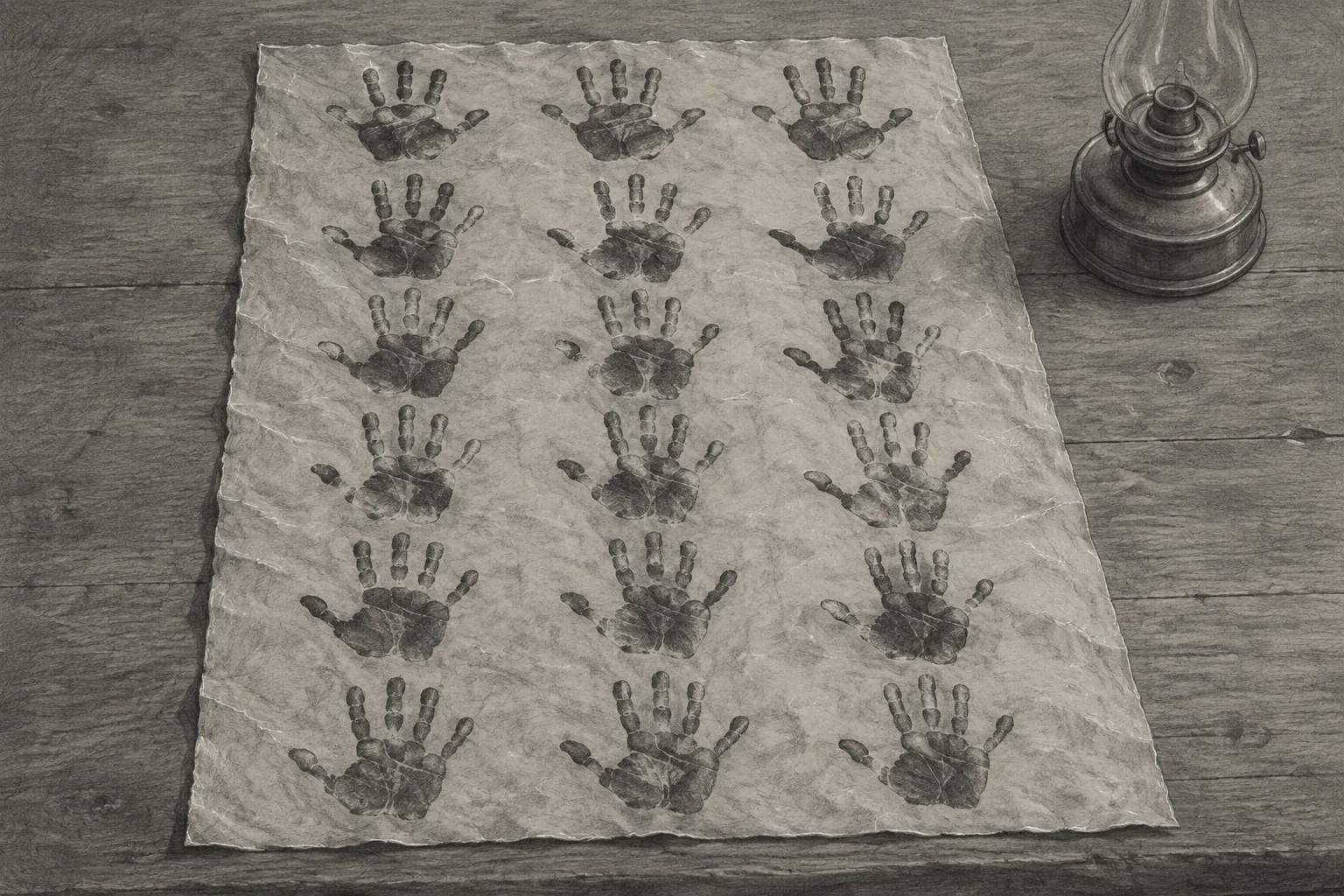
Generated illustration · Xiaogang, 1978: eighteen families dividing the land illegally · after a studio drawing in graphite and chalk on grey paper
01
red handprints on an illegal page
Xiaogang village, 1978
Eighteen families in one Anhui village secretly divided the collective land between themselves and marked the agreement with their handprints, undertaking to raise each other’s children if they were executed for it. That year’s harvest exceeded the previous five combined. The practice was legalised afterwards.
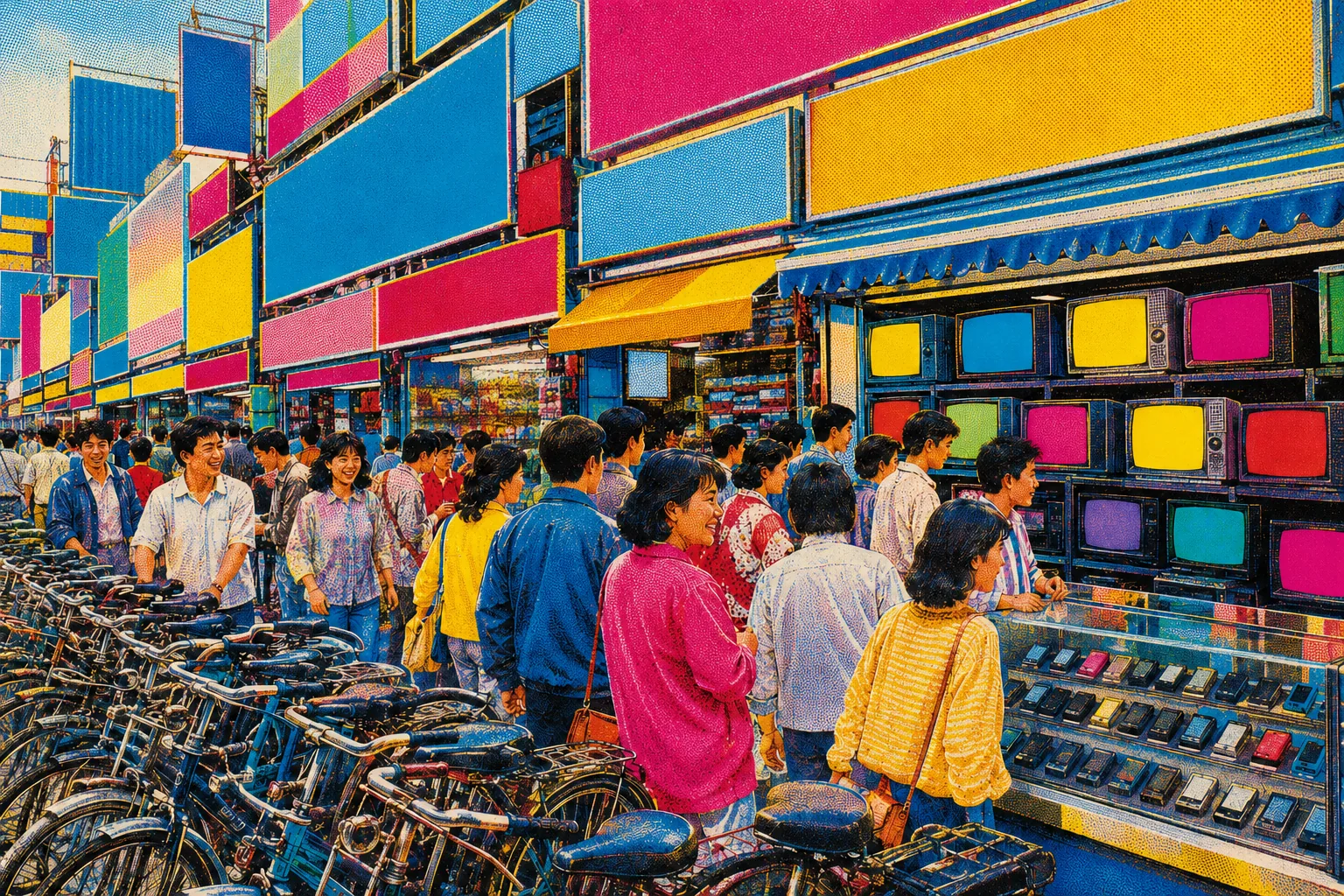
Generated illustration · the reform years, and the permission that rewrote a country · after an early-1990s Chinese urban commercial offset print
02
Says: some will get rich first.
Deng Xiaoping’s formulations
Deng Xiaoping did not revise the theory or state that his predecessor had been wrong. He said that truth should be sought from facts, that the colour of the cat did not matter if it caught mice, and that some people would become prosperous first. These formulations functioned as permission rather than as doctrine.
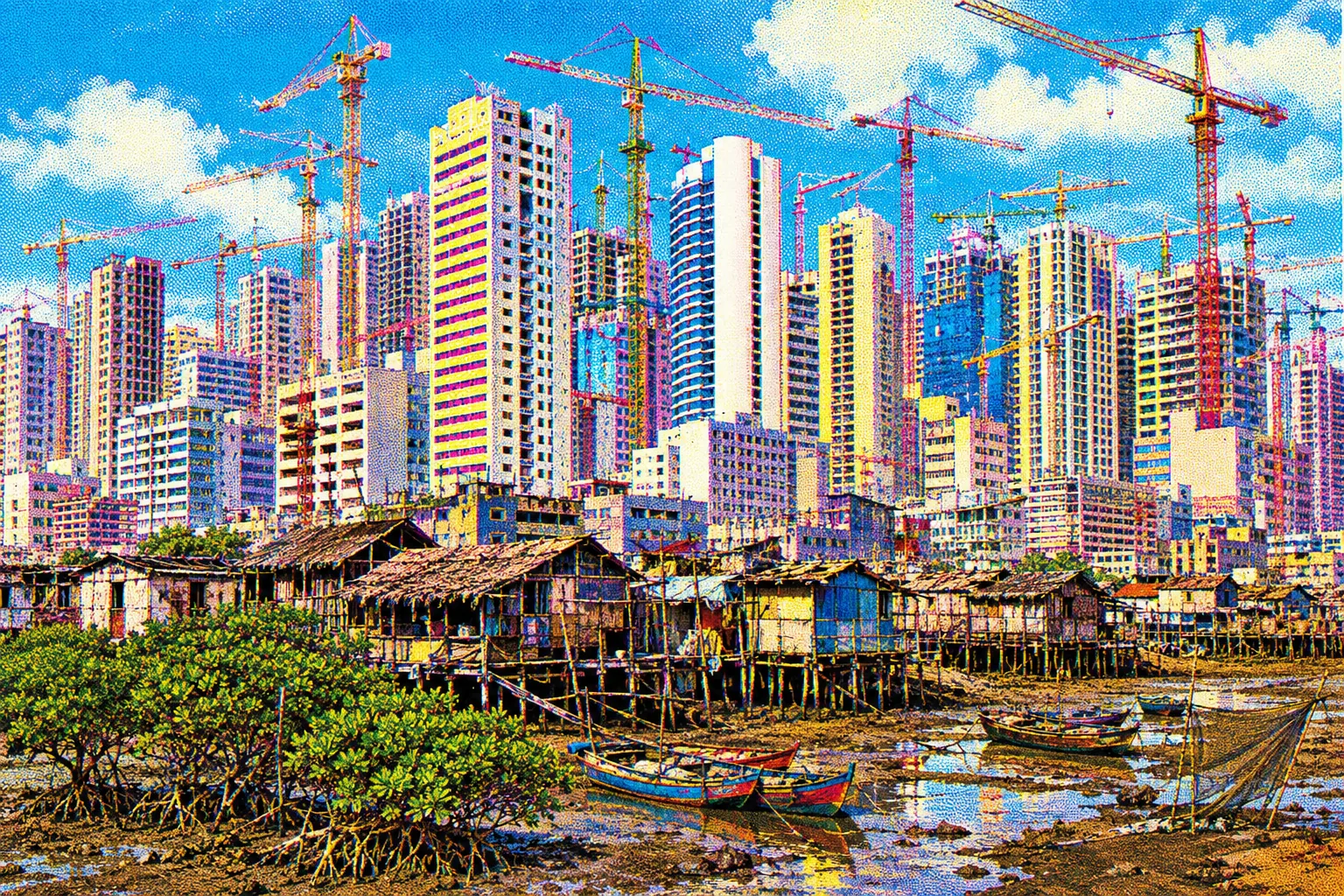
Generated illustration · Shenzhen, from market town to seventeen million in forty years · after an early-1990s Chinese urban commercial offset print
03
Shenzhen was a fishing town. Mangrove, mud. Now seventeen million.
Shenzhen, and eight hundred million
Shenzhen was designated a special economic zone in 1980, when it was a market town of some tens of thousands beside the Hong Kong border. Its population is now around seventeen million. Nationally, the World Bank counts more than eight hundred million people lifted out of extreme poverty, the largest such reduction recorded anywhere.
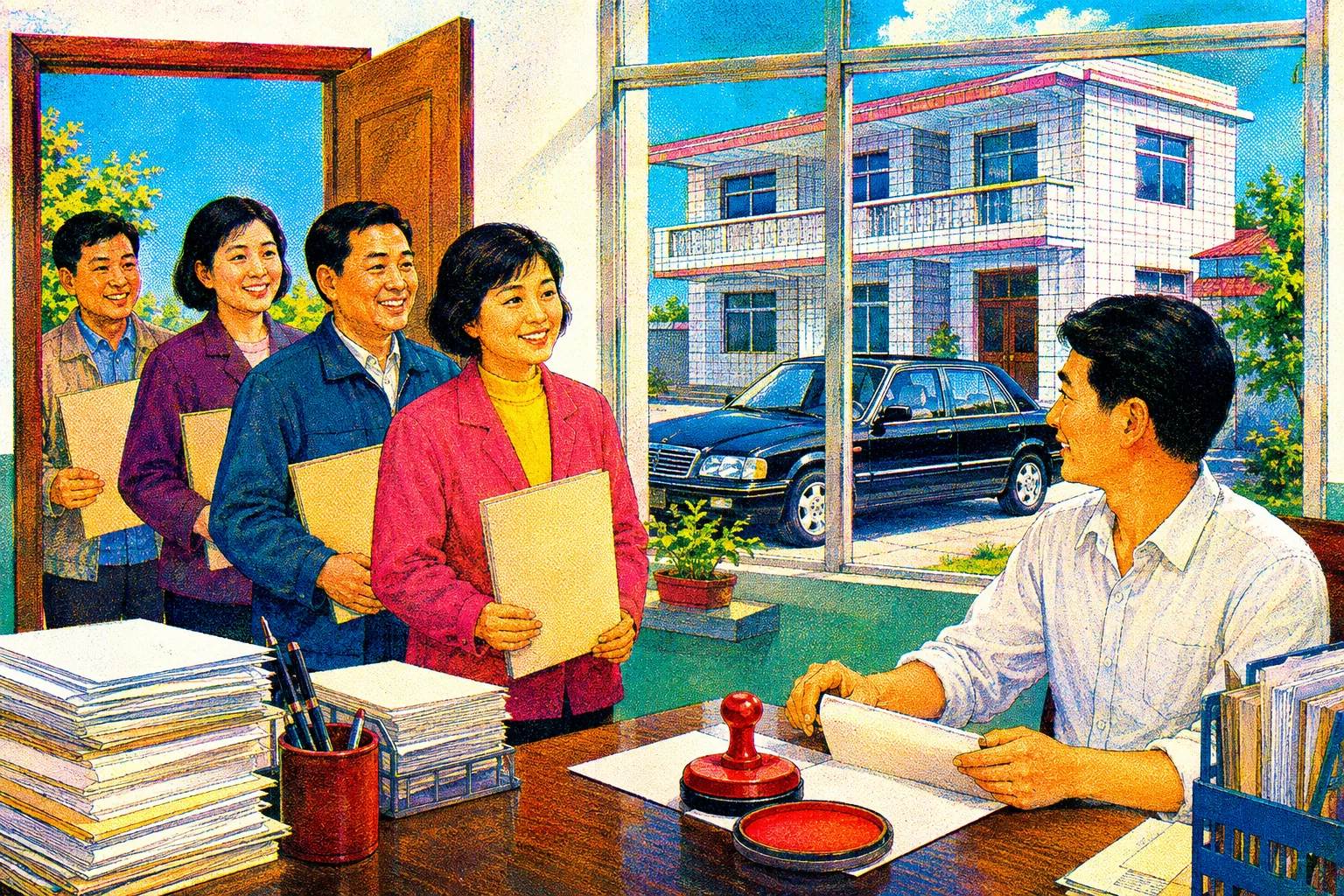
Generated illustration · guāndǎo: two prices for one thing, and whoever had the connection · after an early-1990s Chinese urban commercial offset print
04
Buy at state price, sell at market, pocket a house on the spread.
Guāndǎo: official profiteering
Reform ran two prices for the same goods, a plan price and a market price, so anyone with the necessary official connection could buy at one and sell at the other. Inflation reached the high twenties in 1988. This was the principal grievance on the banners in the square the following spring.
Generated illustration · the Goddess of Democracy, built in four days, standing for five · after a studio drawing in graphite and chalk on grey paper
05
so the world’s cameras are already live in the city.
The Goddess of Democracy, May 1989
Art students assembled the figure from plaster over a metal armature in about four days and raised it in Tiananmen Square on 30 May 1989, facing the portrait on the gate. It stood for five days.
Generated illustration · no inquiry, no archive, no published count — the absence itself · after a studio drawing in graphite and chalk on grey paper
06
There is no list.
The night of 3 to 4 June 1989
Most of the killing took place on the approach roads west of the square, at Muxidi and in the surrounding neighbourhoods, rather than in the square itself. Hundreds of deaths are certain and thousands are credible. No official count has been published and no inquiry has been held. Families have compiled names privately for three decades.

Generated illustration · growth, and the settlement the song describes as unwritten · after an early-1990s Chinese urban commercial offset print
07
we deliver the miracle, you deliver the quiet.
Patriotic education, from 1991
From 1991 the school curriculum was rebuilt around the century of humiliation: what foreign powers did, and who ended it. The material is accurate and selectively directed. It ran alongside an unwritten settlement: sustained economic growth, and no public discussion of 1989.
Generated illustration · the square today: open, crossable, unmarked · after an early-1990s Chinese urban commercial offset print
08
The square’s still there. You can walk across it.
The square today
The square is open. It can be crossed and photographed, and there is no plaque, marker or date anywhere on it referring to 1989. Search terms for the events return nothing within China.
09
Most reproduced image of my country on earth,
The man before the tanks: not depicted
On 5 June 1989 a man carrying two shopping bags stood in front of a column of tanks on Chang’an Avenue. His name and what became of him are unknown. Four photographers recorded the scene, at considerable risk, from a hotel balcony. Those photographs are the record. This wall carries no picture because a generated version would be a manufactured historical document.
14
Now
Words 74 lines
Two thousand and one. We join the WTO.
Everything you own is about to be made by somebody you'll never meet.
Factory of the world, and it starts with a container ship,
Pearl River Delta, girls off the farm on a twelve-month trip
sending money home in an envelope, and the envelope builds a house,
and the house has a fridge, and the fridge is the whole argument. Now count
the rail: forty thousand kilometres of high speed track,
more than the rest of the planet combined, and it's not coming back
to a debate about whether it works. You can sit in Beijing at eight
and be in Shanghai for lunch. Ask a man from New York about his train. Wait.
Shenzhen out of mangrove. Pudong out of paddy field.
Six hundred million phones. Ninety percent of the solar yield.
Belt and Road, ports in Piraeus, Gwadar, Djibouti, Colombo,
and the West woke up in twenty-fifteen going, hang on, where'd the money go?
Fifty million of us outside the borders. Takeaways and labs.
Manchester, Vancouver, Lima, Jo'burg. Same surname on the tabs.
And every single one of those grandparents came out of one of the chapters
you've been listening to for the last hour.
That's not a diaspora. That's a scattering with a reason after.
Now the bill. One child. Nineteen eighty to twenty-fifteen.
Fines, forced procedures, a generation of only sons, and the in-between:
thirty million men who won't find anyone, that's the arithmetic of choice
when you let a household pick, and the household has a preference and a voice.
Then it flips. Birth rate falls off a cliff. They say two. They say three.
Nobody's having three. Population's shrinking. Twenty twenty-three.
You can't tell people to stop for thirty-five years and then say go.
Hukou splits the country in half: born rural, registered rural, and so
your kid can't school in the city where you work, so the kid stays home,
sixty million left-behind children raised by grandparents alone,
video calling a mother on a line in a dorm in a coastal town.
That's the price of the miracle and it's paid in a specific house.
Nine to nine, six days. Jack Ma called it a blessing to be able to work it.
Kids answered with tǎngpíng. Lying flat. Won't buy in, won't circuit.
Xinjiang. Camps. Call it vocational training if you want the state's phrasing.
Hundreds of thousands detained, mosques levelled, families not knowing. I'm not gracing
that with a both-sides. Hong Kong, twenty nineteen, two million out,
national security law, and the paper folded, and that's what that's about.
I said unflinching. So: my grandmother's country does this now.
Both things on one page. The lift and the lock. I'm not resolving it. I don't know how.
She died in March. I was in a meeting. Found out on the Tuesday.
And in the flat there was a tin, and in the tin there were letters,
forty years of them, and every one addressed to me
in characters I could not read.
She sent one every birthday. Every single birthday. Dad translated
the first few when I was small, then he got busy, then I got busy,
then it was just a tin.
So I took them to a woman in Chinatown who does documents,
and she sat with them for an hour, and she was very kind,
and she said, most of these are just news.
Your uncle's leg. The rain. Someone's daughter's wedding.
And then she got to the last one, from the February,
and she went quiet, and she turned it round on the table,
and she said, this one is a question.
Four characters, big, in the middle of the page.
She wanted to know if I was eating enough.
That's it. That's all it says.
Three thousand years ago a king put a bone in a fire
to ask heaven if the harvest would hold and if the child would live,
and a scribe carved the question in beside the crack
so it would outlast every mouth in the room.
And they dug it up and ground it into powder and drank it for a fever.
And she wrote hers on paper and put a stamp on it and sent it to London,
and I put it in a tin.
Same question. Same silence coming back.
Will there be enough. Will the child be alright.
That's the only thing anybody's ever asked the sky.
Everything else in this album is just the weather.
Tiānmìng. The mandate of heaven.
Nobody knows who hands it out.
Nobody knows the day it gets taken back.
Nobody ever knows they're in the last year of anything.
So I'm learning the characters. Slowly. Badly. At thirty-one.
Started with the four in her letter.
Then the ones in my own name.
Generated illustration · after 2001, when China became the manufacturing floor of the world · after a contemporary phone camera photograph or video-call capture
01
Everything you own is about to be made by somebody you’ll never meet.
Accession to the WTO, December 2001
China joined the World Trade Organization in December 2001 and became the principal manufacturing base of the world economy within a decade. Seven of the ten busiest container ports are now Chinese.
Generated illustration · the migrant remittance, arriving before the plaster does · after a contemporary phone camera photograph or video-call capture
02
and the house has a fridge, and the fridge is the whole argument.
Internal migration, and remittances
Around three hundred million people have moved from the countryside to coastal work, and wages are sent home. Rural houses are commonly built a room at a time, with appliances arriving before the plastering is finished.
Generated illustration · more high-speed track than the rest of the planet combined · after a contemporary phone camera photograph or video-call capture
03
You can sit in Beijing at eight
High-speed rail, from 2007
China’s high-speed network grew from nothing in 2007 to more track than the rest of the world combined. Beijing to Shanghai, roughly the distance from London to Warsaw, takes about four and a half hours. The cost and the debt carried by the programme remain in dispute.
Generated illustration · fifty million people outside the borders, each with a chapter behind them · after a contemporary phone camera photograph or video-call capture
04
Manchester, Vancouver, Lima, Jo’burg. Same surname on the tabs.
The Chinese diaspora
Around fifty million people of Chinese descent live outside China. Most families in the diaspora left during one of the periods this album covers: the treaty ports, the famines, the wars, or the reform years.
Generated illustration · tǎngpíng, 2021: declining the arrangement · after a contemporary phone camera photograph or video-call capture
05
Kids answered with tǎngpíng. Lying flat.
Tǎngpíng: lying flat, 2021
A refusal that circulated on the Chinese internet in 2021: do the minimum, buy little, and decline the expected pattern of overwork and consumption. It spread alongside record youth unemployment and was censored within months.
Generated illustration · sixty million children raised by grandparents, seen on a screen · after a contemporary phone camera photograph or video-call capture
06
video calling a mother on a line in a dorm in a coastal town.
Hukou, and left-behind children
The hukou system registers a citizen where they were born, so the child of a migrant worker often cannot attend school in the city where the parent works. An estimated sixty million children have been raised by grandparents, seeing their parents on a screen and in person once a year.
Generated illustration · 996, ruled illegal in 2021, worked anyway · after a contemporary phone camera photograph or video-call capture
07
Nine to nine, six days. Jack Ma called it a blessing to be able to work it.
996
Nine in the morning to nine at night, six days a week: the schedule much of the Chinese technology industry ran on. Jack Ma described it as a blessing in 2019. China’s Supreme Court ruled the practice illegal in 2021.
08
Both things on one page. The lift and the lock. I’m not resolving it.
Xinjiang and Hong Kong: named, not pictured
Xinjiang: several hundred thousand to more than a million Uyghurs and others have been detained since 2017, mosques have been demolished, and families have been unable to obtain information. The UN human rights office concluded in 2022 that this may constitute crimes against humanity. Hong Kong: two million people demonstrated in 2019, a national security law was imposed in 2020, and the territory’s largest independent newspaper closed in 2021. These walls carry no pictures because a generated photograph of a censored and unfolding situation would be a forgery in the same format as the genuine evidence.
Generated illustration · forty years of letters, and a question in four characters · after a contemporary phone camera photograph or video-call capture
09
then it was just a tin.
The letter
The album closes on a letter the narrator cannot read, which asks whether he is eating enough. Three thousand years earlier a Shang king put a bone in a fire to ask heaven whether the harvest would hold and whether the child would live, and had the question carved beside the crack.
MANDATE OF HEAVEN
天命, Tiānmìng — the doctrine that a ruler holds power by heaven's approval and loses it when heaven withdraws. Fourteen tracks of Chinese history, from the Shang oracle bones to now.
The way in is a button, so it needs JavaScript. The album is below it either way, and so are the words.